Bánh Cuốn
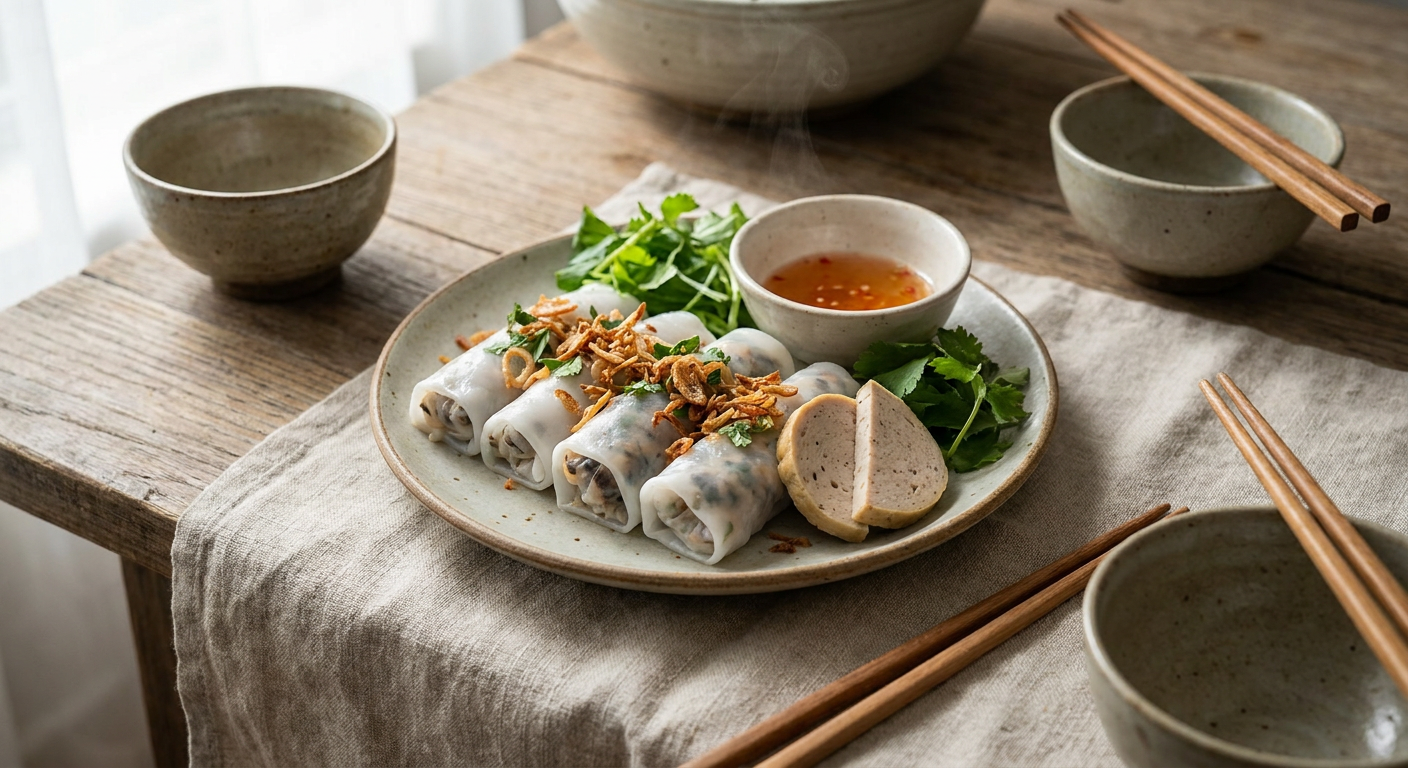
Bánh cuốn — the silky steamed rice roll of Hanoi breakfast — is a batter of ground rice poured onto stretched cloth over steam, cooked in 30 seconds to a sheet so thin it is translucent, rolled around a savory minced pork and mushroom filling. It is the Vietnamese cousin of the Cantonese cheung fun (#65 on our sister site) — same technique, thinner sheet, and the northern topping of fried shallots and ham instead of sweet soy.
Quantities live in the recipe card.
The batter
The filling
- cooked into a loose, spoonable mixture
The pot setup (the whole technique)
- the steam-cooking surface
The finish
- fish sauce, warm water, sugar, lime, garlic, chili
- **Set up the steamer-cloth before touching the batter.** Fill the pan with 2 cm water, bring to a boil (a full 100 °C rolling steam), and fix the cloth drum-tight over the mouth (rubber bands or string). The cloth must be taut and level — a sagging cloth makes a thick, uneven sheet. Test the surface: a drop of batter should cook to a translucent sheet in 25–30 seconds with the lid down.
- **The bridge:** this dish's tool is the technique. A nonstick pan can substitute for the cloth — pour a paper-thin layer of batter, lid on, steam-cook 45 seconds, and peel — the texture is slightly less tender, but the method works. What you cannot bridge is batter thickness: it must be thin enough to see through, thinner than crêpe batter.
Doneness & Quality Checkpoints
- The setup: taut cloth, level, a drop-batter cooked in 25 seconds.
- The sheet: translucent, blistered, slid off the cloth whole.
- The service: just warm, shallots, ham, herbs, and sauce.
Bánh Cuốn
Prep: 40 minutes · Cook: 30 minutes · Total: About 1 hour 10 minutes · Serves 4
Ingredients
The batter
- 200 g rice flour (not glutinous), 2 tbsp tapioca or cornstarch
- 500 ml water; ½ tsp salt
- 1 tbsp neutral oil, stirred in
- Rested 30 minutes
The filling
- 200 g ground pork; 6 dried shiitake (about 30 g), soaked and diced small
- 1 shallot (about 30 g), minced; 1 tbsp fish sauce (about 15 ml), ½ tsp sugar (about 2 g), ½ tsp pepper
- 2 tbsp water — cooked into a loose, spoonable mixture
The pot setup (the whole technique)
- A wide flat pan with a lid, water, and a clean cotton cloth or a fine mesh screen stretched tight over the pan's mouth, secured — the steam-cooking surface
The finish
- Fried shallots (about 30 g); cucumber spears (about 100 g), lettuce (about 50 g), mint and cilantro
- Vietnamese ham (chả lụa), sliced; or good ham
- Dipping sauce: the #25 nuoc cham, or the Hanoi version — fish sauce, warm water, sugar, lime, garlic, chili
Instructions
- **Make the filling first (10 minutes).** Fry the shallot, pork, and shiitake together, seasoning with fish sauce, sugar, and pepper, and add the water to make a moist, loose mixture — it must spoon easily into a line. Cool slightly. Checkpoint — the filling should be savory and just moist; dry filling tears the delicate sheet as it rolls.
- **Pour, steam, fill, roll — one sheet at a time (30 seconds each).** Stir the batter, ladle a thin film onto the cloth (or pan), spreading it thin with the ladle's back, lid down 25–30 seconds, lid up: the sheet should be set, opaque-white, and blistered faintly. Spoon a line of filling across the center, then use a flat spatula (or the traditional bamboo stick) to lift and roll the sheet over the filling, rolling it off onto an oiled plate. Checkpoint — the sheet must be thin enough to show the filling through — that transparency is the standard. If it is opaque-thick, pour less batter next sheet. If it sticks, the cloth needs a wipe with an oiled paper between sheets. The roll's ends are left open; it is a soft cylinder, not a sealed tube.
- **Serve at body temperature, never hot, never cold.** Lay the rolls on the plate, scatter fried shallots and cucumber, and set the ham beside. The dipping sauce and herbs go to the table. Checkpoint — eating test: the roll should slide apart at a nudge — silken, just warm, the filling savory inside — with the crunch of fried shallots against it and the sauce's sharp seasoning. Bánh cuốn's beauty is delicacy; the moment the rolls cool to fridge temperature or dry in the air, that beauty fades, which is why it is a breakfast made to order and eaten standing.
Finish & Plate
Rolled sheets overlapping on an oiled plate, shallots scattered, ham and cucumber beside — the sauce in a communal bowl. Eat within minutes, or keep the stack covered with a cloth to hold warmth and moisture.
Troubleshooting
| Symptom | Cause | Fix |
|---|---|---|
| Sheet tears at the roll | Too thick, too dry, or filling too dry | Thinner pour; cover the stack; moister filling |
| Sheet sticks to the cloth | Cloth dry or un-oiled | Wipe with oiled paper between sheets |
| Sheets rubbery | Batter too starchy or under-rested | Rest 30 minutes; measure the starch |
Storage, Make-Ahead & Variations
- Batter and filling keep 1 day refrigerated; cook to order. Cooked rolls hold 1 hour under a cloth, re-steam 1 minute to revive (imperfectly). - Variations: bánh cuốn thanh trì (the naked roll, unfilled, dipped in the sweet Hanoi sauce); the mushroom-only vegetarian filling. The fusion direction — a bánh cuốn sheet replacing pasta in a light roll-up with the crab roe (#113) — is a natural experiment in silk.