Bò Kho
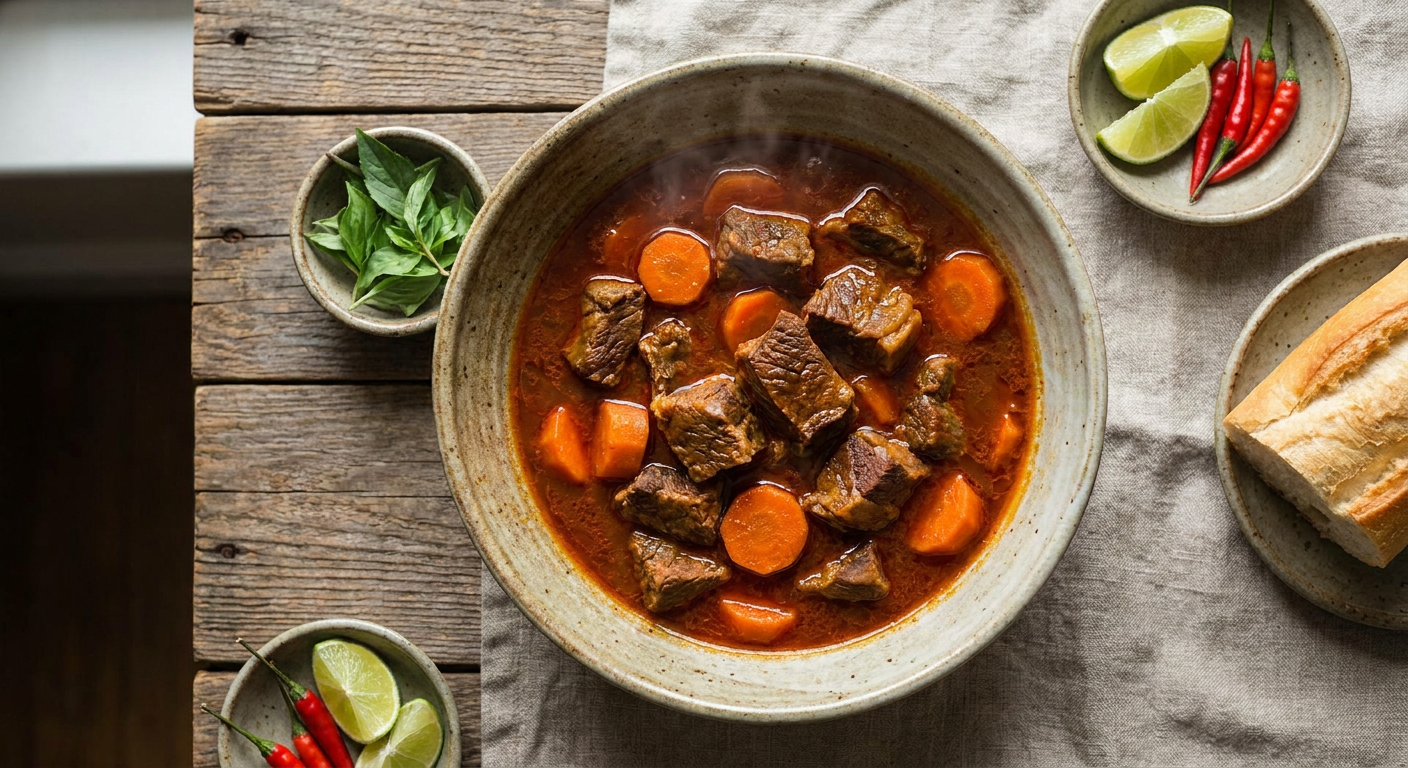
Bò kho — Vietnamese beef stew with lemongrass, star anise, and tomato — is where French beef stew meets the Southeast Asian pantry: tender chuck in a deeply aromatic, gently sweet-spiced broth, served over noodles or with baguette for dunking. It is phở's (#24) heartier cousin: same spice instincts, richer body, and vegetables in the pot.
- **Marinate 30 minutes to 1 hour.** The fish sauce and aromatics get a head start into the beef before the sear. Cube the chuck large — it shrinks by a third in the braise.
- **The bridge:** the curry powder looks wrong and is right — Vietnamese bò kho recipes almost all stir in a spoon or two, for color and a whisper of turmeric-root warmth rather than curry flavor. Skip it and add extra annatto and five-spice; the stew's identity survives every substitution except the lemongrass and star anise.
Doneness & Quality Checkpoints
- The sear: deep crust, fond left in the pot.
- The simmer: a tremble, 2 hours, chopstick-tender beef.
- The balance: fish sauce salt, sugar sweetness, narrow spice cabinet.
Bò Kho
Prep: 30 minutes · Cook: 2 hours 30 minutes · Total: About 3 hours · Serves 4–6
Ingredients
The beef and marinade
- 1 kg beef chuck, cut into 4 cm cubes
- 2 tbsp fish sauce (about 30 ml), 1 tbsp soy sauce, ½ tsp salt, ½ tsp pepper
- 1 tbsp minced lemongrass (about 10 g), 3 cloves garlic, minced
The aromatic base
- 3 tbsp neutral oil; 1 tbsp annatto oil or extra neutral oil (for color)
- 2 stalks lemongrass (about 60 g), bruised and cut to 5 cm lengths; 4 cloves garlic (about 15 g), sliced; 1 onion (about 200 g), quartered
- 2 tbsp curry powder (the Vietnamese stir-in — it is not curry, it is seasoning) or 1 tbsp extra five-spice
- 1 cinnamon stick, 2 star anise, 1 tsp fennel seed
- 300 g tomatoes, diced, or 3 tbsp tomato paste (about 50 g); 2 tbsp (about 25 g) sugar
- 2 carrots (about 250 g), rolled cut
The broth
- 1.5 litres beef stock or water with 1 beef bouillon cube
- 2 tbsp fish sauce, plus more to finish; 1 tsp sugar
To serve
- Banh pho or egg noodles, or a baguette; spring onions and cilantro; lime wedges; chili slices or sriracha
Instructions
- **Sear the beef hard (10 minutes).** Heat the oil in a heavy pot over high heat and brown the beef cubes in batches — a deep crust on at least three sides, without crowding (crowding steams gray). Checkpoint — the pot's bottom should be collecting a dark, sticky film — that fond is the stew's flavor deposit. Do not scrub it away; the liquid will lift it shortly. Patience at this stage is the difference between stew and soup.
- **Bloom the aromatics, build the base (8 minutes).** Lower the heat to medium, add the lemongrass, garlic, and onion, and fry 3 minutes until fragrant. Stir in the curry powder and tomato paste (or fresh tomatoes), the cinnamon and star anise, and the sugar, and fry 2 minutes more — the paste should darken and the smell should go from raw to roasted. Checkpoint — this is the braise's perfume moment — lemongrass bright, star anise warm, tomato caramelized. If the base smells flat, 2 more minutes of stirring will fix it; if it smells scorched, the heat was high.
- **The long simmer (2 hours).** Return the beef, pour in the stock, and add the fish sauce and sugar. Bring to a bare simmer — a tremble around 95 °C, not a boil — cover partially, and cook 1½ hours. Add the carrots and continue 30 minutes more, until the beef yields to a chopstick's twist and the carrots are tender but whole. Checkpoint — the broth should be a deep red-brown, clearly aromatic (lemongrass first, then anise), and just barely thickened from the beef's own collagen. Taste: salt-forward, sweet underneath, spice at the finish. Adjust with fish sauce — never plain salt — for the deep-umami version of salty.
- **Serve over noodles or with bread.** Noodles in the bowl, ladle of stew over, herbs and lime at the table. Or the rustic way: the pot at the center, baguette alongside for the broth. Checkpoint — eating test: the beef should be tender enough to bite through with intention but not falling apart (bò kho's ideal is firmer than French stew), the broth sippable on its own, the carrot sweet and intact. Dunked baguette — the colonial inheritance — soaks the spice broth into the crust, and is arguably the dish's best bite.
Finish & Plate
A ladle over noodles, herbs and lime at the table, or the shared pot with baguette. Leftovers tighten overnight into the best version — reheat gently.
Troubleshooting
| Symptom | Cause | Fix |
|---|---|---|
| Broth tastes thin despite hours | Weak stock, skipped fond | Bouillon cube; sear hard, scrape the fond |
| Beef still tough at 2 hours | Wrong cut or simmer too high | Chuck at a tremble; check at 2½ hours |
| Spices overwhelming, medicinal | Over-measured spice | Small amounts; the aromatics lead |
Storage, Make-Ahead & Variations
- Keeps 4 days and improves — the classic make-ahead. Freezes 2 months. The broth is also a noodle soup base on its own (bò kho noodle soup is a street classic). - Variations: the chicken version (gà kho); the potato-and-carrot heartier version; the fusion direction — bò kho as the ragu over the poutine fries (#138's cousin) or inside the bánh mì (#25), where it belongs to history already.