Bibimbap
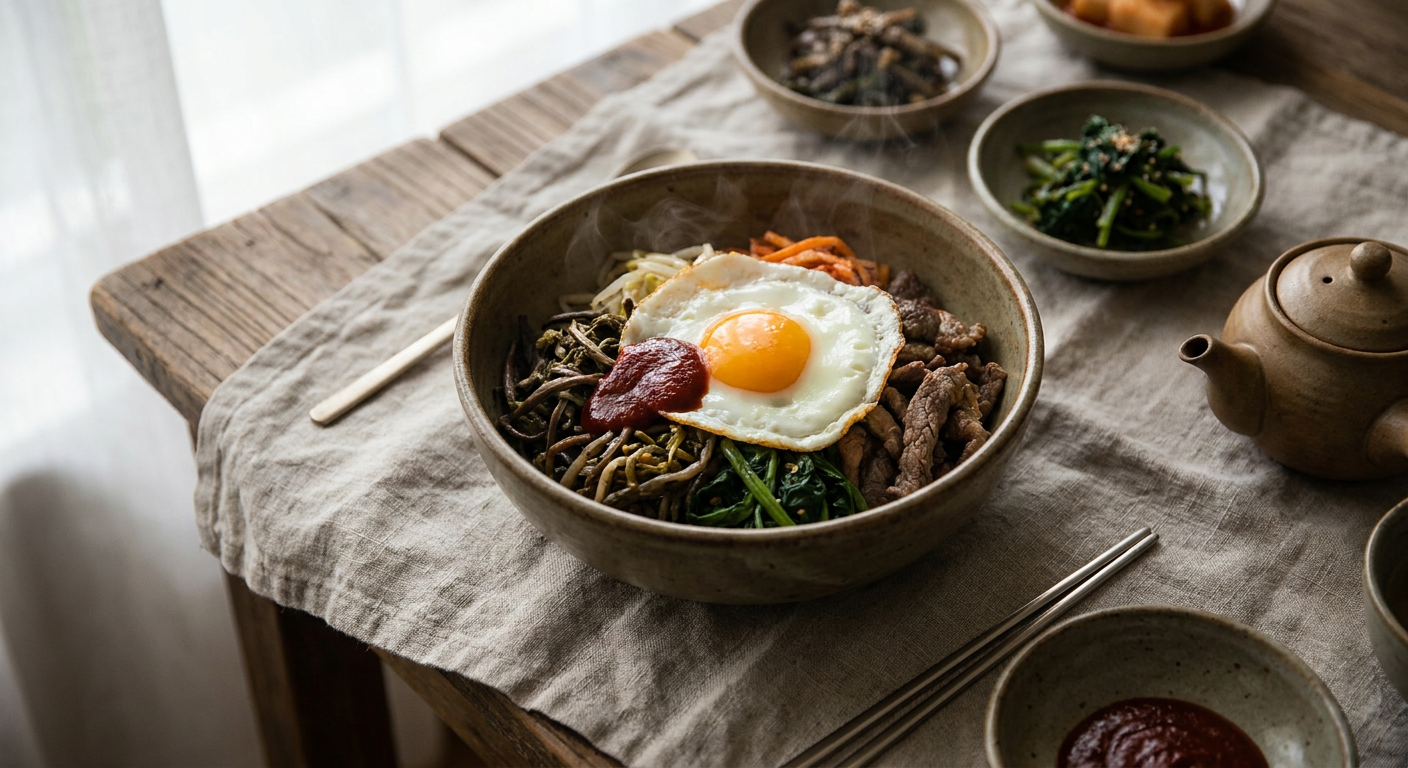
Quantities live in the recipe card.
The rice and protein
The namul (each seasoned separately — this is the point)
The sauce and finish
- the deep-tradition namul)
Doneness & Quality Checkpoints
- The namul: each separately cooked, distinctly seasoned, tasting complete alone.
- The eggs: crisp-edged, liquid yolk.
- The assembly: the unmixed wheel, sauce beside, stirred at the table.
Bibimbap
Prep: 40 minutes · Cook: 30 minutes · Total: About 1 hour 15 minutes · Serves 4
Ingredients
The rice and protein
- 400 g cooked short-grain rice (about 200 g dry), kept hot
- 250 g ground beef (or thinly sliced beef), marinated 15 minutes in 1 tbsp soy (about 15 ml), 1 tsp sugar, 1 minced garlic clove, 1 tsp sesame oil
The namul (each seasoned separately — this is the point)
- 150 g spinach: blanched 30 seconds, shocked, squeezed hard, cut; tossed with ½ tsp sesame oil, a pinch of salt, ½ tsp sesame seeds (about 3 g)
- 150 g bean sprouts: blanched 2 minutes; tossed the same way with a scallion
- 100 g carrots (about 100 g), julienned: stir-fried 2 minutes with a drop of sesame oil and salt
- 100 g shiitake or button mushrooms, sliced: stir-fried 3 minutes with 1 tsp soy and a drop of sesame oil
- 100 g zucchini or cucumber, julienned: salted 10 minutes, squeezed, dressed likewise
The sauce and finish
- Gochujang sauce: 3 tbsp gochujang, 1 tbsp sesame oil (about 15 ml), 1 tsp sugar, 1 clove garlic, 1 tsp toasted sesame seeds, a splash of water to loosen
- 4 eggs (about 200 g); neutral oil; 10 g toasted sesame seeds and sesame oil (about 5 ml) to finish
- (Optional: 100 g fernbrake or doraji bellflower root from a Korean market — the deep-tradition namul)
Instructions
- **Prepare all components (30 minutes, in sequence).** Blanch and dress the greens and sprouts; stir-fry carrot, mushroom, zucchini separately; brown the marinated beef; mix the gochujang sauce. Checkpoint — line the components up in bowls: each should taste complete and slightly over-seasoned alone — sesame-forward, each distinct. This tasting-each-step is the cook's quality gate; a bland component stays bland in the bowl.
- **Fry the eggs last (4 minutes).** Fry each egg in a thin film of oil until the edges are crisp and lacy and the yolk still liquid. Checkpoint — the yolk is the bowl's sauce along with the gochujang — it must run. Cooked-through yolks make a dry bibimbap.
- **Assemble the wheel, unmixed.** Hot rice — steaming at roughly 70 °C when it leaves the pot — in each bowl, the beef in the center, the vegetables arranged around it like a color wheel, the egg on top, sesame seeds scattered. Serve with the gochujang sauce in a dish beside. Checkpoint — the visual — the unmixed wheel — is part of the dish: white rice, green spinach and sprouts, orange carrot, brown mushroom, yellow yolk, red sauce. The diner adds gochujang to taste and stirs violently from the bottom — the mixing is the finale, not the kitchen's job.
Finish & Plate
One bowl per diner, sauce dish alongside. Stirling instruction: from the bottom, thoroughly, immediately — the hot rice and runny yolk make the sauce. A bowl of the #60's kimchi jjigae beside is the full Korean table.
Troubleshooting
| Symptom | Cause | Fix |
|---|---|---|
| Bowl tastes flat, monochrome | Vegetables cooked/seasoned together | Each namul separately — the dish's one law |
| Rice gone cold by serving | Components done before rice | Time everything to the hot rice; warm the bowls |
| Too spicy / not spicy enough | Gochujang dosed by the cook | Sauce on the side — each diner seasons |
Storage, Make-Ahead & Variations
- Namul keep 2 days refrigerated in separate containers (a bibimbap assembly line for the week — the Korean lunchbox tradition); the beef and eggs are to order. The dolsot crust is always last-minute. - Variations: the dolsot version above; the seafood version; the vegetarian temple-style with tofu. The fusion direction — #135's tteokbokki alfredo borrows the cheese-and-chili instinct — starts from this bowl's gochujang arithmetic.