Budae Jjigae
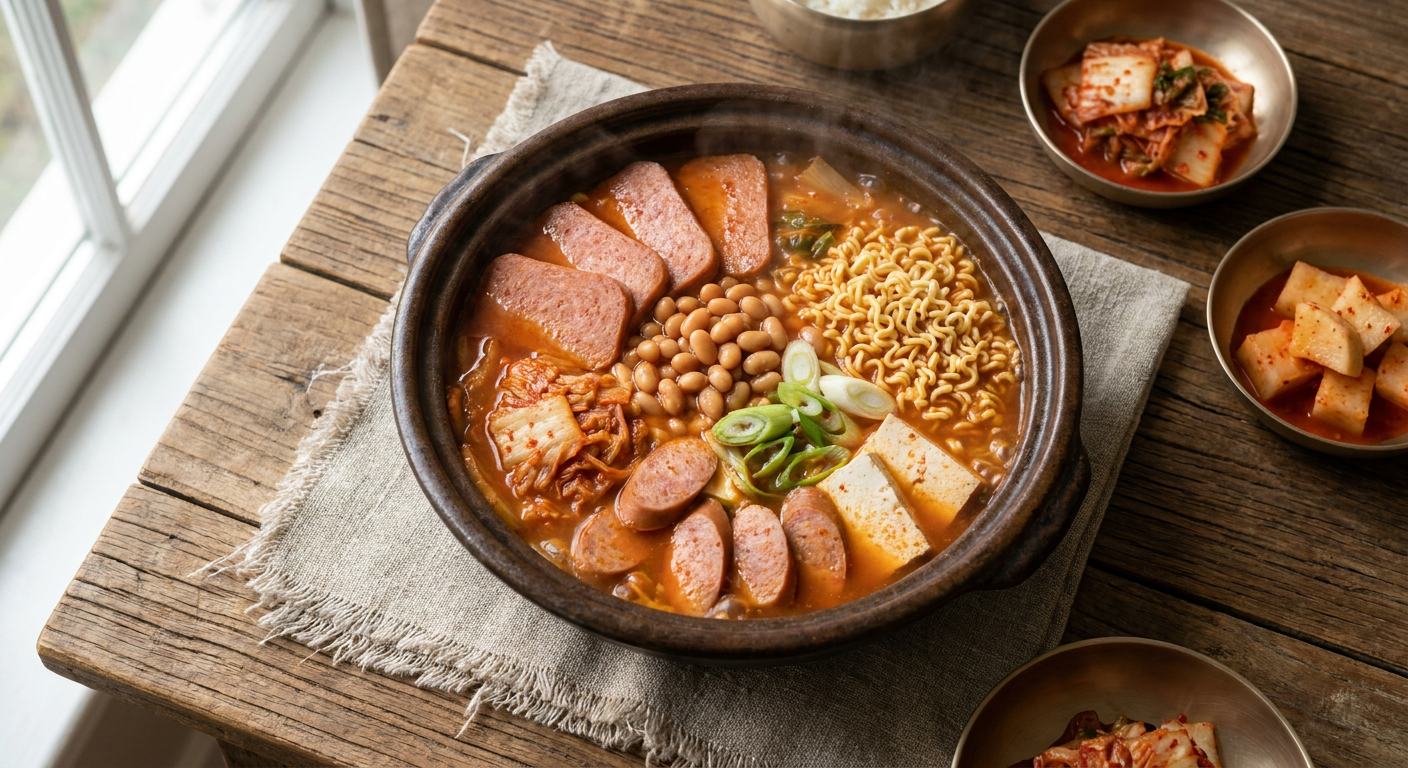
Budae jjigae — "army base stew" — is history in a pot: born around Uijeongbu's military bases after the Korean War, when cooks folded American surplus (spam, hot dogs, baked beans) into Korean stew technique (gochujang, kimchi, ramen). It is the site's most literal fusion dish — hunger's invention that became a beloved classic — and it remains one of the great feeding-a-crowd recipes: one pot, everything in it, noodles to finish.
Quantities live in the recipe card.
The broth base
- a small honest oddity; optional)
The assembly (arranged, not dumped)
- good bratwurst bridges upward)
- genuinely good)
- **Arrange the pot, then pour.** Budae jjigae is assembled raw in the pot in a neat wheel — meats, kimchi, vegetables in sections — then the seasoned broth is poured over and the whole thing bubbles at the table. The arrangement is half the presentation; the mess comes later, from the eating.
- **The bridge:** the original was built from army surplus because that is what existed — spam and hot dogs are the authentic ingredients, and better sausage simply upgrades the same dish. This recipe's honest stance: use the best processed meat you are willing to eat; the stew's gochujang-kimchi base carries anything.
Doneness & Quality Checkpoints
- The broth: gochujang-kimchi base, punchy before the meats enrich it.
- The arrangement: the wheel assembled raw, simmered at the table.
- The finish: cheese melted, ramen last, noodles eaten first.
Budae Jjigae
Prep: 25 minutes · Cook: 25 minutes at the table · Total: About 50 minutes · Serves 4
Ingredients
The broth base
- 750 ml anchovy-kelp stock or water (the #61's quick kombu-anchovy broth)
- 2 tbsp gochujang (about 40 g); 1 tbsp gochugaru (about 8 g); 1 tbsp soy sauce
- 2 tbsp kimchi, chopped, plus a splash of its juice; 1 tbsp minced garlic (about 10 g)
- 1 tbsp instant-coffee or cola (the old street trick for depth — a small honest oddity; optional)
- 1 onion (about 150 g), sliced; 3 spring onions, in lengths
The assembly (arranged, not dumped)
- 150 g spam, in thick slices; 3–4 frankfurters, in chunks (the classic "sausage" — good bratwurst bridges upward)
- 150 g ground beef, small clumps; 100 g baked beans, the war-era can (about 100 g drained; optional and divisive even in Korea)
- 150 g firm tofu, in slices; 100 g shiitake mushrooms; ½ a zucchini, sliced; some cabbage leaves (about 100 g)
- 1–2 slices of processed American cheese or mozzarella (the modern touch — genuinely good)
- 1 pack instant ramen noodles (discard the seasoning packet); a handful of rice cakes (the #64's), optional
Instructions
- **Build the broth base in the pot.** The stock coming to a rolling bubble — 100 °C at the center, the gochujang dissolving fast — before any assembly. Stir the gochujang, gochugaru, garlic, soy, and kimchi juice into the stock until dissolved; add the onion and bring to a bubble at the table burner or stovetop. Checkpoint — taste the liquid: spicy, savory, sour from the kimchi — a bolder, punchier version of the kimchi jjigae's (#60) broth. The processed meats will add fat and salt as they cook, so keep it just under fully seasoned now.
- **Arrange and simmer (15 minutes).** Lay in the arranged sections — spam, sausage, beef clumps, kimchi, tofu, mushrooms, vegetables, baked beans if using — in a wheel around the pot. Simmer 12–15 minutes at a lively bubble, until the sausage is plump, the beef is cooked, and the broth has turned orange-red with rendered fat. Checkpoint — the surface should be bubbling and slightly fattied-over — the meats' fat is the stew's body. Taste and adjust: salt (soy) nearly always, and a pinch of sugar if the kimchi runs very sour.
- **The final act: cheese and ramen (4 minutes).** Lay the cheese slices to one side to melt into the broth, add the ramen noodles and rice cakes to the other, and simmer just until the noodles are done — 3 minutes at most. Everyone eats from the pot as the noodles soften. Checkpoint — eating test: the first bowlful is chaos that works — chewy noodles in spicy-savory broth, a bite of spam, some kimchi, melting cheese strands, a mushroom. The ramen must be eaten first (it overcooks in minutes — the pot's only urgency), and the last of the broth, cheese-woven, is drunk or spooned over rice. It should taste better than its ingredients have any right to compose.
Finish & Plate
The pot stays at the center, on its burner, for the whole meal — this is a one-pot, eat-as-it-cooks dish with rice and banchan alongside. Soju is traditional; the dish's history deserves some acknowledgment with whatever you pour.
Troubleshooting
| Symptom | Cause | Fix |
|---|---|---|
| Broth too salty | Processed meats over-salting | Dilute with unseasoned stock; less soy next time |
| Ramen bloated | Added too early | Last 3 minutes, eaten immediately |
| Stew tastes flat | Timid gochujang-kimchi base | The base must lead — build it bolder |
Storage, Make-Ahead & Variations
- Best made to order; the broth base keeps 3 days for the next pot. Leftovers reheat well with fresh ramen. - Variations: the modern restaurant version with more cheese, the no-beans purist version, the seafood addition. The fusion direction is the dish itself — see #130's bulgogi cheesesteak and #129's kimchi grilled cheese for the block that grew from this pot's logic.