Chawanmushi
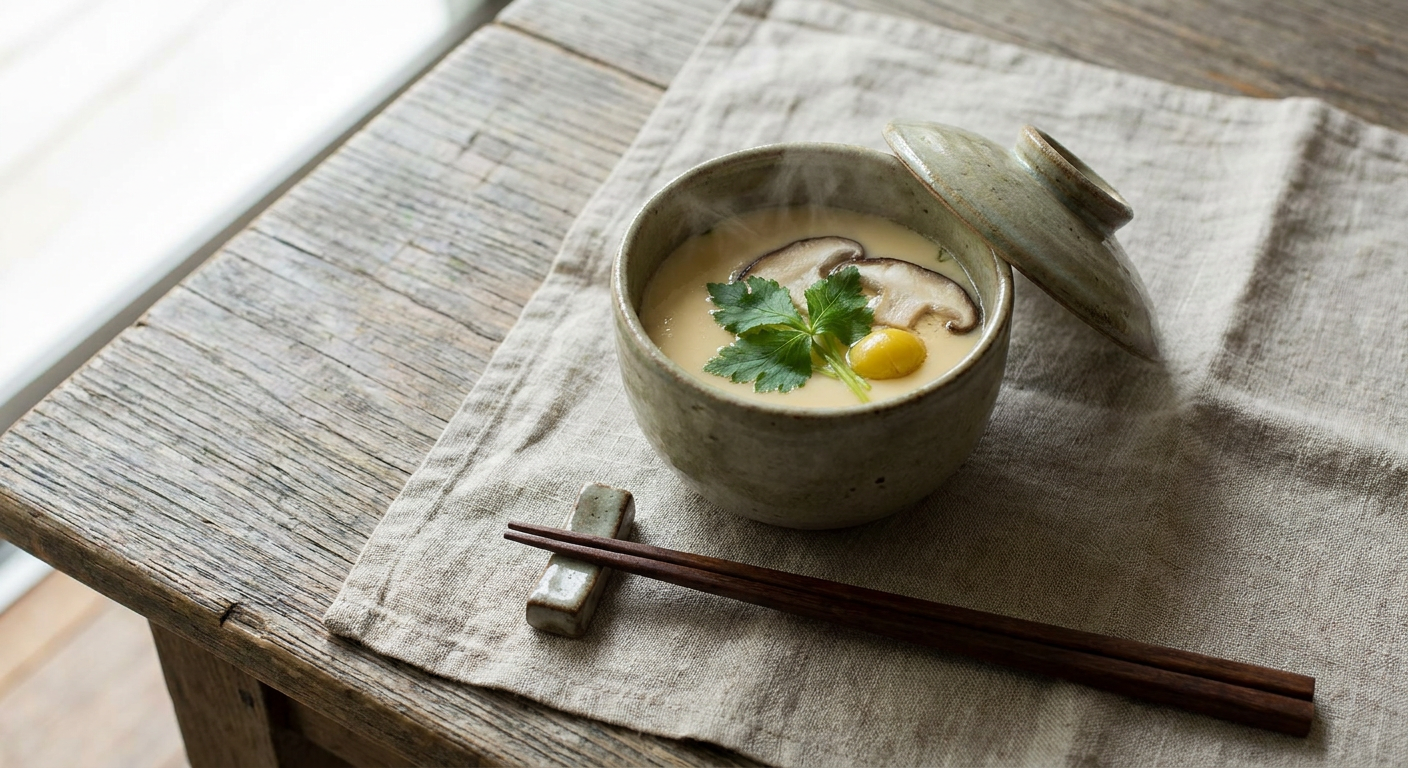
Chawanmushi — savory egg custard steamed in a cup — is Japanese refinement in one dish: a silken, trembling custard that barely holds, hiding chicken, shrimp, and mushroom within the steam's gentle cooking. The technique is the ratio (egg to liquid) and the steam's gentleness — this is the steamed egg custard family's most delicate member, the cousin of the Cantonese zheng shui dan (#68 on our sister site).
Quantities live in the recipe card.
The custard
- no froth
- this dish is half dashi by volume), cooled to warm
The hidden filling (per cup)
To finish
- **The ratio is the recipe.** 150 g egg to 400 ml liquid is the silken target — measure once, and this custard never fails. More egg makes firm custard; less makes soup. Strain the mixture through a fine sieve — twice is not excessive — because any chalaza or bubble becomes a flaw in the finished glass-smooth surface.
- **The bridge:** the cups matter less than the steam. Any heatproof cup or small bowl (100–150 ml) works; a lid or foil over each cup replaces the traditional wooden ones. What you cannot skip: the foil — uncovered custards wrinkle and water-log.
Chawanmushi
Prep: 20 minutes · Cook: 15 minutes · Total: About 40 minutes · Serves 4
Ingredients
The custard
- 3 eggs (about 150 g, or 50 g each), beaten gently — no froth
- 400 ml dashi (the freshest you can make — this dish is half dashi by volume), cooled to warm
- 1 tsp soy sauce (about 5 ml), ½ tsp salt (about 3 g), 1 tsp mirin
The hidden filling (per cup)
- 2 pieces chicken thigh, 1.5 cm dice, blanched 30 seconds
- 1 shrimp, cleaned, or 2 more chicken pieces
- 2 thin slices shiitake; 1 slice kamaboko fish cake (optional); a few spinach leaves, blanched
To finish
- 1 tsp yuzu zest or a small sprig of mitsuba, per cup
Instructions
- **Fill the cups.** Divide chicken, shrimp, shiitake, and spinach between four cups. Pour the strained custard over gently, down the side of the cup, leaving 5 mm at the rim. Cover each cup tightly with foil. Checkpoint — the liquid should be warm, not hot — hot liquid starts cooking the egg before the steamer and gives a head start to curdling. Hold a finger in it: pleasantly warm is the range, roughly body temperature.
- **Steam gently (12–15 minutes).** Bring a steamer to a boil, then reduce to the barest simmer — a wisp of steam, not a jet. Steam the covered cups 12 minutes, then test one: the surface should be set but tremble at a nudge, and a skewer should come out clean with the first watery film, not raw egg. Checkpoint — the fail mode is high steam: the custard bubbles, sieves, and turns tofu-like. Gentle steam, foil on, and pulling at the first set — the window between unset and over-steamed is about 3 minutes wide, so check at 12.
- **Rest and garnish.** Rest the cups 2 minutes off the heat (the carryover finishes the deepest center), then lift the foil and set a sliver of yuzu zest or mitsuba on each — the steam releases its perfume over the first spoonful. Checkpoint — eating test: the spoon should slide through with no resistance — the custard is savory jelly, not flan — and each bite should find a hidden piece: chicken, shrimp, mushroom. The taste is dashi first, egg second — if it tastes primarily of egg, the dashi was weak.
Troubleshooting
| Symptom | Cause | Fix |
|---|---|---|
| Custard sieved, honeycombed | Steam too hard | Barest wisp, foil on, check at 12 minutes |
| Surface pocked with bubbles | Uncovered, or frothy egg | Beat gently, strain, cover |
| Custard unset at center | Pulled early, cups too deep | 3 more minutes; wide shallow cups set faster |
Storage, Make-Ahead & Variations
- Best steamed to order; the custard mixture (uncooked, strained) holds 1 day refrigerated — steam from cold, adding 2 minutes. Steamed cups re-steam 4 minutes, imperfectly. - Variations: the summer version served chilled; the winter version with a gingoshi-style soy gel on top; the fusion direction — a spoon of the tonkotsu broth (#5) in place of a quarter of the dashi, which makes an unreasonably good rich custard.