Chicken Katsu Curry
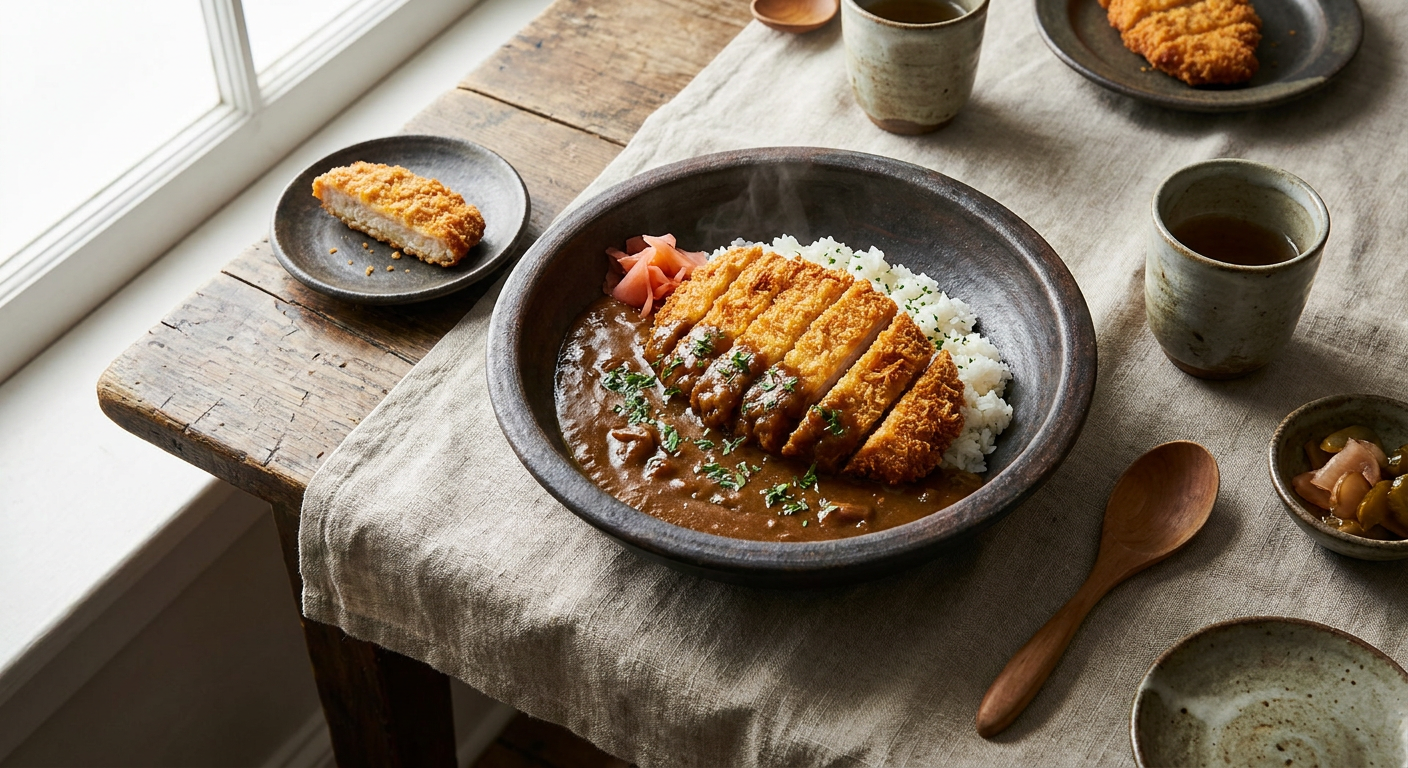
Japanese curry is itself a fusion dish with a century of history — a British navy stew that Japan adopted, sweetened, thickened, and turned into a national comfort food. Katsu curry stacks another layer: the panko-cutlet on top. The authentic version uses a curry roux block (sold in every Japanese grocery); the from-scratch roux below tastes fresher and takes ten extra minutes.
- **Double-panko for the lasting crunch.** Press the panko on firmly, then let the breaded cutlets rest 10 minutes before frying — the coating sets and adheres.
- **The bridge:** Japanese curry roux blocks (S&B Golden Curry, Java Curry) are the weeknight answer and there is no shame in them — this site's rule is honest, not purist. Dissolve half a block into the simmered vegetables and stock. What you lose versus the from-scratch roux: the fresh-grated fruit, which you can simply stir in anyway, and a slightly less processed taste.
Doneness & Quality Checkpoints
- The cutlet: locked panko, amber crust, 74 °C interior.
- The curry: dark onions, thick gloss, sweet-savory balance, visible chunks.
- The bowl: crisp side and curried side in every serving.
Chicken Katsu Curry
Prep: 30 minutes · Cook: 30 minutes · Total: About 1 hour · Serves 4
Ingredients
The katsu
- 4 boneless chicken thighs (or 2 breasts, butterflied), about 700 g
- Salt and pepper; 60 g flour; 2 eggs, beaten; 150 g panko
- Neutral oil for frying, 2 cm deep, at 170 °C
The curry
- 1 onion (200 g), sliced thin; 1 carrot (120 g), rolled cut; 1 potato (250 g), in chunks
- 2 tbsp butter (30 g), 3 tbsp flour (25 g), 2 tbsp curry powder (S&B is the classic), 1 tsp garam masala
- 1 tbsp grated apple and 1 tbsp grated pear or another apple (the Japanese sweetness)
- 500 ml chicken stock (or dashi for the lighter Kanto style)
- 2 tbsp soy sauce, 1 tbsp Worcestershire sauce, 1 tsp honey
- 1 bay leaf; salt to finish
To serve
- 4 bowls steamed short-grain rice; pickled Fukujinzuke or red ginger
Instructions
- **Bread the cutlets.** Season the chicken, coat in flour, then egg, then panko, pressing hard so the crumbs lock. Rest 10 minutes. Checkpoint — an even, thick panko coat everywhere, with no wet spots. If the panko isn't sticking, the egg layer is too thin — dip again.
- **Fry (3–4 minutes a side at 170 °C).** Fry the cutlets in the shallow oil at a steady 170 °C, turning once, until deep golden. Drain on a rack, not paper — paper traps steam and softens the underside. Checkpoint — the crust should be an even amber and audibly crackle when tapped. Interior 74 °C. If the crust browns long before the chicken is done (thick thighs), finish 5 minutes in a 160 °C oven.
- **Build the curry (20 minutes).** Sauté the onion in butter until deeply browned at the edges, 8–10 minutes — this is the curry's body, and pale onions make flat curry. Add carrot and potato, toss, then sprinkle the flour and curry powder over and stir 2 minutes until the pot smells toasted. Gradually add the stock, then apple, pear, soy, Worcestershire, honey, and bay. Simmer until the vegetables are tender and the sauce thickly coats a spoon, about 15 minutes. Salt to finish. Checkpoint — the finished sauce should be thick — noticeably thicker than an Indian curry, glossy, brown, with visible chunks. Taste: sweet first, then mild spice, then a savory bottom. Japanese curry is a stew, not a heat dish; if it tastes dull, the missing note is usually Worcestershire or salt.
- **Serve: cutlet sliced, curry poured beside, never over.** Slice each cutlet across into strips, hold the shape, set on rice, and pour the curry around the cutlet and over part of the rice — the crust stays crisp where it matters. Checkpoint — each bowl should have crisp-cutlet access and curried rice in the same bite, plus pickles. The first bite should have crust, chicken, curry, and rice — that stack is the entire dish.
Finish & Plate
Rice in one half of each bowl, sliced cutlet against it, curry ladled over the rice and around (not over) the cutlet. Fukujinzuke on the side — its crunch and pickle-sharpness are engineered for this dish.
Troubleshooting
| Symptom | Cause | Fix |
|---|---|---|
| Crust detached in the pan | Breading rushed, wet chicken | Pat dry, press panko hard, rest 10 minutes |
| Curry tastes bland | Onions under-browned, or missing Worcestershire | Brown to the edge of burnt; add Worcestershire by teaspoons |
| Curry too thick, gluey | Too much flour | Stock in splashes until it pours slowly |
Storage, Make-Ahead & Variations
- The curry keeps 3 days and improves; the cutlet is best eaten immediately (a 160 °C oven for 6 minutes revives leftover crust passably — never the microwave). Freeze the curry a month. - Variations: the same curry over hamburger steak is the other classic; katsu sandwiches (#111 is its cousin) reuse the cutlet. The fusion direction — katsu curry panini, curry ramen — exists because the sauce freezes so well.