Dashi French Onion Soup
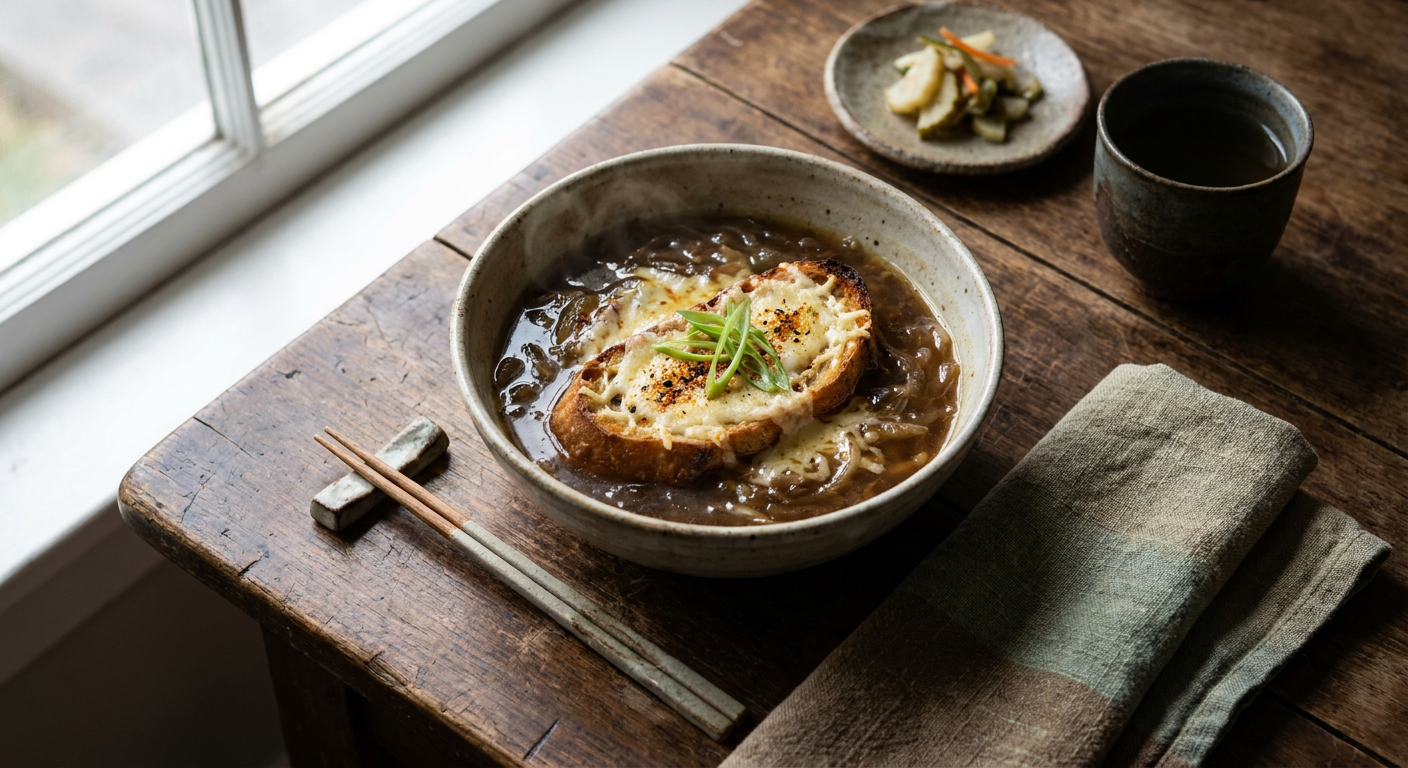
Dashi French onion soup keeps everything French and swaps the broth: the slow-caramelized onions, the wine deglaze, the toast and molten gruyère lid — all of it floating on dashi instead of beef stock. The result is lighter, cleaner, and quietly profound: kombu's umami meets the onion's sweetness, and the cheese still rules the bowl.
- **Caramelize the onions honestly — 50 to 60 minutes.** This is the French heart of the recipe and the one step that cannot be bridged: low heat, frequent stirring, the onions traveling from translucent to deep amber-brown. Shortcuts produce onion soup; patience produces this dish.
- **The bridge:** dashi granules at 1 tsp per 250 ml make a genuinely good version (the simmer will deepen them) — the fresh kombu-katsuobushi version is clearer and finer. Either way, the soy and mirin season the broth in place of the beef stock's salt.
Doneness & Quality Checkpoints
- The onions: deep amber, one hour, no shortcuts.
- The broth: dashi-savory, soy-seasoned, one notch under-salted.
- The lid: bubbling, gold-blistered, served in heated bowls.
Dashi French Onion Soup
Prep: 20 minutes · Cook: 1 hour 15 minutes · Total: About 1 hour 40 minutes · Serves 4
Ingredients
The onions
- 1 kg onions (about 4 large), sliced thin root-to-tip
- 40 g butter; 1 tsp salt
- 100 ml dry white wine or sake (the block's both-ways moment — sake runs the Japanese direction)
The broth
- 1 litre dashi: from 20 g kombu (about 20 g) and 10 g katsuobushi (soaked 30 minutes, heated to just under the boil, removed) and 10 g katsuobushi (steeped 3 minutes, strained)
- 1 tbsp soy sauce (about 15 ml); 1 tsp mirin
- A sprig of thyme or 1 bay leaf; black pepper
The lid
- 8 slices baguette, toasted; 150 g gruyère, grated (about 150 g)
- Optional: a pinch of sansho or nutmeg
Instructions
- **The onions, patiently (55–60 minutes).** The pot over medium-low — roughly 120 °C at the base, a gentle sizzle — Melt the butter in a wide heavy pot, add the onions and salt, and cook over medium-low, stirring every few minutes — 20 minutes to soft and translucent, 40 more to deep, jammy brown. Deglaze with the wine or sake, scraping the fond. Checkpoint — the onions should be a deep amber-brown mass, sweet and collapsed, with the fond dissolved back in — the color of the finished soup is set here. Pale onions make a thin soup, and no amount of broth fixes them.
- **Add the dashi and simmer (15 minutes).** Pour in the dashi with the soy, mirin, thyme, and pepper; simmer gently 15 minutes for the flavors to marry. Taste. Checkpoint — the broth should taste of sweet onion and sea — the dashi's kombu umami reads almost like a light beef stock's depth, but cleaner, with no heaviness. Season with soy by the teaspoon. The soup should be one notch under-salted: the cheese lid is salty.
- **The lid and the broil.** Ladle the soup into oven-safe bowls, float the toasted baguette slices, and pile the gruyère thickly over. Broil until the cheese is bubbling and blotched gold — 2 to 4 minutes, watched. Checkpoint — eating test: the crack through the cheese lid, the soaked bread, and then the broth — French onion soup's architecture intact, but the broth beneath tastes like the sea met the onion field: lighter than the beef version, with kombu's savory hum where the stock's weight was. The sake version runs a shade more Eastern than the wine; both work. This is the block's most seamless recipe — ask your guests to name what changed, and enjoy the silence.
Finish & Plate
Bowls on plates (they are hot), a knife and spoon, and the first crack of the lid at the table. A green salad and the rest of the sake or wine beside.
Troubleshooting
| Symptom | Cause | Fix |
|---|---|---|
| Broth tastes weak | Onions under-caramelized | The color is the flavor — give it the hour |
| Too salty under the cheese | Over-seasoned broth | Cheese carries salt; season light |
| Dashi tastes fishy | Katsuobushi over-steeped or boiled | 3 minutes' steep, never a boil |
Storage, Make-Ahead & Variations
- The onion-broth base keeps 4 days and improves; assemble and broil to order. The #108 is the block's soup-course anchor; the #146's chowder runs the same swap logic into New England. - Variations: the miso version (a spoon of white miso off-heat), the sake-deglaze version noted above. The fusion block's soups (#106, #146) are this recipe's family.