Galbi Jjim
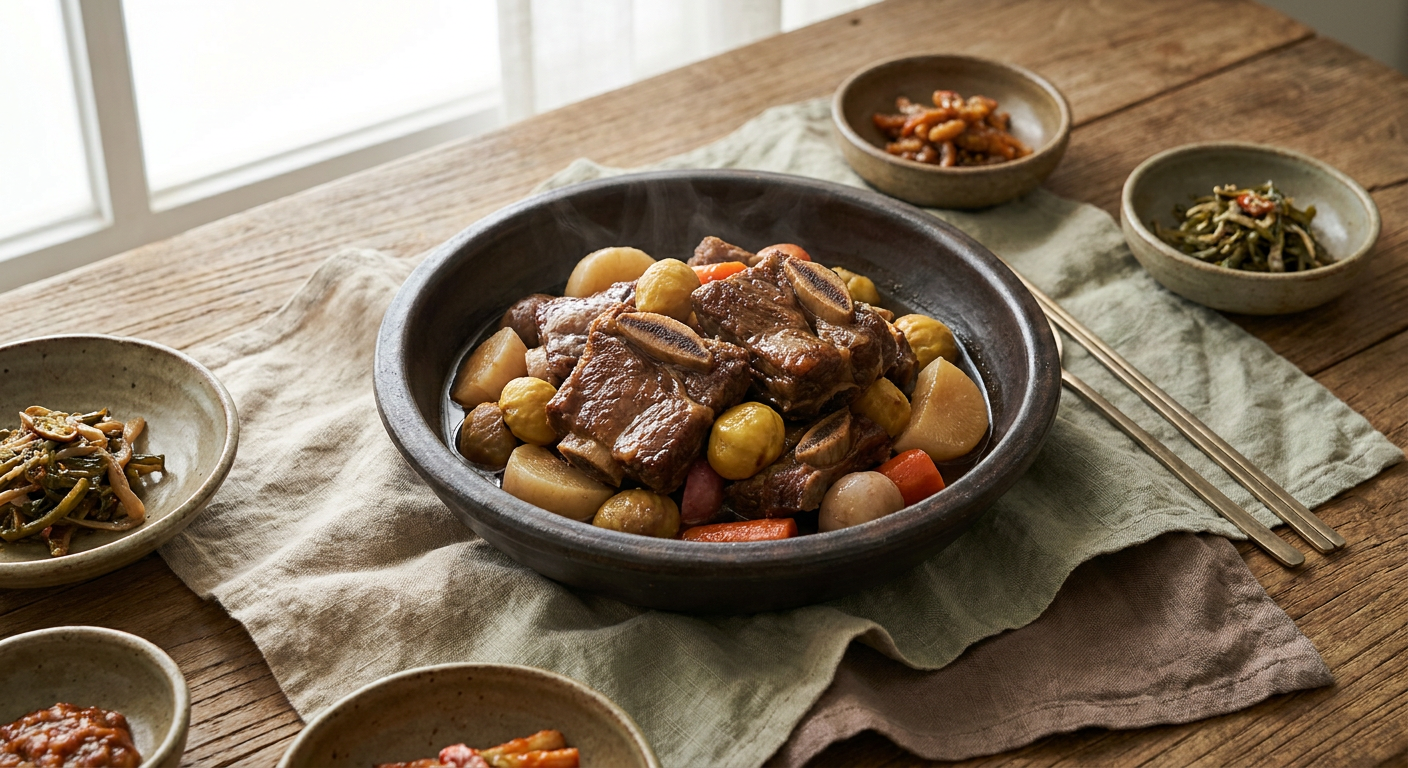
Galbi jjim — braised short ribs in a sweet-savory soy glaze with jujubes, chestnuts, and vegetables — is Korean celebration food: the dish that appears at holidays and weddings, glossy and tender enough to fall from the bone at a chopstick's nudge. It is the Korean braise's fullest expression — beef, pear, soy, and time — and the leftovers are the best part.
- **Soak, then boil, then braise — the three-stage rib.** The soak draws the blood (clearer braise), the first boil (15 minutes in plain water) lifts the scum, and the braise itself then runs clean. This is the same discipline the phở (#24) and bo kho (#30) blanches run — braises of great clarity are blanched first.
- **The bridge:** jujubes and chestnuts are the celebratory notes and both are optional — pear and soy carry the braise's identity. Asian pear's enzyme tenderizes the beef (the bulgogi #59 principle, here at braise scale); a firm apple bridges. Cut the meat between the bones into serving pieces (ask the butcher — "galbi cut" is through-the-bone).
Doneness & Quality Checkpoints
- The ribs: soaked, first-boiled, then braised — three stages, clean pot.
- The glaze: reduced to glossy, spoon-coating, soy-forward with pear sweetness.
- The meat: chopstick-slide from the bone, seasoned to the bone.
Galbi Jjim
Prep: 30 minutes, plus 1 hour soaking · Cook: 1 hour 45 minutes · Total: About 3 hours 15 minutes · Serves 4
Ingredients
The ribs
- 1.2 kg beef short ribs (English cut), soaked in cold water 1 hour to draw blood, drained — the soak water runs pink at first
- 1 litre water, for the first boil
The braising liquid
- 1 Asian pear (about 300 g), half grated with juice, half in chunks; 1 onion (about 200 g), half grated, half wedged
- 6 cloves garlic (about 25 g), minced; 1 tbsp minced ginger (about 10 g)
- 5 tbsp soy sauce (about 75 ml); 3 tbsp sugar or honey (about 40 g); 1 tbsp mirin or sweet rice wine (about 15 ml)
- 1 tbsp sesame oil (about 15 ml); black pepper; 2 dried red dates (jujubes) if available; 6 chestnuts, peeled (both optional but traditional)
- 600 ml water or beef stock (about 600 g)
- 2 carrots (about 200 g), rolled cut; 1 potato (about 250 g), in chunks; 3 shiitake mushrooms (about 60 g, stemmed)
- 2 spring onions; sesame seeds and a drizzle of sesame oil to finish
Instructions
- **The first boil (15 minutes).** Cover the ribs with plain water, boil hard 15 minutes, drain, and rinse the ribs and the pot. Checkpoint — the water will be grey and unappetizing — that is the point. The rinsed ribs are clean and ready for a braise that needs no skimming. Skipping this stage makes a murkier, scummy pot.
- **Build the braise and simmer low (1 hour).** The pot held at a tremble — about 95 °C, never a rolling boil — through the hour. Return the ribs with the grated pear-onion-garlic-ginger, soy, sugar, mirin, pepper, dates, chestnuts, and stock. Bring to a bare simmer, cover partially, and cook 1 hour, turning the ribs every 20 minutes. Checkpoint — at the hour the meat should be tender but still on the bone, and the braising liquid a deep brown. The pear's grated half has dissolved into the liquid, sweetening and lightening — taste: soy-savory with a clean fruit sweetness, not sugar-heavy.
- **Add the vegetables and glaze (30–35 minutes).** Add carrots, potato, mushrooms, and the chunked pear and onion. Uncover, raise the heat slightly, and simmer 30 minutes, turning occasionally, until the vegetables are tender and the sauce has reduced to a glossy, spoon-coating glaze that clings to everything. Checkpoint — eating test: the rib should slide from the bone with chopsticks and taste sweet-savory through to the bone, the glaze lacquering each piece; the vegetables should be sauce-saturated and intact; the chestnut's sweet starch and the jujube's faint wine-y note ride along. The finish — sesame seeds, sesame oil, spring onion — is the Korean signature. If the sauce is still liquid, simmer with the lid off; if reduced before the vegetables are tender, add a splash of water.
Finish & Plate
The whole glazed pot to the table — ribs lacquered, vegetables glistening, sesame over — with rice and a bowl of the #60's kimchi to cut the sweetness. A holiday dish served family-style in its own pot.
Troubleshooting
| Symptom | Cause | Fix |
|---|---|---|
| Sauce thin, no glaze | Under-reduced | Lid off, simmer — the glaze is the goal |
| Meat tough at the bone | Under-braised or boiled hard | The tremble, and time — check at each hour |
| Too sweet, dessert-adjacent | Sugar over-measured | More soy and pepper; less sugar next batch |
Storage, Make-Ahead & Variations
- Keeps 4 days, improves to day three; freezes 2 months. The make-ahead is traditional and recommended. - Variations: the dak galbi jjim (chicken), the spicy gochujang version (#128's cousin), the holiday version with more jujubes and ginkgo. The fusion direction — #123's massaman short rib tacos — is this braise philosophy dressed in another spice cabinet.