Ganjang Gejang
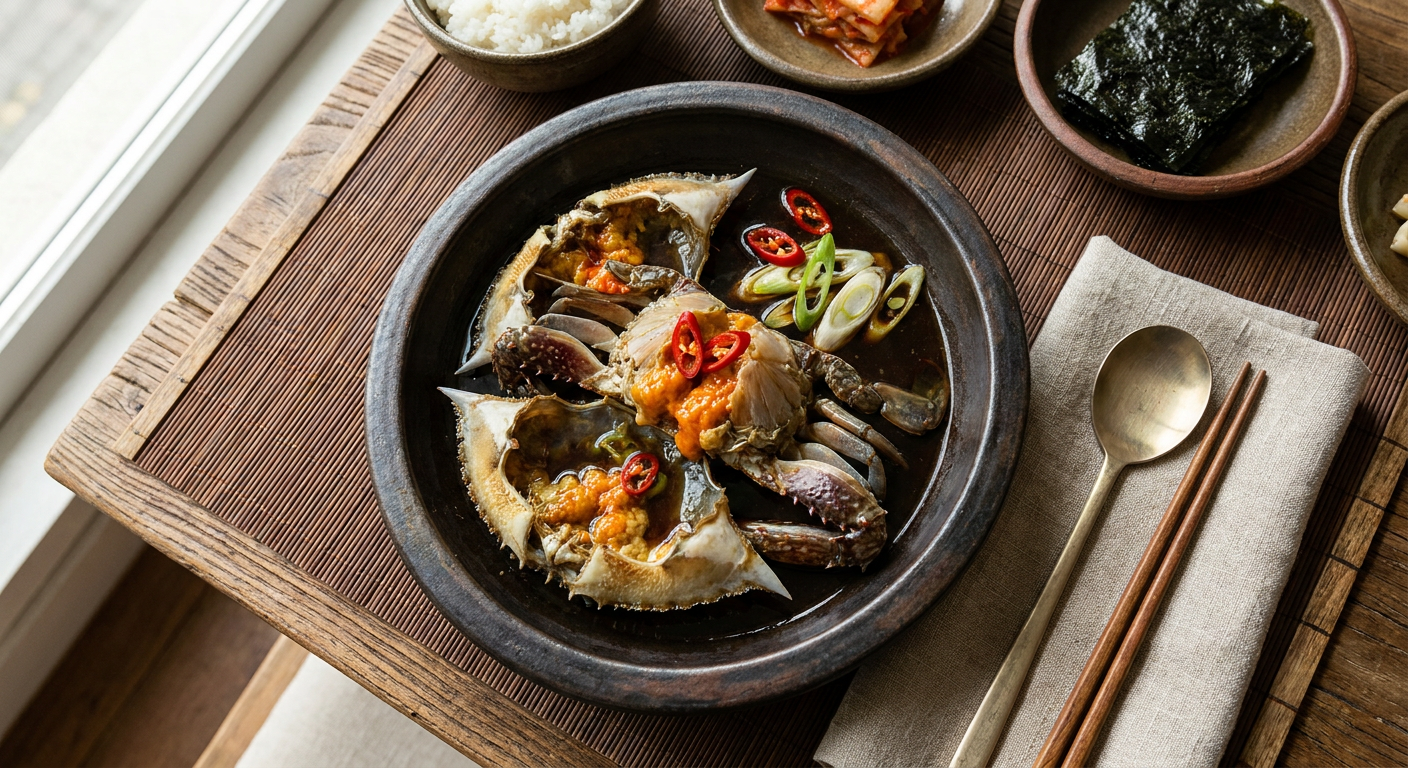
Ganjang gejang — raw crab cured in soy sauce — is one of Korea's great delicacies: the soy brine firms the raw crab's flesh into a custard-like, intensely savory treat that Koreans call "rice thief" (it vanishes bowls of rice). It is a curing project rather than a cooking one — 24 to 48 hours of patience — and its food safety depends entirely on freezing the crabs first.
Quantities live in the recipe card.
The crabs
- **frozen at -20 °C for 24 hours first** (the parasite-safety step, non-negotiable for raw crab), then thawed in the fridge
The soy brine (enough to cover)
- **Freeze the crabs first.** Raw crab carries parasite risk; commercial gejang is made from pre-frozen crab, and the home version must do the same — 24 hours at -20 °C, thawed slowly in the refrigerator. This is the one step this site will not let you skip.
- **The bridge:** small fresh blue crabs or flower crabs are the traditional; frozen-cleaned crab from Asian groceries works. The brine is the technique — it must be boiled, cooled, and poured over, then can be re-boiled and reused for a second batch (the aged brine gets better; restaurants keep theirs for years).
Ganjang Gejang
Prep: 30 minutes · Cook: 10 minutes (the brine) · Total: About 30 minutes active (24–48 hours curing) · Serves 4 as a small dish
Ingredients
The crabs
- 4 fresh blue crabs (about 200 g each), cleaned, cut in halves or quarters (or 500 g small flower crabs) — **frozen at -20 °C for 24 hours first** (the parasite-safety step, non-negotiable for raw crab), then thawed in the fridge
The soy brine (enough to cover)
- 500 ml water; 250 ml soy sauce (about 250 g)
- 100 g sugar or 4 tbsp honey; 100 ml mirin or makgeolli
- 1 onion (about 150 g), sliced; 6 cloves garlic (about 25 g), smashed; 3 slices ginger
- 2 dried red chilies; 1 tbsp whole black peppercorns; 1 bay leaf; 3 spring onions
- 1 apple or Asian pear (about 150 g), sliced (the fruit sweetness)
Instructions
- **Boil and cool the brine (15 minutes).** Simmer all the brine ingredients 10 minutes, then strain and cool completely — fully cold before it touches the crab. Checkpoint — taste the cooled brine: intensely savory-sweet, seasoned past drinkable — a curing liquid, not a soup. The apple's sweetness and the mirin round the soy's edge; the aromatics ride behind.
- **Submerge and cure (24–48 hours).** Pack the crab pieces in a container just their size, pour the cold brine over to cover completely, and refrigerate. At 24 hours, turn the pieces; taste at 24, serve by 48. Checkpoint — at 24 hours the flesh has begun to firm and turn translucent-amber; at 36–48 it reaches the classic texture — softly set, custard-glossy, deeply seasoned. The shell's inner meat pulls away whole and glistens. Taste one piece at 24 hours: it should be salty-sweet-savory through, not just on the surface.
- **Serve cold, with rice — the classic pairing.** Lift the pieces, let them drain a beat, and serve them cold with hot rice, the brine's collected juices in a small dish for the rice. Checkpoint — eating test: the work is in the eating — the shell's meat is sucked and picked out (the gejang ritual), the soft, soy-set flesh tasting of the sea under the brine's sweet-savory depth. One bite of crab, one spoon of rice. The rice is not a side; it is the dish's other half — the "rice thief" reputation is an instruction.
Troubleshooting
| Symptom | Cause | Fix |
|---|---|---|
| Flesh too salty | Over-cured | 24–30 hours max for small pieces; rinse before serving next batch |
| Flesh still raw-soft | Under-cured | Give it more time; the set is the doneness |
| Brine cloudy, sour smell | Contamination | Discard; sterilize the container; keep fully refrigerated |
Storage, Make-Ahead & Variations
- The cured crab keeps 2–3 days refrigerated in its brine (it continues to firm and salt); the brine itself re-boils and re-uses for the next batch, improving for months. - Variations: yangnyeom gejang (the spicy-seasoned sibling), the quick 4-hour "lunch gejang" of modern Seoul. The fusion direction — gejang over the #6 chirashi rice, or the brine's idea applied to the site's #106's sister techniques — is the soy-cure conversation continuing.