Green Curry Chicken
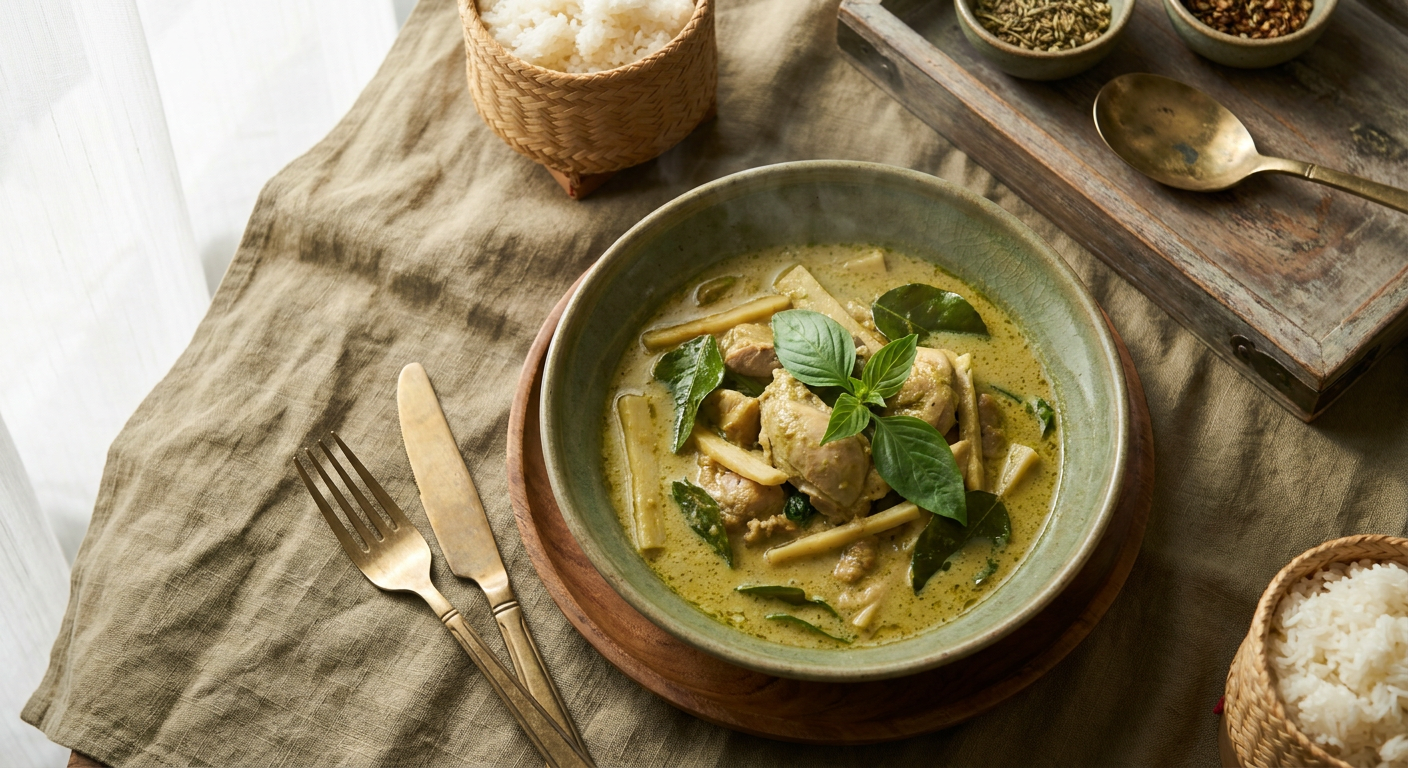
Green curry (kaeng khiao wan — "sweet green curry," a name that undersells its heat) is the Thai curry that runs on freshness: green chilies, lemongrass, galangal, makrut lime leaves, and Thai basil, pounded into a paste and fried in cracked coconut cream until the oil splits and turns fragrant-green. The paste is the recipe; everything after it is arithmetic.
- **Make (or honestly bridge) the paste.** The mortar method takes 15 minutes and produces a paste that fries like a fresh herb paste should; a food processor with minimal water is the working shortcut. Store paste (Mae Ploy green curry) is the genuine weeknight bridge — buy it, but fry it the same way. What you lose with store paste is the fresh-chili brightness; what you keep is the technique.
- **The bridge:** Thai basil is the finisher and does not substitute with Italian basil (wrong sweetness); any Asian grocery carries it, and mint bridges in a pinch at a real character loss. Thai eggplant (pea-sized or golf ball) bridges with regular eggplant.
Doneness & Quality Checkpoints
- The crack: visible oil pools in the reduced cream.
- The paste: fried to fragrance in the cracked oil, never raw-scented.
- The finish: Thai basil wilted off the heat, chilies raw on top.
Green Curry Chicken
Prep: 30 minutes · Cook: 30 minutes · Total: About 1 hour · Serves 4
Ingredients
The green curry paste — extra keeps 2 weeks
- Makes about 6 tbsp
- 6 green bird's eye chilies, plus 2 large mild green chilies
- 2 stalks lemongrass (about 60 g), sliced thin; 1 tbsp chopped galangal
- 4 makrut lime leaves, shredded; 1 tsp makrut zest or lime zest
- 3 cloves garlic; 2 shallots (about 60 g)
- 1 tsp coriander seed, toasted; ½ tsp cumin seed, toasted; ½ tsp shrimp paste (kapi) or 1 tsp fish sauce
- Pound in a mortar (or food processor with a splash of water) to a fine paste
The curry
- 400 ml coconut cream (thick top of two cans of full-fat coconut milk, chilled)
- 500 g chicken thigh, sliced
- 2 tbsp fish sauce (about 30 ml), 1½ tsp palm sugar (about 6 g)
- 100 g Thai eggplant, quartered (or regular eggplant in chunks); 50 g bamboo shoots (optional)
- 6 more makrut lime leaves, torn; a large handful Thai basil (the anise-sweet basil, not Italian)
- 2 small red chilies, sliced on the diagonal, for finish
To serve
- Jasmine rice
Instructions
- **Crack the cream (8 minutes).** Simmer the thick coconut cream in a wok or pot over medium heat — the cream around 100 °C as it reduces — until it thickens and the oil visibly separates, glistening pools at the edges. Checkpoint — the "cracking" is the curry's foundation: paste fried in coconut oil, not water. Low-fat coconut milk refuses to split (see the khao soi note, #2 — same technique, and if your milk won't crack, keep reducing or change brands).
- **Fry the paste (3–5 minutes).** Lower the heat, add the paste, and fry it in the cracked cream, stirring constantly, until it darkens slightly and the raw smell cooks off — the oil will streak green-yellow and the kitchen should smell fiercely aromatic. Checkpoint — the paste should sizzle gently and coat the spatula in fragrant oil. This frying stage is the single biggest difference between homemade curry and the undercooked versions: unfried paste tastes sharp and raw; fried paste tastes deep and round. Give it the full 3–5 minutes without letting it scorch.
- **Build and simmer (15 minutes).** Add the chicken and turn to coat in the paste. Pour in the remaining thinner coconut milk (plus 100 ml water if needed to just cover), add fish sauce, palm sugar, eggplant, bamboo, and the torn lime leaves. Simmer gently 10–12 minutes, until the chicken is tender and the eggplant is soft and green-gold. Checkpoint — taste the sauce: it should be salty first (fish sauce), then hot (the paste's chilies), then sweet (palm sugar), with the coconut's richness carrying all three. Adjust with fish sauce and sugar by small amounts — the balance is struck in the pot, not at the table.
- **Finish with the fresh (1 minute, off the heat).** Off the flame, stir in the Thai basil (it should wilt, not cook) and the sliced chilies. Serve with jasmine rice. Checkpoint — eating test: the sauce should coat rice richly, the heat building over bites, the Thai basil's anise arriving at the swallow. The eggplant should be sauce-saturated silk. If the basil is missing, the curry is unfinished — its fresh sweetness is the counterpart the fried paste needs.
Finish & Plate
Family style in a deep bowl, the green oil streaking the surface, basil and chilies visible on top. Jasmine rice for each diner. Green curry is best eaten promptly — the basil's perfume fades within the hour.
Troubleshooting
| Symptom | Cause | Fix |
|---|---|---|
| Curry tastes raw and sharp | Paste not fried in cracked cream | Crack the cream; fry the paste the full time |
| Sauce broken, watery | Coconut milk too thin | Full-fat milk, chilled, thick cream on top |
| Heat overwhelming | Too many bird's eyes in the paste | Serve with extra rice; halve the chilies next batch |
Storage, Make-Ahead & Variations
- The paste keeps 2 weeks refrigerated (a film of oil on top) or 3 months frozen in spoons; the finished curry keeps 2 days and improves. Fresh basil is always at serving. - Variations: beef (simmer 45 minutes), fish (add in the last 5), the fish-ball street version. The fusion direction — #122's green curry mussels — pours this sauce over French fries, and the sauce's salt-fat-acid structure is exactly why it works.