Hotteok
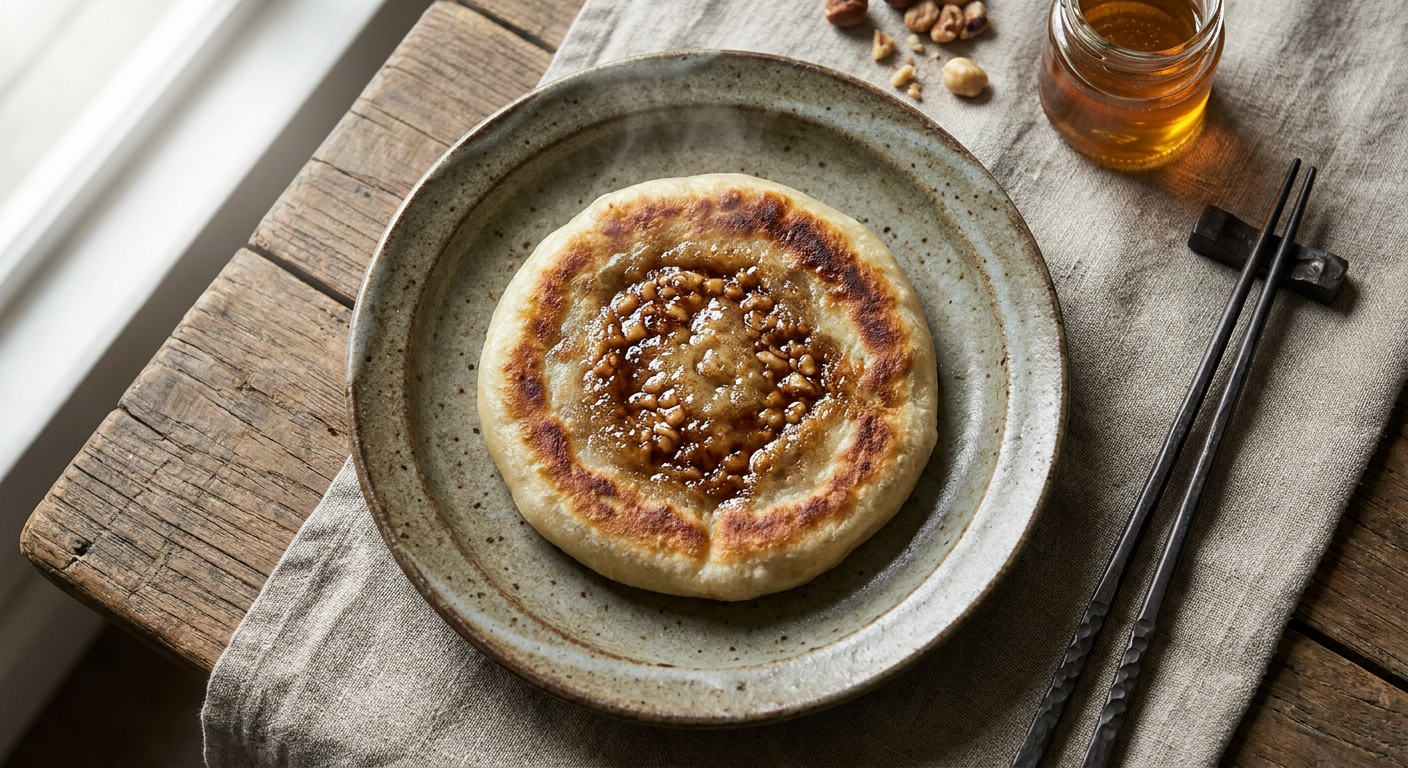
Hotteok — Korean sweet filled pancakes — is winter street food at its most beloved: a yeast dough flattened on a griddle until crisp, its molten heart of brown sugar, cinnamon, and nuts running out at the first bite. The name sounds like "ho-ddeok" and means, roughly, "barley cake" — no one is sure — but the thing itself needs no translation: hot, crisp, molten, gone in four bites.
Quantities live in the recipe card.
The dough
- or all-purpose in full, softer)
The filling
- the classic alternative)
The griddle
- a small pan bottom works)
- **Rise the dough, mix the filling.** The dough doubles in an hour and should be soft, slack, and slightly sticky — that slackness is what lets it flatten and stretch around the filling. Mix the filling in a bowl; portion it into 8 small piles for speed at the griddle.
- **The bridge:** glutinous rice flour (chapssal garu) gives the chew the street carts have; it is optional but excellent and sold in all Korean groceries. No bridge needed for anything else — sugar, cinnamon, nuts are already your pantry.
Hotteok
Prep: 20 minutes, plus 1 hour rising · Cook: 20 minutes · Total: About 1 hour 45 minutes · Makes 8 pancakes
Ingredients
The dough
- 250 g all-purpose flour; 50 g glutinous rice flour (the chew — or all-purpose in full, softer)
- 1 tsp instant yeast; 1 tbsp sugar (about 12 g); ½ tsp salt
- 200 ml warm water; 1 tbsp neutral oil
- Risen 1 hour, deflated, rested 15 minutes
The filling
- 80 g brown sugar (light or dark, or half palm sugar for depth)
- 1½ tsp cinnamon (about 4 g); a pinch of salt
- 40 g chopped walnuts or peanuts, or sunflower seeds; 1 tbsp sesame seeds
- (The modern street variants: cheese, or sweet red bean — the classic alternative)
The griddle
- Neutral oil, 2–3 mm in the pan; a flat spatula or a "hotteok press" (any flat, heavy object — a small pan bottom works)
Instructions
- **Shape around the filling.** With oiled hands, tear off a ball of dough (about 70 g), flatten it in your palm into a disc, place a spoon of filling in the center, and draw the edges up and pinch closed into a tight ball — the filling fully sealed inside. Checkpoint — the ball should be sealed with no sugar showing (leaking sugar burns on the griddle and welds the pancake to the pan) and slightly floppy — the slack dough is correct. Set seam-down on an oiled tray while you shape the rest.
- **Griddle, flatten, press (3–4 minutes a side).** Heat the oil in a pan over medium until it shimmers. Lay the balls seam-down with space between, let them fry 30 seconds, then press each flat with the spatula — firmly, to a disc about 1 cm thick and 8–10 cm across. Fry 2–3 minutes to deep golden, flip, press lightly again, and fry the second side 2–3 minutes more. Checkpoint — the pancake should be crisp and blistered deep gold on both faces, visibly puffed where the sugar boils inside — you may see a dark thread of molten sugar escaping (a small leak is character, a gush needs a tighter seal next time). The press is essential: the disc shape cooks the center before the outside burns.
- **Serve dangerously hot.** Straight from the pan onto a paper-lined tray, a brief warning to eager children, and into the hand. Checkpoint — eating test: the first bite cracks the crisp shell and releases the molten sugar-cinnamon-nut center — lava-hot, stretching in threads, the nuts' crunch riding the syrup. The contrast — shatter-crust, chew, molten core — is the entire dish. It should be eaten standing at the stove in winter, per tradition; seated at a table is a lesser but acceptable modern concession.
Troubleshooting
| Symptom | Cause | Fix |
|---|---|---|
| Sugar leaked, pancake welded to pan | Seal incomplete | Pinch the ball closed tightly; seam-down first |
| Center raw dough, outside burnt | Pressed too thick | Press firmly — 1 cm thick max |
| Dough dry, cracked | Not enough water or rise | Slack, sticky dough is the target |
Storage, Make-Ahead & Variations
- Made and eaten in the moment (reheat in a dry pan for 2 minutes per side — the microwave's rubber is refused); the dough keeps 1 day refrigerated after its first rise. - Variations: the red bean filling (the traditional alternative), the cheese-and-honey modern cart version. The fusion direction — #118's pandan waffles with miso butter — is the breakfast-table cousin, and the #150's affogato is dessert logic's other sealed surprise.