Jaew Bong
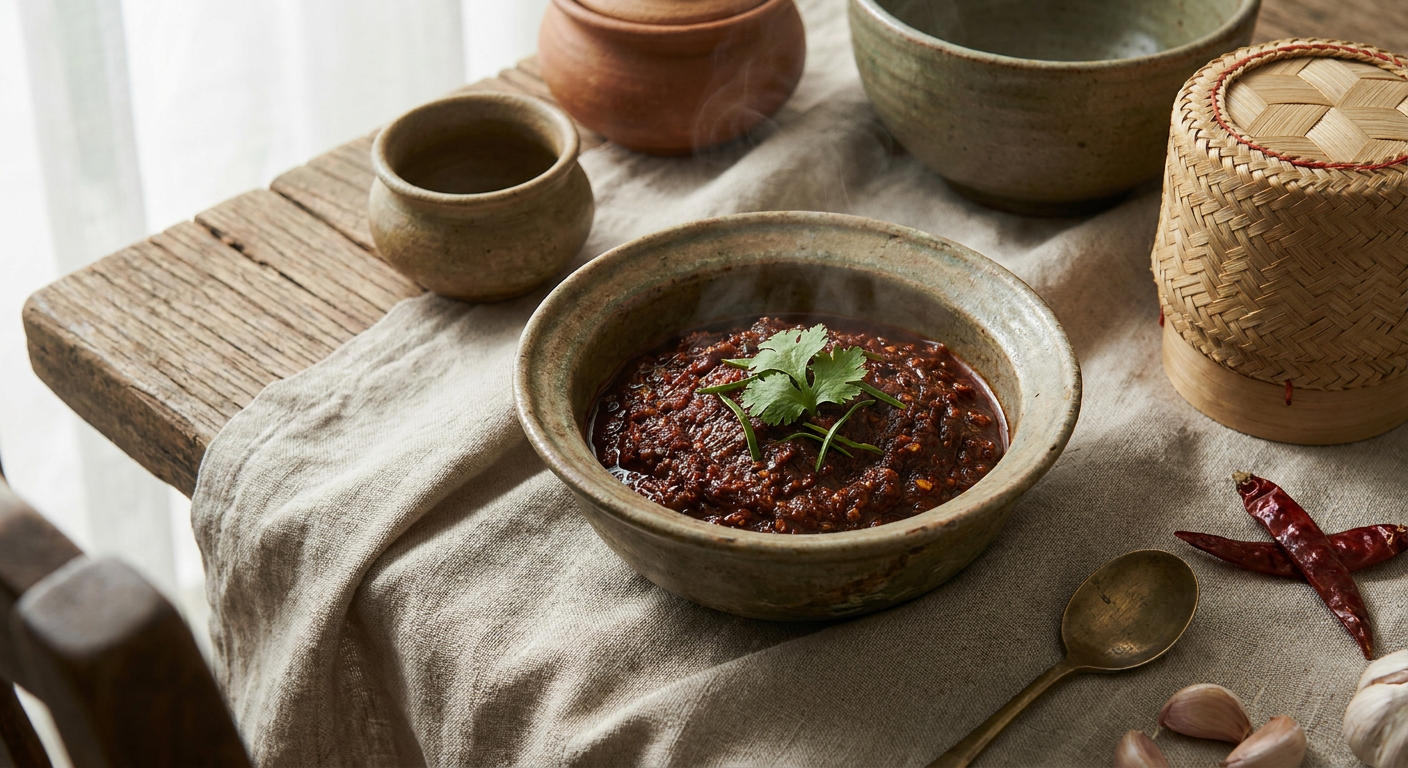
Jaew bong — Luang Prabang's sweet chili relish — is the Lao table's most loyal condiment: roasted chilies and shallots pounded with galangal and dried buffalo skin (in the traditional version; this recipe runs the vegetarian common variant), bound with a touch of palm sugar into a chunky, mahogany-red relish that is at once sweet, smoky, and gently hot. It sits on the table beside sticky rice and grilled everything (#81) for weeks, improving.
Quantities live in the recipe card.
The relish
- both roasted
- **Roast the aromatics dry.** Char the shallots and garlic in a dry pan (or under the broiler) until the skins blacken and the insides soften — 10–12 minutes — then peel. Roast the dried chilies in the same pan 1–2 minutes until fragrant and just darkened. This dry-roasting is the relish's depth; raw shallots make a sharp, one-note paste.
- **The bridge:** the dried buffalo skin is the authentic Luang Prabang chew; pork rinds (crushed at the end) are the honest bridge, or omit for the vegetarian version most home recipes run. The chilies: medium dried reds (New Mexico or similar) give the mahogany color and gentle heat; bird's eyes would make a hotter, thinner relish.
Jaew Bong
Prep: 10 minutes · Cook: 15 minutes · Total: About 25 minutes · Makes about 1 cup
Ingredients
The relish
- 8–10 dried red chilies (about 15 g), stems removed
- 4 shallots (about 120 g), unpeeled, and 1 head of garlic (about 30 g), halved — both roasted
- 1 tbsp chopped galangal (about 10 g); 1 tsp chopped lemongrass
- 2 tbsp palm sugar (about 25 g), grated; 1 tbsp fish sauce (about 15 ml)
- ½ tsp salt; optional: 20 g dried buffalo skin or pork rind, toasted and pounded in (the deep-tradition texture)
- 1 tbsp neutral oil
Instructions
- **Pound to a rough paste.** In a mortar (or a food processor with restraint), pound the roasted chilies, shallots, garlic, galangal, and lemongrass to a rough, slightly chunky paste — not a smooth puree. Checkpoint — the paste should be flecked and coarse — texture is part of the relish's identity. The color should be deep mahogany-red, and the smell roasted-sweet rather than sharp.
- **Cook it down with the sugar (8–10 minutes).** Heat the oil in a small pan, add the paste, and fry gently 3 minutes; add the palm sugar, fish sauce, and salt, and cook 5 more minutes, stirring, until the sugar melts in and the relish darkens and thickens to a jammy spoon-coating texture. Add the crushed rind or buffalo skin if using, cook 1 minute. Checkpoint — the finished relish should be dark, glossy, and thick — a spoonful mounds rather than pours. Taste: sweet first, then roasted chili heat, then salt — the sweetness is a genuine Lao signature (this is a sweet relish), and the fish sauce anchors it.
- **Cool and jar.** Cool completely, then jar and refrigerate. The flavor rounds and deepens over days. Checkpoint — eating test with sticky rice (#36) and grilled chicken (#81): a pinch of rice, a dab of jaew bong — sweet smoke and gentle heat against the neutral rice, and it will sit on the table for weeks, improving with every dip. It should taste like a condiment with a main character's confidence.
Troubleshooting
| Symptom | Cause | Fix |
|---|---|---|
| Relish sharp, one-note | Aromatics not roasted | Char the shallots and garlic fully |
| Too sweet, jam-like | Sugar over-run | The fish sauce balances — add by teaspoons |
| Texture pasty, flat | Over-processed | Pound coarse; the flecked texture is the identity |
Storage, Make-Ahead & Variations
- Keeps 3–4 weeks refrigerated in a sealed jar (the sugar-salt preserve it); the flavor improves in week one. Freeze indefinitely in spoons. - Variations: the buffalo-skin version (the Luang Prabang original), the hotter all-bird's-eye version, the tomato-jaew cousin. The fusion direction — #141's bloody mary and #138's aioli — both start with a spoon of this jar.