Jjajangmyeon
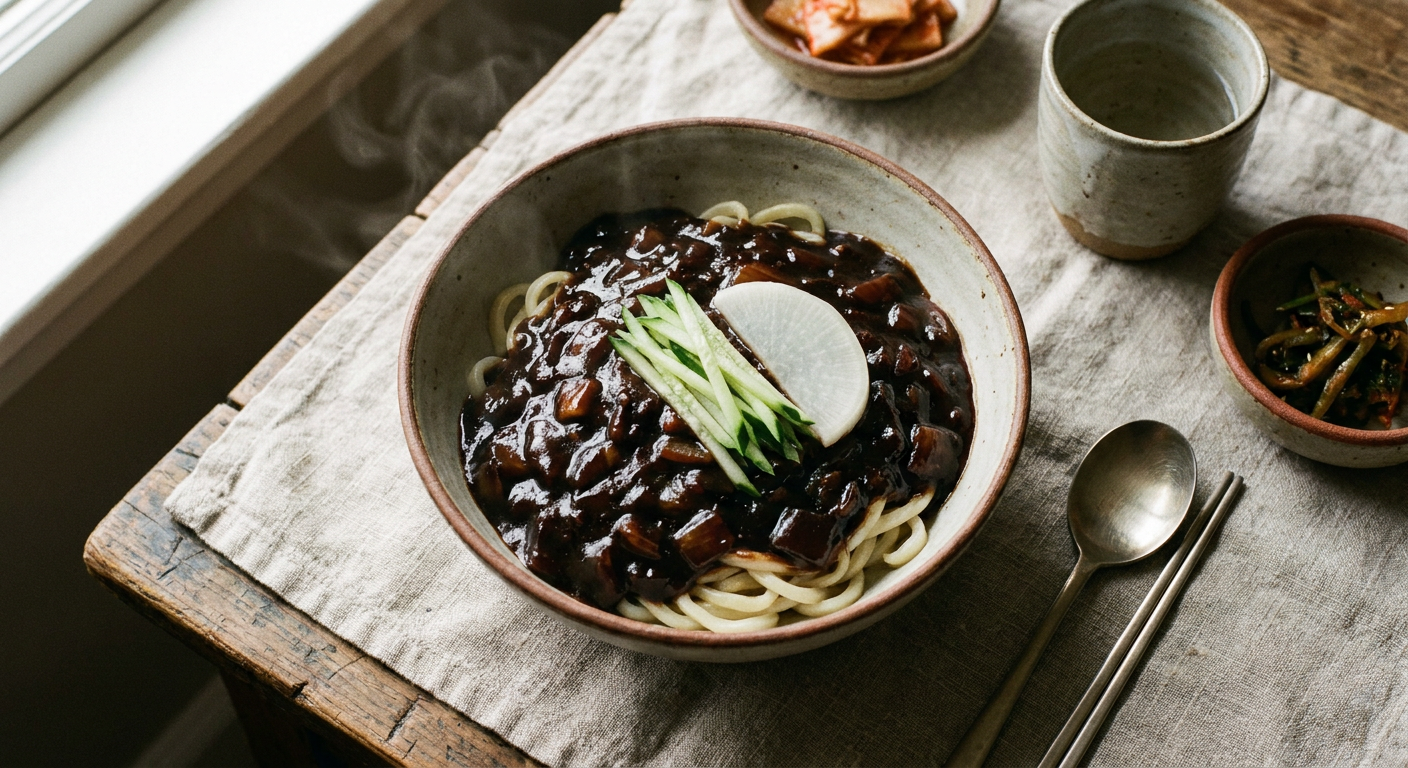
Quantities live in the recipe card.
The sauce
- the one non-negotiable)
- the Seoul style includes it)
The noodles
Doneness & Quality Checkpoints
- The paste: fried in fat before any liquid — the yakgun step.
- The sauce: glossy, spoon-coating, roasted-not-bitter, savory-sweet.
- The bowl: hot noodles, generous sauce, raw cucumber crown.
Jjajangmyeon
Prep: 20 minutes, plus 30 minutes sauce rest · Cook: 25 minutes · Total: About 1 hour 15 minutes · Serves 4
Ingredients
The sauce
- 200 g chunjang (Korean black bean paste — the one non-negotiable)
- 300 g pork belly or shoulder, diced small
- 1 onion (about 200 g), diced; ½ zucchini (about 100 g), diced; 1 potato (about 150 g), diced
- 2 tbsp neutral oil; 1 tsp sugar (about 4 g); 1 tsp sesame oil (about 5 ml)
- 300 ml water or stock; 2 tsp cornstarch or potato starch in 3 tbsp water (the glossy thickness)
- (Cabbage, about 100 g, is a traditional addition and divides opinion — the Seoul style includes it)
The noodles
- 4 portions fresh jjajangmyeon noodles or udon or thick wheat noodles (about 500 g), boiled to order
- Cucumber, julienned fine (about 80 g), for the classic raw topping
Instructions
- **Render the pork, fry the paste (6 minutes).** The pan at a solid medium — an oil surface around 150 °C — hot enough to fry the paste without scorching it. Brown the pork in the oil until its fat renders and the edges crisp, 4 minutes. Push the pork aside, add the chunjang to the fat, and fry it 2 minutes, stirring, until it darkens further and smells roasted. Checkpoint — the paste should sizzle in the fat and smell nutty-bitter in a promising way — the raw harshness cooking out. This is the sauce's foundation moment; unfried chunjang makes a sharp, unbalanced sauce.
- **Add the vegetables, then simmer (10 minutes).** Stir the onion, zucchini, and potato (plus cabbage if using) through the paste, add the water and sugar, and simmer at a lively bubble 8–10 minutes, until the vegetables are tender and the sauce has begun to thicken and darken. Checkpoint — the sauce should be reducing and the onion turning translucent-melting — the onion dissolves into sweetness that balances the bean paste's bitterness. Taste: savory, faintly sweet, deeply roasted — not bitter. If bitterness lingers, another minute of simmer plus a pinch more sugar.
- **Thicken to the gloss (2 minutes).** Stir the starch slurry and drizzle it in while stirring — the sauce should thicken immediately to a glossy, spoon-coating, dark-brown-black sauce. Off the heat, sesame oil. Checkpoint — the sauce's body is the dish's identity test: it should coat a lifted spoon heavily and close slowly — thick enough to cling to each noodle strand, loose enough to sauce, never paste. Too thick: a splash of water; too thin: more slurry, a teaspoon at a time.
- **Boil the noodles, sauce, crown.** Boil the noodles to order, drain hard, and portion into large bowls. Ladle the hot sauce generously over each, and crown with the raw cucumber. Checkpoint — eating test: the classic first bite is mixed — chopsticks lifting and folding the sauce through the noodles (the diner does the final mixing), the cucumber's cold crunch against the hot, glossy, savory-sweet noodles. It should taste deeper than it looks — the black is roasted grain and bean, not burnt — with the pork's richness through every strand. Eat fast; jjajangmyeon waits for no one.
Finish & Plate
One deep bowl per person, the sauce ladled in a generous pool (mixing is the diner's job), cucumber over. Danmuji (yellow pickled radish) alongside is the traditional sharp counter — the dish's official partner.
Troubleshooting
| Symptom | Cause | Fix |
|---|---|---|
| Sauce bitter | Paste not fried, or paste over-fried | The 2-minute fry window; a pinch of sugar |
| Sauce pasty, gluey | Over-thickened | Water by spoons to the coat-the-spoon body |
| Dish tastes flat | Vegetables skipped, or timid pork | The onion's sweetness is structural; render the pork fully |
Storage, Make-Ahead & Variations
- The sauce keeps 4 days (improves) and freezes 2 months; noodles always to order. The make-ahead sauce is the traditional weeknight format. - Variations: jjajangbap (over rice), the seafood version, the gan-jjajang (drier, stir-fried style). The fusion direction — #72's own story continues in the site's block at #130–135, where Korean flavors meet Western formats; this dish wrote the proof that it works.