Kaeng Naw Mai
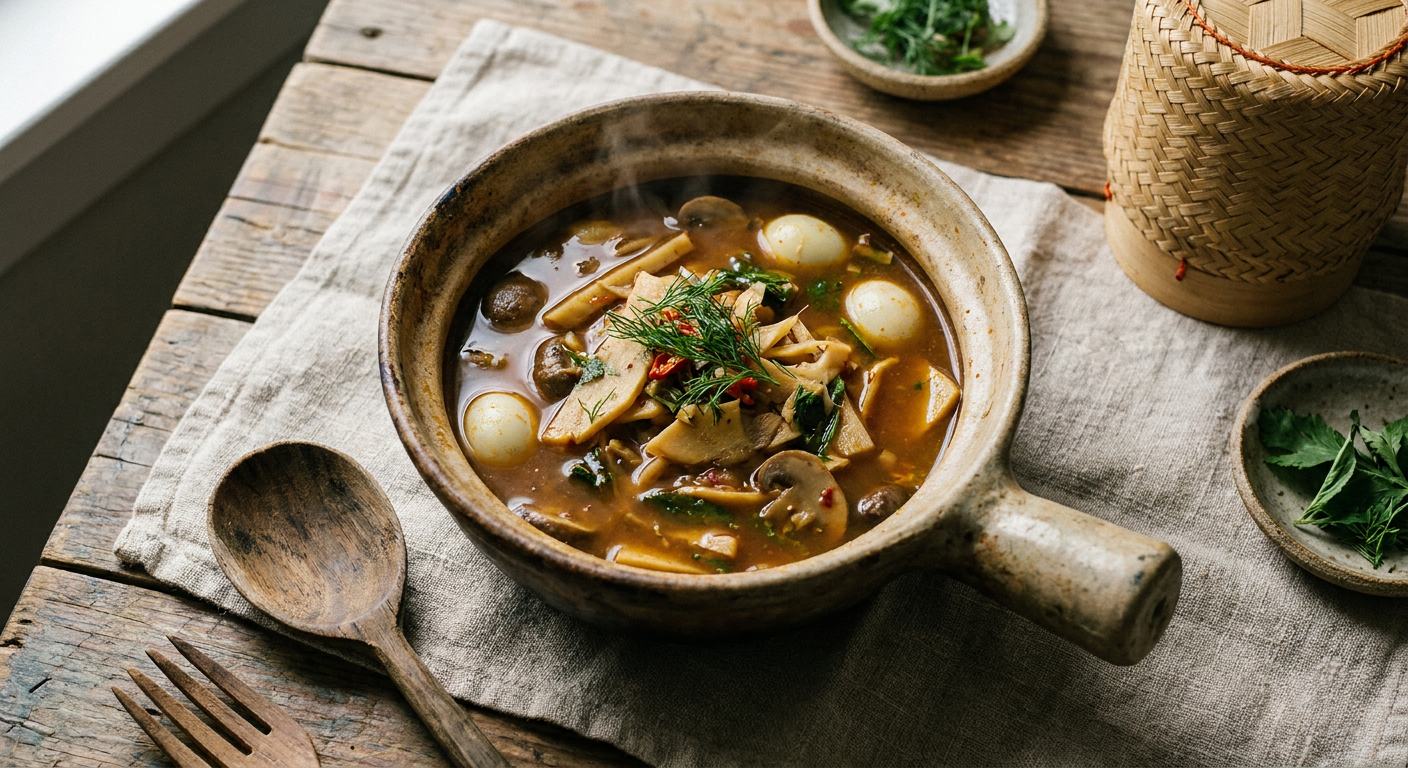
Kaeng naw mai — Lao bamboo soup — is the Mekong's homeliest and most distinctive daily soup: young bamboo simmered with yanang leaf juice (a forest green whose extract gives the soup its jade color and forest scent), fermented fish paste, and a little pork. It is rustic, faintly bitter, gently sour — the taste of the Lao countryside in a bowl, and the hardest dish on this site to bridge honestly.
Quantities live in the recipe card.
The soup
- sold frozen in Lao groceries) — the bridge below
- **Make the yanang extract.** Blend the frozen leaves with water and strain through a fine sieve — the liquid will be deep jade and smell of forest leaves. This extract is the soup's body and identity.
- **The bridge (the most honest one on this site):** yanang is not replaceable — its herbal bitterness and green extract are the soup. The two options: (1) find the frozen leaves (any Lao or Hmong grocery; they freeze well); (2) make a spinach-and-moringa version — thin, green, nourishing — and accept that you have made a cousin, not the soup. State which one you made; both feed people.
Kaeng Naw Mai
Prep: 15 minutes · Cook: 20 minutes · Total: About 35 minutes · Serves 4
Ingredients
The soup
- 300 g young bamboo shoots (canned or vacuum-packed; fresh if in season, boiled first), sliced thin
- 200 g pork ribs or pork belly, sliced thin
- 500 ml yanang leaf extract (from 50 g frozen yanang leaves, blended with 400 ml water and strained — sold frozen in Lao groceries) — the bridge below
- 300 ml water; 1 tbsp padaek or fish sauce (about 15 ml)
- 2 cloves garlic, smashed; 2 bird's eye chilies, bruised
- 100 g fresh or canned bamboo's liquid (for depth), or a splash more padaek
- 1 tomato (about 100 g), wedged; a handful of cilantro and spring onion to finish
Instructions
- **Simmer the pork and bamboo (15 minutes).** Bring the water and yanang extract to a gentle simmer with the pork, bamboo, garlic, and padaek. Simmer 15 minutes, until the pork is tender and the broth has taken the bamboo's flavor. Checkpoint — the broth should be a translucent jade — cloudy-green, not clear — and taste of the forest leaf first, fermented fish second, bamboo's faint bitterness third. The smell is the test: green, earthy, faintly wild.
- **Add the tomato and finish (5 minutes).** Add the tomato wedges and bruised chilies, simmer 3 minutes, and finish off the heat with cilantro and spring onion. Checkpoint — eating test with jasmine rice: the first spoonful is gentle and unfamiliar — the yanang's green bitterness riding over the padaek's funk, the bamboo's tender crunch, the tomato's small sweetness. It is an acquired taste the Lao acquire in childhood, and the honest record here is that the soup tastes of a place, and the place is worth tasting on its own terms. The bitterness is the point — the same way the #31's dill or the #78's sakhan are the point.
Troubleshooting
| Symptom | Cause | Fix |
|---|---|---|
| Broth gray, muddy | Blended the leaves too hot | Blend cold; strain fine |
| Bitterness overwhelming | Too much yanang, bamboo under-boiled | Balance the extract; boil fresh bamboo fully |
| Soup tastes thin | Padaek short | Fish sauce by spoons until depth arrives |
Storage, Make-Ahead & Variations
- Improves overnight — the bamboo and yanang deepen; keeps 3 days. The extract (strained) freezes 1 month in cubes. - Variations: with dried fish instead of pork, with mushrooms. The fusion direction is honest abstention: this soup stays home, and the site records it as the frontier it is.