Khao Piak Sen
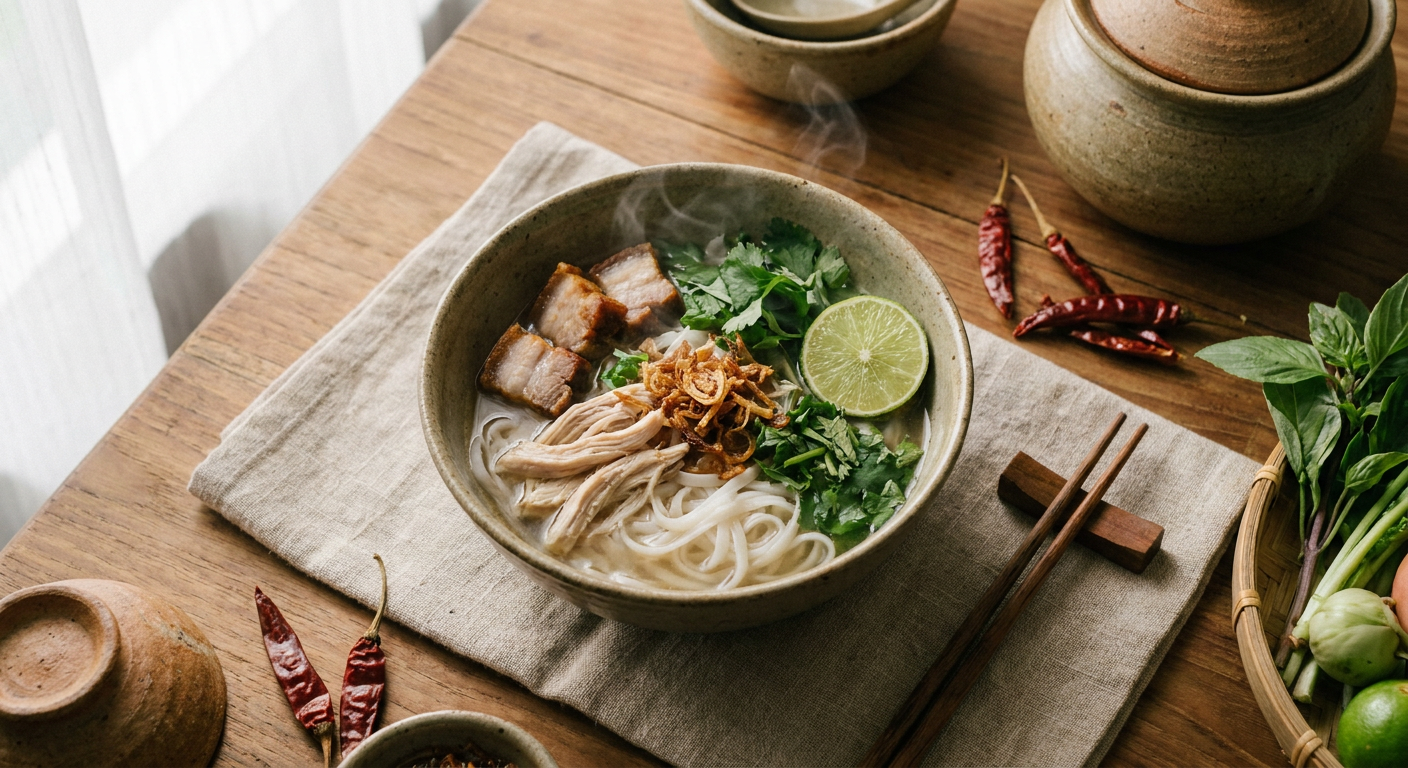
Quantities live in the recipe card.
The noodles (hand-made — the heart)
- the dough decides)
The broth
The bowls and table
Doneness & Quality Checkpoints
- The dough: boiling-water method, soft-earlobe texture, rested.
- The noodles: cut thick, cooked to glossy-soft with gentle chew.
- The broth: clear, ginger-garlic gentle, faintly thickened by the noodles' starch.
Khao Piak Sen
Prep: 40 minutes, plus 30 minutes resting · Cook: 30 minutes · Total: About 1 hour 45 minutes · Serves 4
Ingredients
The noodles (hand-made — the heart)
- 200 g rice flour; 100 g tapioca starch
- ½ tsp salt; 250 ml boiling water (approximately — the dough decides)
- The rice flour toasted dry 5 minutes first, until faintly fragrant (the chew's secret)
The broth
- 700 g chicken thighs and/or a chicken carcass, skin on
- 1 head garlic (about 30 g), halved crosswise; a 7 cm piece ginger (about 30 g), sliced
- 2 litres water; 1 tbsp fish sauce, plus more to finish; 1 tsp salt
- 1 stalk lemongrass, bruised (optional)
The bowls and table
- Fried garlic and its oil (the #40's method, 3 cloves); spring onion and cilantro, sliced
- Lime wedges; sliced chili in fish sauce; black or white pepper; bean sprouts (about 100 g)
Instructions
- **Make the noodle dough (15 minutes plus rest).** Stir the hot water into the toasted flours and salt with a chopstick until cool enough to touch, then knead 5 minutes to a smooth, soft, non-sticky dough — add water by the teaspoon if it crumbles, tapioca by the teaspoon if it sticks. Rest, covered, 30 minutes. Checkpoint — the dough should feel like a soft earlobe — pliable, warm, elastic without being sticky. This is the same softness gauge as the tang yuan (#121 on the sister site) dough family: trust the touch test.
- **Roll and cut (15 minutes).** Roll the dough on a tapioca-dusted surface to 3–4 mm — thicker than pasta, intentionally — and cut into short, fat noodles 1 cm wide and 6–8 cm long. Toss the cut noodles in tapioca starch so they don't stick. Checkpoint — the noodles should look rustic and thick — they will swell further in the broth and turn dumpling-soft. Uniformity matters less than thickness: thin noodles over-cook to mush in this dish.
- **Simmer the broth (30 minutes).** The water held at a gentle bubble — about 95 °C, the surface barely moving — through the whole simmer. Simmer the chicken, garlic, ginger, lemongrass, and salt in the water at a gentle bubble 30 minutes, until the chicken is tender. Lift the chicken, shred or cut its meat, and return it to the pot. Season with fish sauce — the broth should taste gentle, clear, ginger-warm, and just fully salted. Checkpoint — this is a clear, soothing broth — no chili, no oil — the Lao equivalent of chicken soup for colds. The garlic halves melt to a whisper; the ginger carries. Do not let it boil hard and cloud.
- **Cook the noodles in the broth (3–4 minutes).** Drop the fresh noodles into the simmering broth and cook 3–4 minutes, until they float and turn glossy-translucent and soft-chewy. They will thicken the broth slightly with their starch — that faint body is authentic and intended. Checkpoint — eating test: a bowl with noodles, broth, chicken, fried garlic and oil, cilantro, and a hard pinch of pepper — the first slurp is the texture's revelation: fat, slippery-soft noodles with a gentle chew, in a broth that tastes of chicken and ginger and nothing hiding. The lime and chili sauce sharpen it to taste. This is a bowl that cures homesickness for a country you have never visited.
Finish & Plate
One deep bowl per person — noodles, chicken, broth, garlic oil, herbs — the lime and chili sauce at the table. Breakfast, lunch, or the late-night bowl; khao piak sen keeps Lao hours.
Troubleshooting
| Symptom | Cause | Fix |
|---|---|---|
| Noodles mushy, dissolving | Rolled thin, over-boiled | 3–4 mm thickness; 3–4 minutes |
| Dough crumbly, won't hold | Under-hydrated or under-kneaded | Water by teaspoons; knead to smooth |
| Broth cloudy and dull | Boiled hard | The gentle bubble, always |
Storage, Make-Ahead & Variations
- The broth keeps 3 days; noodles are cooked to order (the cut raw noodles hold 1 day refrigerated under a damp cloth — or freeze floured on a tray). Leftover soup thickens overnight — thin with water and re-season. - Variations: the beef version, the version with blood cake (the traditional market bowl). The fusion direction — these noodles in the #5's tonkotsu — is a mashup of soft and springy chew that the site's noodle logic endorses.