Khao Poon
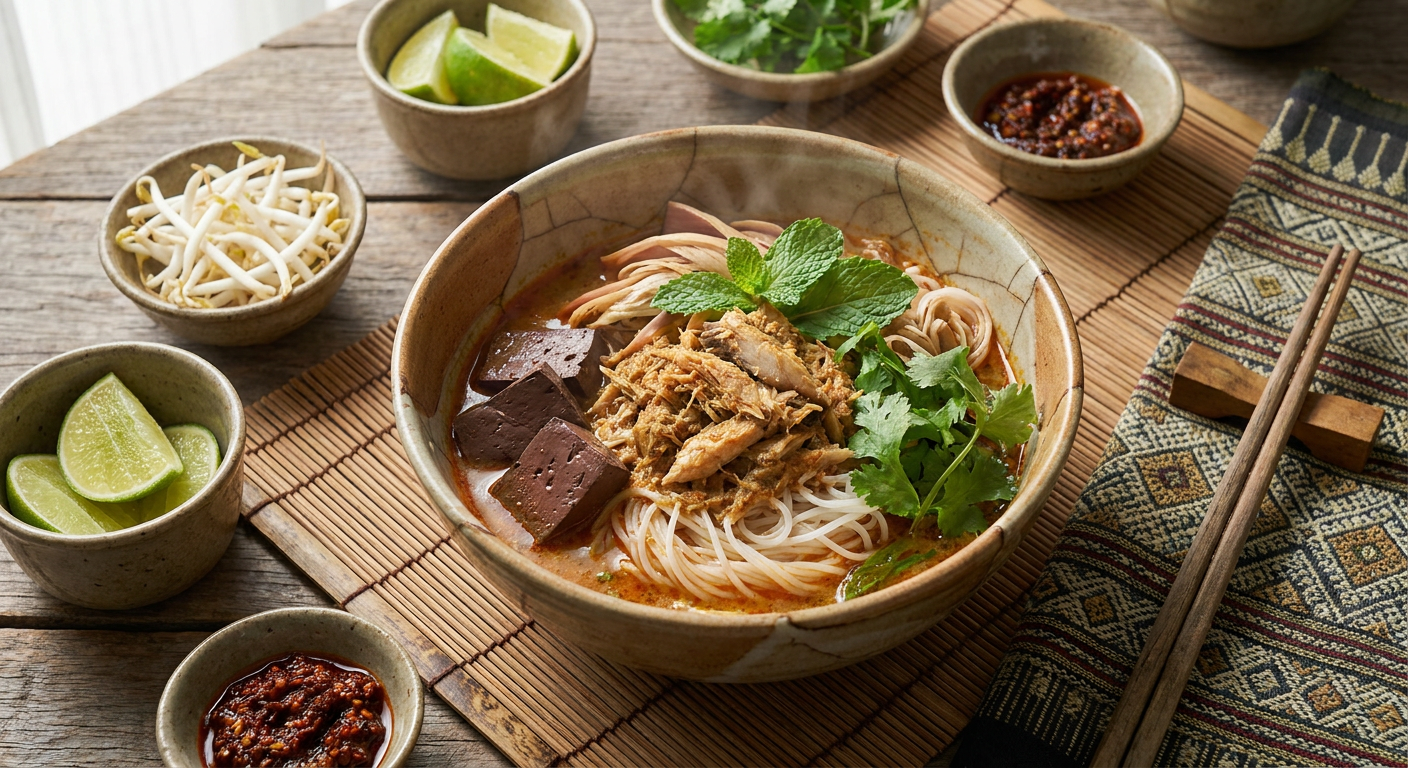
Khao poon — Lao coconut noodle soup — is the festive bowl of Lao celebrations: rice vermicelli in a coconut-red curry broth loaded with chicken (or fish), pound upon pound of fresh herbs, and the signature Lao finish of raw vegetables and lime at the table. It is khao soi's (#2) gentler cousin — no fried-noodle crown, no crispy layer, all broth — and the herbs are not garnish but a second soup living inside the first.
- **Fry the paste in the thick cream first.** The khao soi law (#2) runs here: crack the coconut cream, fry the curry paste in the split oil until fragrant, then build. The khao poon difference comes after — the broth runs thinner, the coconut lighter, and the herbs heavier.
- **The bridge:** banana blossom is a bonus texture (shredded cabbage bridges); the herb trio's dill and culantro are the Lao signature — see the #78's notes. The padaek is optional depth; fish sauce carries the recipe honestly.
Doneness & Quality Checkpoints
- The base: cracked cream, fried paste, the red-orange streak.
- The broth: thinner than khao soi's, coconut-gentle, just under-seasoned.
- The table: the herb mountain is the recipe's second half.
Khao Poon
Prep: 35 minutes · Cook: 45 minutes · Total: About 1 hour 25 minutes · Serves 4–6
Ingredients
The broth
- 500 g chicken thighs, bone-in, or 500 g firm fish chunks
- 400 ml coconut milk (one can, cream and liquid together)
- 3 tbsp red curry paste (#43's recipe or store)
- 2 stalks lemongrass (about 60 g), bruised; 4 makrut lime leaves, torn
- 1 tbsp fish sauce (about 15 ml), plus more to finish; 1 tsp palm sugar
- 600 ml chicken stock or water; 1 tbsp padaek or fish sauce
The noodles and table
- 300 g dried rice vermicelli (the thin ones), soaked and briefly boiled (about 75 g dry per serving)
- Banana blossom or shredded cabbage (about 100 g); bean sprouts (about 100 g)
- A mountain of herbs: mint, cilantro, and the Lao trio if findable — dill (about 20 g), sawtooth herb (culantro, about 10 g), and Thai basil (about 15 g) — the bowl's green half
- Lime wedges; sliced chilies; the #87 jerky crumbled over, optional and traditional
Instructions
- **Crack, fry, build (10 minutes).** Simmer the thick coconut cream in a pot until it splits and glistens, fry the curry paste in it 2–3 minutes until darkened and fragrant, then add the chicken and turn to coat. Checkpoint — the paste should fry in visibly split oil — red-orange streaks, roasted fragrance. This fried foundation is what separates khao poon from a coconut soup with paste stirred in.
- **Simmer the broth (30 minutes).** The coconut broth held at a gentle bubble — about 95 °C — never a rolling boil (which would split the coconut). Add the stock, the remaining coconut milk, the bruised lemongrass, lime leaves, fish sauce, and palm sugar. Simmer gently until the chicken is tender (25–30 minutes), lifting it to shred when done. Season the broth — coconut-rich, gently spicy, salted to just past comfort. Checkpoint — the broth should be a light orange-brown, noticeably thinner than khao soi's — pourable, soupy, drinkable. Taste: coconut first, curry warmth behind, salt and a whisper of palm sugar. It should taste one notch under-seasoned — the lime and herbs at the table finish it.
- **Assemble the bowls and the herb mountain.** Vermicelli in each bowl, shredded chicken over, ladle of broth over that. The herbs, raw vegetables, sprouts, lime, and chilies go to the table in piles — each diner finishes their own bowl with a small garden's worth. Checkpoint — eating test: the first slurp is coconut-warm and gentle; then you add the herbs — mint and dill by the fistful, a squeeze of lime, some bean sprouts — and the bowl transforms from a curry soup to something green, fresh, and alive between sips. The herbs are not on the soup; they are in it, in every spoonful, by design. That is the Lao bowl's whole idea: the broth warms, the garden refreshes, and the meal holds both at once.
Finish & Plate
Bowls of noodles and broth, the herbs and vegetables in the center, lime and chilies beside — each bowl customized to the diner's hand. The celebration format feeds a crowd from one pot and one garden.
Troubleshooting
| Symptom | Cause | Fix |
|---|---|---|
| Broth heavy, khao soi-like | Coconut over-run, reduced too far | The thinner pour is the target; stock to loosen |
| Paste taste raw | Not fried in split cream | The crack-and-fry law — 3 full minutes |
| Bowl tastes flat before herbs | By design — the herbs finish it | Trust the table's half; add lime first |
Storage, Make-Ahead & Variations
- Broth keeps 3 days (improves); noodles and herbs always fresh. The fish version (khao poon nam pa) runs the same clock with fish chunks in the last 8 minutes. - Variations: the fish version, the extra-padaek deep version. The fusion direction — #142's khao poon bouillabaisse — carries this broth to the Mediterranean, and the site's block built the bridge deliberately.