Khao Poon Bouillabaisse
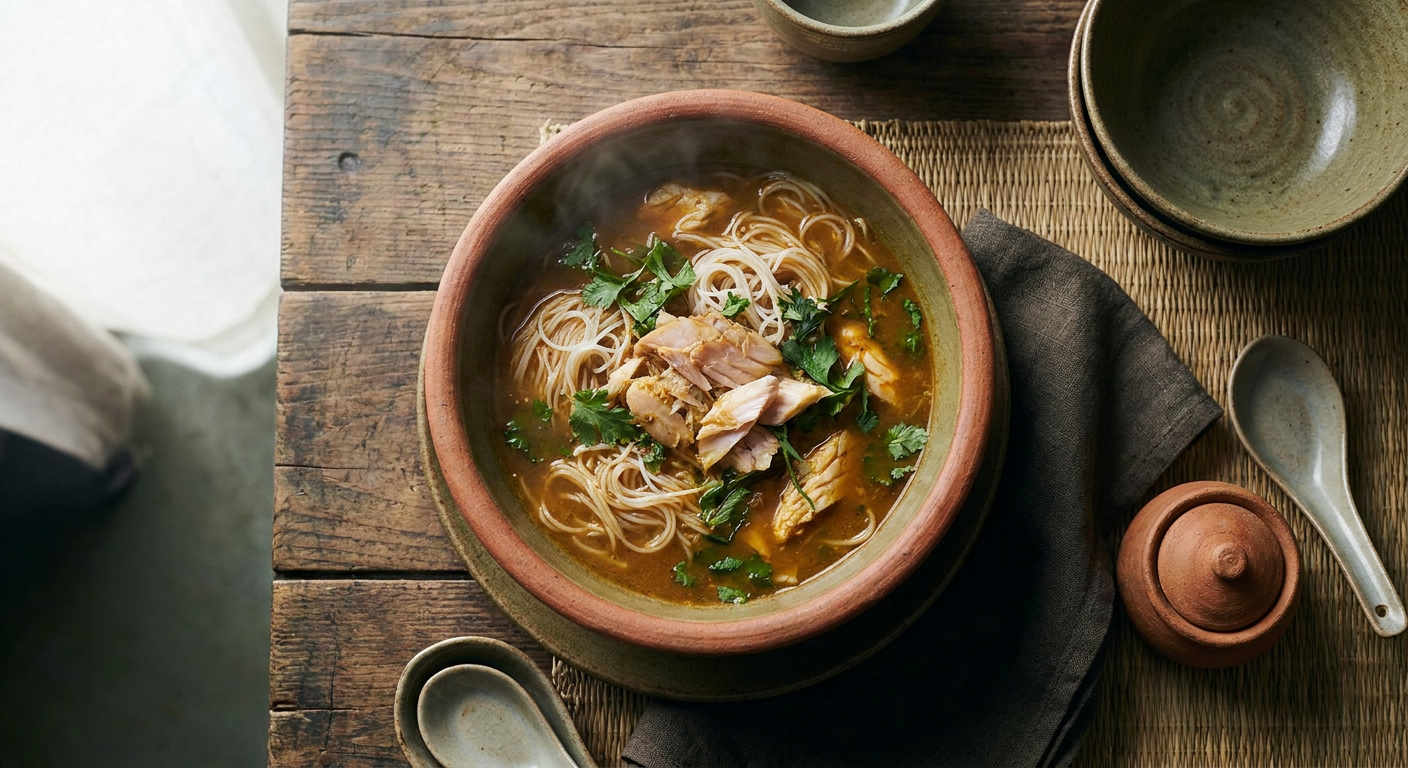
Khao poon bouillabaisse is the block's grandest meeting: Marseille's fish stew — saffron, fennel, tomato, the rouille — built on the Lao #88's coconut-curry broth, with rice vermicelli where the baguette was and the #88's herb mountain where rouille's croûtes stood. Two seafood-stew traditions, both built on the same instincts (aromatics, tomato, fish stock, patient simmer), finding they had more in common than either expected.
Quantities live in the recipe card.
The stock
- simmered 30 minutes, strained
The stew (both parents present)
The rouille (kept, translated)
- a chili mayonnaise in the rouille's role
To serve
- **The stock is the project — fish bones and shrimp shells, 30 minutes, strained.** Both parent cuisines agree on this law entirely; the block merely inherits it.
- **The bridge:** saffron is the one luxury (a pinch, steeped — its presence is Marseille's vote); the red curry paste is the Lao-Thai vote, and the coconut milk the broth's merger. The rouille's bridge is honest: a curry-paste aioli, the #138's kin.
Doneness & Quality Checkpoints
- The stock: bones and shells, 30 minutes, strained.
- The braid: saffron-fennel and curry-coconut both legible in one spoonful.
- The seafood: pulled at the mussels' opening, finished in the bowl.
Khao Poon Bouillabaisse
Prep: 40 minutes · Cook: 45 minutes · Total: About 1 hour 30 minutes · Serves 4
Ingredients
The stock
- 500 g fish bones and shrimp shells (saved from the seafood below), or 1 litre good fish stock
- 1 onion (about 150 g), 1 carrot (about 100 g), a stalk of celery; 4 parsley stems; 1 litre water — simmered 30 minutes, strained
The stew (both parents present)
- 800 g mixed seafood: white fish chunks, shrimp, mussels, or a small cleaned crab
- 3 tbsp oil; 1 fennel bulb (about 200 g), sliced; 1 onion (about 150 g), sliced; 4 cloves garlic (about 15 g)
- 2 tbsp red curry paste (the #43/#88's); a pinch of saffron, steeped in 3 tbsp warm water
- 400 g tomatoes, crushed (or 1 can); 200 ml coconut milk
- 1 tbsp fish sauce (about 15 ml); 1 tsp sugar; 1 orange peel strip (bouillabaisse's secret, kept)
- The #88's finish: a handful each dill, mint, and cilantro (about 15 g each)
The rouille (kept, translated)
- 1 egg yolk; 100 ml oil; 1 clove garlic; 1 tsp red curry paste or gochugaru; a squeeze of lime — a chili mayonnaise in the rouille's role
To serve
- 300 g rice vermicelli, soaked and briefly boiled; lime wedges; the rouille stirred into each bowl by the diner
Instructions
- **The aromatic base (10 minutes).** In a wide pot, soften the fennel, onion, and garlic in the oil over medium — 8 minutes, translucent and sweet. Add the curry paste and fry 2 minutes in the oil until fragrant, then the saffron with its water, the tomatoes, the orange peel, and the strained stock. Checkpoint — the base should smell of both ports at once: fennel and saffron rising over the curry paste's lemongrass — the fusion's whole argument, forming in one pot.
- **The simmer (25 minutes).** Simmer gently — the broth at a bare tremble, roughly 95 °C — for 20–25 minutes until the tomatoes have collapsed and the broth is a deep orange-gold; add the coconut milk and simmer 5 minutes more. Season with fish sauce and sugar — one notch under-salted (the shellfish add). Checkpoint — the broth should be a satiny orange — bouillabaisse's saffron-gold deepened by the curry's red — and taste of the sea first, then fennel and saffron, then the coconut's round and the curry's warmth arriving late. The two stews' signatures should braid, not blend.
- **The seafood's quick bath (5–6 minutes).** Raise the heat; add the firm fish first, the mussels and shrimp in the last 3 minutes, and cook just until the mussels open and the shrimp curl. Checkpoint — the #106's law: pull the pot the moment the shellfish open; the seafood finishes in the heat of the bowl. Overcooking the seafood is the one way to fail this dish, and both cuisines agree on that too.
- **The bowls: noodles, stew, herbs, rouille.** Vermicelli in each bowl, the stew ladled over, the herbs scattered (the #88's mountain, unabridged), the rouille in a spoon at the side — each diner stirs it in to their own strength. Checkpoint — eating test: the first spoonful is the braid — saffron-fennel and coconut-curry over the sweet seafood, the vermicelli drinking the broth, the herbs' green arrival, and the rouille stirred in adding its garlic-chili cream. The lime finishes. It should taste like two of the world's great fish stews discovering they were always close — and the diner holds the meeting.
Finish & Plate
Deep bowls, the herbs falling into the steam, the rouille spoon beside each, limes at the table. A spoon and chopsticks both — the block's most bilingual table setting, for its most bilingual pot.
Troubleshooting
| Symptom | Cause | Fix |
|---|---|---|
| Broth tastes single-note | One parent's aromatics shorted | Both signatures, checked at the simmer |
| Seafood overcooked | Boiled instead of bathed | The last-3-minutes law, mussels as the clock |
| Rouille dominates | Over-stirred in | The diner's spoon, not the pot |
Storage, Make-Ahead & Variations
- The broth base keeps 3 days; seafood and noodles to order; the rouille keeps 3 days refrigerated. The block's #88 and the #89 are the parents; this recipe is their port call. - Variations: the crab-rich version, the saffron-doubled. The fusion block's grand-meeting seats: #113, #123, and this.