Northern Khao Soi
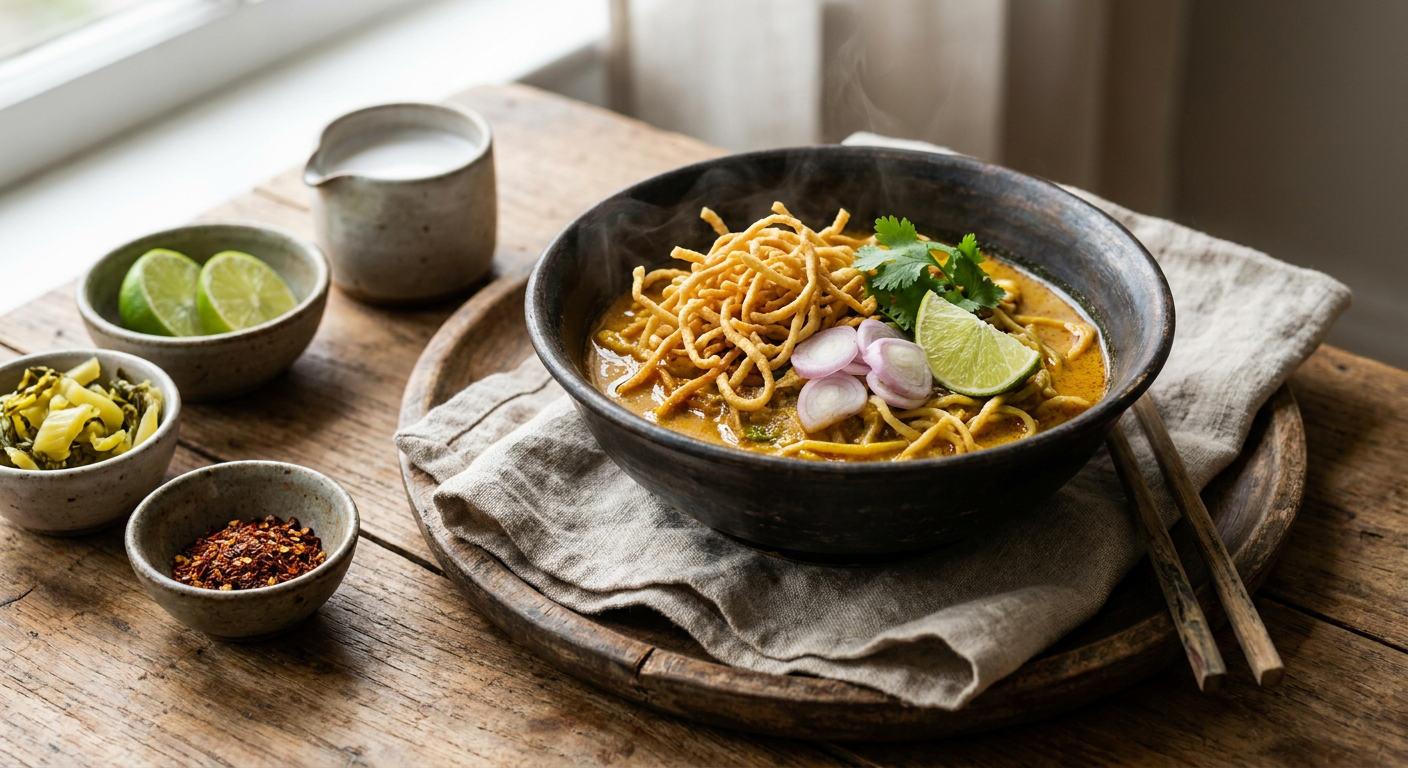
Quantities live in the recipe card.
The curry base
- a Chinese-Thai inheritance)
Homemade paste (optional but worth it)
- pounded to a paste in a mortar
The noodles
The garnish plate (never optional)
Doneness & Quality Checkpoints
- The cream: visibly split, oil glistening.
- The paste: fried to roasted fragrance, never raw-scented.
- The broth: orange, lightly coat-the-spoon, saltier than the final target.
- The bowl: all four textures present in the first bite.
Northern Khao Soi
Prep: 30 minutes · Cook: 1 hour · Total: About 1 hour 30 minutes · Serves 4
Ingredients
The curry base
- 400 ml coconut cream (two 400 ml cans of full-fat coconut milk, chilled — scoop the thick cream, about 200 g per can, off the top)
- 3 tbsp homemade khao soi paste (below) or 4 tbsp good Mae Ploy yellow curry paste
- 500 g chicken thighs (about 350 g boneless weight), bone-in, cut through the joint into pieces
- 2 tbsp fish sauce (about 30 ml), plus more to taste; 1 tbsp palm sugar (about 15 g) or dark brown sugar
- 500 ml chicken stock
- 1 tsp curry powder (the unexpected, authentic ingredient — a Chinese-Thai inheritance)
Homemade paste (optional but worth it)
- 6 dried red chilies (about 10 g), rehydrated; 3 shallots (about 90 g), 4 garlic cloves (about 15 g), 1 tbsp chopped galangal, 1 tsp chopped ginger, 1 stalk lemongrass (bottom third), 1 tsp coriander seed, ½ tsp cumin seed, ¼ tsp turmeric powder — pounded to a paste in a mortar
The noodles
- 300 g fresh wheat egg noodles (or medium dried), boiled to just past al dente
- A handful of the same noodles, deep-fried in 180 °C oil until golden, for the crisp top
The garnish plate (never optional)
- Lime wedges, pickled mustard greens (or quick-pickled cabbage), thinly sliced shallots, fresh cilantro
Instructions
- **Split the cream (10 minutes).** Simmer the thick coconut cream in a wide pot until it thickens and the oil begins to separate and glisten on the surface — about 8–10 minutes over medium heat. Checkpoint — you should see visible pools of clear oil around the edges of the cream. This "cracking" is the flavor foundation: the curry paste fry in real fat, not water. If your coconut milk refuses to split, keep reducing — low-fat cans are the usual culprit.
- **Fry the paste (5 minutes).** Lower the heat, add the curry paste (plus the curry powder), and fry it in the cracked cream, stirring constantly, until it darkens and smells roasted rather than raw. Checkpoint — the paste should sizzle quietly and coat the spatula in a brick-red, fragrant oil. Raw paste smells sharp and vegetal; fried paste smells deep and slightly sweet. This is the single biggest flavor difference between home and restaurant versions.
- **Build the broth (45 minutes).** Add the chicken pieces and turn to coat. Pour in the stock and the remaining thinner coconut milk, add fish sauce and palm sugar, and simmer gently until the chicken is tender and the broth is a rich, uniform orange, about 40–45 minutes. Taste — it should be salty first, then coconut-rich, then warming-spice sweet. Checkpoint — the chicken thigh joint should slip easily from a chopstick twist, and the broth should coat a spoon lightly. Season it slightly saltier than you want the finished bowl — the noodles will absorb and dilute.
- **Assemble the bowls.** Boil the fresh noodles. In each bowl: a nest of soft noodles, ladle of broth with a chicken piece, then a generous crown of the fried crispy noodles. Serve with the whole garnish plate alongside. Checkpoint — the first bite should have all four textures in it: soft noodle, crispy noodle, tender chicken, and a crunch of pickled mustard with lime. The crispy noodles slowly soften into the curry as you eat — the dish is designed to change as you go.
Finish & Plate
One chicken piece and a generous ladle per bowl, crispy noodle crown pushed down slightly at one edge so it soaks on one side and stays crisp on the other. The garnish plate goes in the middle of the table — each diner adds lime, pickles, and shallot bite by bite.
Troubleshooting
| Symptom | Cause | Fix |
|---|---|---|
| Broth thin and separated | Cream never split, paste water-fried | Reduce harder at step 1; use full-fat coconut milk |
| Tastes flat despite good paste | Missing salt-sour balance | More fish sauce, then a harder squeeze of lime at the table |
| Crispy noodles gone instantly | Crowned too deep in hot broth | Keep the crown above the surface; press only one edge |
Storage, Make-Ahead & Variations
- The broth improves overnight and keeps 3 days refrigerated; fry the crispy noodles fresh each serving or hold them in a low oven. Boil noodles to order. - Beef shank or braised beef substitutes for chicken (extend simmer to 90 minutes); a vegetarian version on roasted mushrooms and light soy still delivers with the same garnish discipline. The leftover broth, unstretched, is one of the best braising liquids on this site.