Kimbap
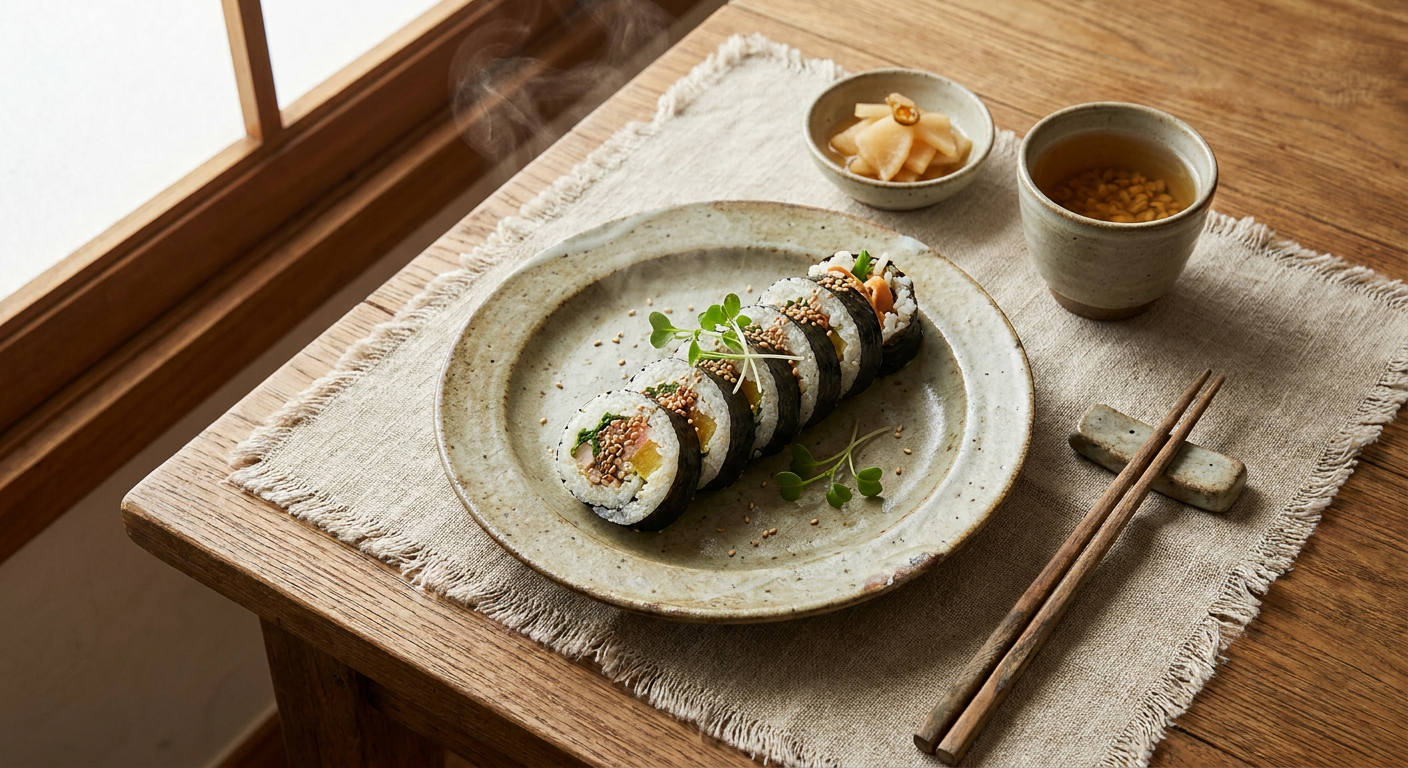
Kimbap — Korean seaweed rice rolls — looks like sushi's sibling and eats like a complete picnic lunch: seasoned rice rolled with cooked fillings (spinach, carrot, egg, pickled radish, bulgogi or fish cake, ham) in seaweed, sliced into neat coins. Where sushi rice is vinegared, kimbap rice is sesame-oiled — a different flavor spine — and the fillings are all fully cooked, making it the lunchbox and picnic and beach-day food of Korea.
Quantities live in the recipe card.
The rice
The fillings (each cooked and seasoned separately — the #58 law)
The rolls
- **All fillings cooked, seasoned, and cooled before rolling.** Kimbap's fillings are each complete dishes in miniature — the egg sheet salted, the spinach dressed — and the rice is sesame-seasoned, never vinegared. Line everything up in strips: the roll is an assembly.
- **The bridge:** danmuji (yellow pickled radish) is in every Korean grocery and its sweet-tart crunch is the classic spine of kimbap; quick-pickled radish or carrot bridges. The mat helps but hands roll kimbap fine — Korean home kitchens commonly skip it.
Kimbap
Prep: 50 minutes · Cook: 20 minutes · Total: About 1 hour 15 minutes · Makes 4 rolls (16–24 pieces)
Ingredients
The rice
- 300 g short-grain rice, cooked with 330 ml water; while hot, seasoned with 1½ tbsp sesame oil (about 20 ml), ¾ tsp salt, 1 tsp toasted sesame seeds
- Cooled to just above room temperature
The fillings (each cooked and seasoned separately — the #58 law)
- 3 eggs (about 150 g), beaten with a pinch of salt, fried into a thin sheet, sliced into strips
- 100 g spinach, blanched, squeezed, dressed with a few drops of sesame oil and salt
- 1 carrot (about 100 g), julienned, stir-fried 2 minutes with a pinch of salt
- 100 g pickled radish (danmuji, the yellow jar) or quick-pickled burdock, in strips
- 150 g bulgogi (#59's, cooked) or fish cake strips or ham, lightly pan-fried
- Optional: 50 g seasoned fish cake (eomuk bokkeum) or a few slices of American cheese (the school-lunch tradition)
The rolls
- 4 sheets of dried seaweed (gim), the toasted kind
- A bamboo mat (helpful, not mandatory); sesame oil for the final sheen and the knife
Instructions
- **Lay the rice, leave the border.** On each sheet of seaweed (shiny side down), spread about 150 g of rice in an even layer across two-thirds of the sheet, leaving a 2 cm bare strip at the top edge and a thin edge of rice at the bottom — the seal. Checkpoint — the rice layer should be thin and even — about 5 mm — thick rice bursts the roll and overwhelms the fillings. Wet or oiled fingers keep it from sticking to your hands.
- **Fill the center line and roll tight.** Lay the filling strips in a horizontal line across the rice's center — egg, spinach, carrot, radish, meat — one neat row, not piled. Lift the near edge, fold over the fillings, press gently to compact, and continue rolling to the far edge, tightening as you go; the bare strip seals with a dab of water or the rice's stickiness. Checkpoint — the roll should be firm and uniform — gentle, even pressure throughout (the mat's job if used). A loose roll falls apart at slicing; too-tight squeezes the fillings out the ends. The seal should hold without visible seam gaps.
- **Sheen, rest, slice.** Brush the finished roll lightly with sesame oil, sprinkle sesame seeds, and rest 2 minutes (the oil softens the seaweed's crackle into sliceable suppleness). Slice into 1.5–2 cm coins with an oiled knife, wiping and re-oiling between cuts. Checkpoint — eating test: each coin shows the spiral — rice's sesame first, then the fillings' textures in sequence: egg's soft, spinach's earth, carrot's sweet, radish's crunch, meat's savor. It should taste complete and gentle — a portable meal, not a snack — and the coins hold their shape in the hand. Pack them for lunch the next day; kimbap is the tradition that made the lunchbox an art form.
Troubleshooting
| Symptom | Cause | Fix |
|---|---|---|
| Roll bursts or gaps | Overfilled or over-stuffed rice | Thin rice, one line of fillings |
| Slices crush, deform | Cut with a dry knife | Oil the blade, wipe between cuts |
| Seaweed tough, chewy | Cut immediately, no rest | The 2-minute sesame-oil rest softens it |
Storage, Make-Ahead & Variations
- Best the day made; refrigerated, the rice hardens — revive at room temperature or a brief toaster-oven pass. The components keep 1 day separately for a fresh roll. - Variations: chamchi kimbap (tuna salad), cheese kimbap (the kids' classic), kimchi kimbap, the triangle gimbari snack format. The fusion direction — #119's cha ca fish tacos borrows the hand-held complete-meal logic — and the site's #148 neighborhood continues it.