Kitsune Udon
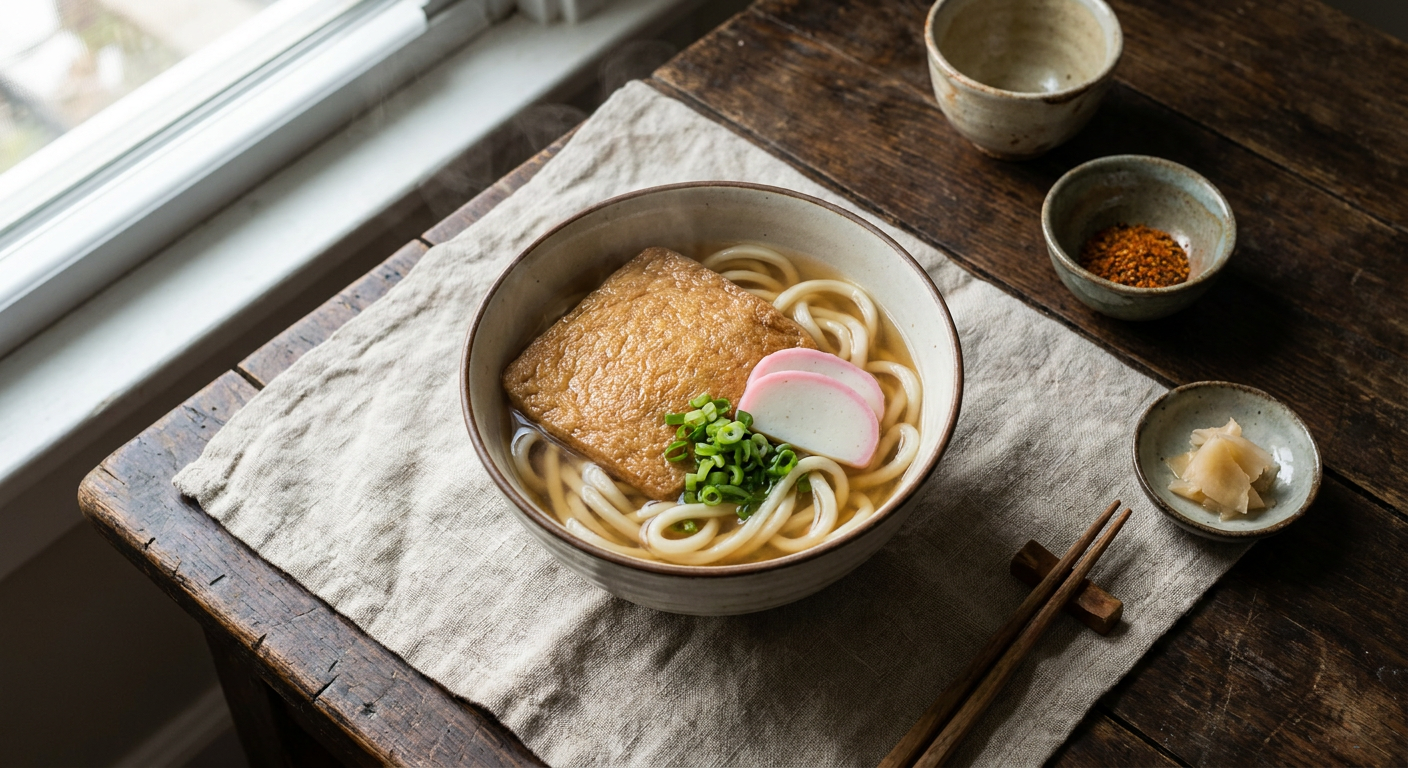
Kitsune udon — "fox udon" — is thick wheat noodles in hot dashi broth, topped with sweet simmered fried tofu (aburaage). The fried pouch's story is the fox who loves it; the kitchen's story is simpler: sweet-savory tofu against clean broth is one of the great comfort equations, and the chew of udon makes it a meal.
Quantities live in the recipe card.
The noodles
The broth (kakejiru)
The fox topping (sweet simmered tofu)
To finish
- **Simmer the tofu first, in its own stronger broth.** The aburaage simmers in a sweeter, saltier liquid than the soup — the contrast between the sweet tofu and the clean broth is the dish's architecture. Simmering it directly in the soup dilutes both.
- **The bridge:** aburaage are shelf-stable in most Asian groceries. If unavailable, pan-fry thin tofu slices until golden and simmer them the same way — you lose the pouch's honeycomb that drinks broth, but the sweet-soy tofu effect holds.
Kitsune Udon
Prep: 10 minutes · Cook: 20 minutes · Total: About 30 minutes · Serves 2
Ingredients
The noodles
- 2 portions fresh or frozen udon (about 400 g; frozen Sanuki udon is the secret best in ordinary freezers)
The broth (kakejiru)
- 800 ml dashi (from 20 g kombu and 10 g katsuobushi, or water + granules)
- 3 tbsp soy sauce (about 45 ml), 2 tbsp mirin, 1 tsp sugar (about 4 g), ¾ tsp salt
The fox topping (sweet simmered tofu)
- 2 aburaage (fried tofu pouches, about 60 g), halved into triangles
- 200 ml dashi or water, 1½ tbsp soy sauce, 1½ tbsp mirin, 1 tsp sugar
- Simmered 10 minutes until the pouches drink the sweet broth
To finish
- 2 spring onions, sliced thin; a pinch of shichimi; optional: a kamaboko slice or a soft egg (6 minutes)
Instructions
- **Simmer the tofu (10 minutes).** Pour the tofu's simmering liquid (dashi, soy, mirin, sugar) into a small pan, add the halved pouches, and simmer with a small lid or foil directly on the surface (otoshibuta) at a bare bubble 10 minutes, turning once. Off heat, let them steep. Checkpoint — the pouches should look glazed and slightly shrunken, and when lifted, hold visible broth in their layers. Taste: sweet-salty, the sugar forward — they are almost a preserve, deliberately stronger than the soup.
- **Heat the broth.** Warm the 800 ml dashi with soy, mirin, sugar, and salt to a bare simmer — do not let it boil hard, which dulls dashi's fragrance. Taste: it should be saltier than a soup you'd drink alone, but gentler than the tofu's liquid — the two must remain distinct. Checkpoint — the broth is the dish's body: clear, fragrant, savory. If it tastes flat, the dashi is the suspect — this soup, like chawanmushi (#20), hides nothing.
- **Cook the udon and assemble (3 minutes).** Boil the udon per the package (fresh: 2–3 minutes; frozen: 1 minute — frozen udon is already cooked and needs only separation). Drain, rinse briefly (unlike soba, udon needs only a quick rinse), and divide into two hot bowls. Pour the hot broth over, top each bowl with the simmered tofu triangles, scallions, and shichimi. Checkpoint — eating test: the first slurp should be broth-forward, then the udon's chew — thick, springy, slippery — then a bite of the sweet tofu, which floods the mouth against the clean broth. The scallion cuts between. If the tofu and broth taste the same, the tofu was simmered in the wrong pot.
Troubleshooting
| Symptom | Cause | Fix |
|---|---|---|
| Tofu bland in the soup | Simmered in the soup, not its own liquor | Separate simmer, stronger by design |
| Broth cloudy or dull | Boiled hard, or weak dashi | Bare simmer; fresh dashi |
| Udon gummy | Overcooked, under-rinsed | 1–3 minutes per type, quick rinse |
Storage, Make-Ahead & Variations
- The simmered tofu keeps 3 days in its liquor and improves; the broth base (kaeshi + dashi assembled) keeps 3 days. Assemble to order. - Variations: tsukimi (raw egg cracked onto the hot broth), tanuki (crispy tempura bits), or the kitsune-tanuki both. The fusion direction: the sweet simmered tofu sliced over the zaru soba (#21) is a real Kyoto summer dish — the same fox, colder.