Kongguksu
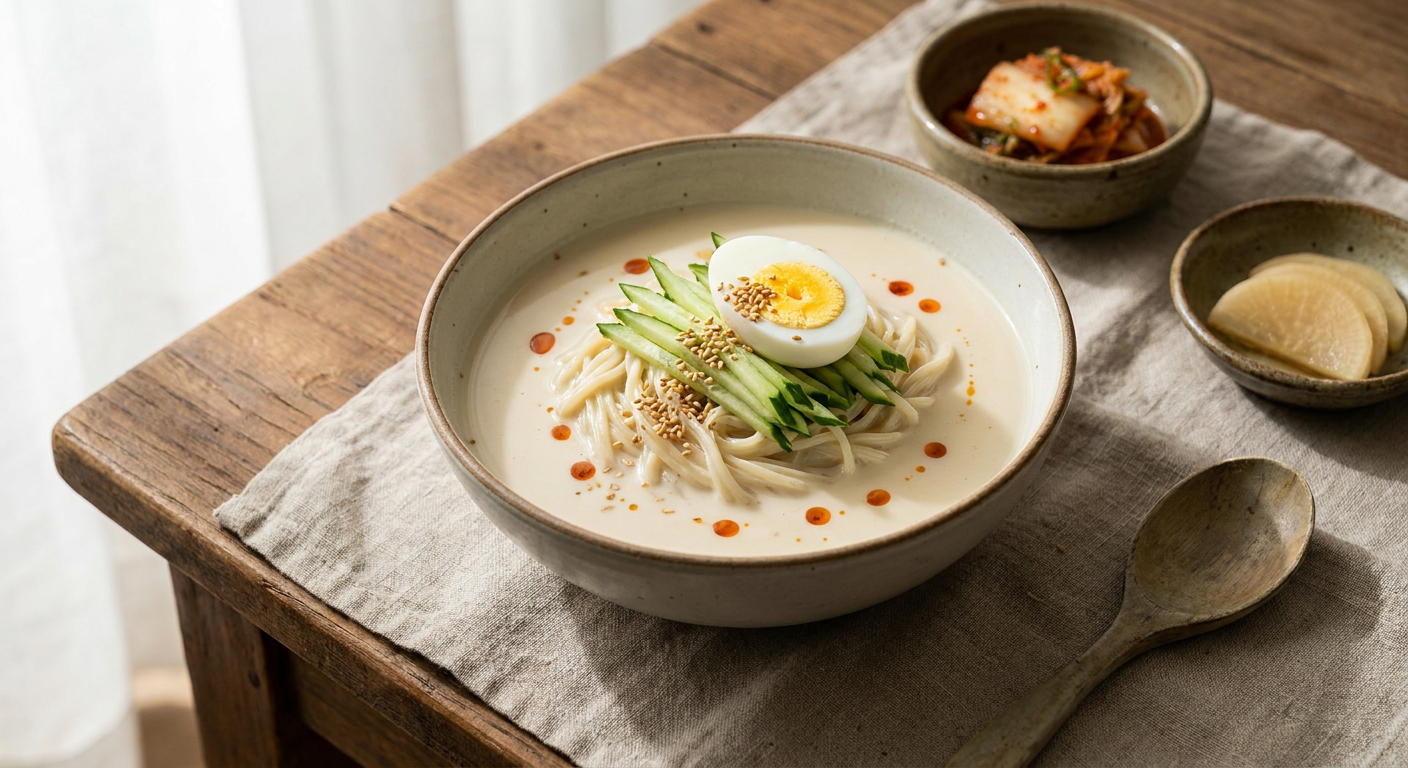
Kongguksu — noodles in cold soy milk broth — is Korea's gentlest summer dish: wheat noodles swimming in a chilled, strained puree of soaked soybeans, salted lightly, nothing else. It tastes like the idea of soybeans — sweet, milky, clean — and its whole technique is the soaking, cooking, and straining of the beans.
Quantities live in the recipe card.
The soy milk (fresh — the entire point)
- the honest bridge, at a real loss of freshness)
The noodles and bowl
- **Soak, boil, peel, blend, strain — the beans' five steps.** Soak the beans until plump (they double), boil 8–10 minutes until tender (a bean crushes smoothly), then — the step worth the effort — slip the skins off with a rinse-rub under water (the skins are the chalky note). Blend with cold water and strain through a fine sieve.
- **The bridge:** carton soy milk (unsweetened) makes a passable kongguksu in 5 minutes — thinner, cooked-tasting, but cold and clean. What you lose is the fresh beans' sweetness and the thick, body-rich texture. If using carton, chill it hard and salt it lightly.
Kongguksu
Prep: 10 minutes, plus 4 hours soaking · Cook: 10 minutes · Total: About 30 minutes (plus soaking and chilling) · Serves 3–4
Ingredients
The soy milk (fresh — the entire point)
- 200 g dried soybeans, soaked 4–6 hours or overnight
- A pinch of salt; 400–600 ml cold water for blending
- (Or 1 litre unsweetened soy milk — the honest bridge, at a real loss of freshness)
The noodles and bowl
- 300 g thin wheat noodles (somyeon, about 100 g dry per serving)
- ½ cucumber (about 100 g), julienned, salted lightly; 1 tomato (about 120 g), sliced (both classic)
- Ice cubes; sesame seeds and a drop of sesame oil (optional)
Instructions
- **Blend and strain the milk.** Blend the cooked, peeled beans with 400 ml cold water until completely smooth, then strain through a fine sieve, pressing the solids with a spoon; add more water until the texture is like thin cream — thick enough to coat a spoon, thin enough to drink. Checkpoint — taste the milk: it should taste sweet, clean, and faintly beany, with a salt level just below noticeable. The straining matters: any grit remains grit forever. Chill the milk until genuinely cold.
- **Boil and ice the noodles.** Cook the somyeon 3–4 minutes, drain, and rinse under cold water, then hold in ice water until the strands are cold to the core. Drain in coils. Checkpoint — the same cold-to-the-core law as the naengmyeon (#68): warm noodles in cold broth warm the whole bowl. Ice them fully.
- **Assemble and eat immediately.** Noodle coil in a deep cold bowl, cucumber and tomato over, pour the chilled soy milk around and through, add 2–3 ice cubes, and a drop of sesame oil and sesame seeds if using. Checkpoint — eating test: the broth is the dish — cold, faintly sweet, milk-smooth over the soft noodles, the cucumber's snap and tomato's acid brightening each mouthful. Salt at the table to taste (some like it saltier). It should taste nourishing and almost dessert-quiet — the anti-tteokbokki (#64), and both are equally Korean summer.
Troubleshooting
| Symptom | Cause | Fix |
|---|---|---|
| Broth chalky, gritty | Skins left on, or under-strained | Peel the beans; strain twice |
| Broth tastes flat, beany-bitter | Under-boiled beans | The full 8–10 minutes cooks the raw note out |
| Bowl warms quickly | Warm noodles, no ice | Ice the noodles fully; ice cubes in the bowl |
Storage, Make-Ahead & Variations
- The soy milk keeps 1 day refrigerated (it separates — re-blend or shake); noodles to order. The beans' soaked-then-cooked batch can feed this dish and the #74's soy-braised side dishes in one session. - Variations: with the #68's buckwheat noodles, the fruit-topped modern version. The fusion direction — kongguksu's milk as the base for a savory panna cotta (#116 neighborhood) — is the site's own soy-meets-dairy conversation.