Kuay Teow Reua (Boat Noodles)
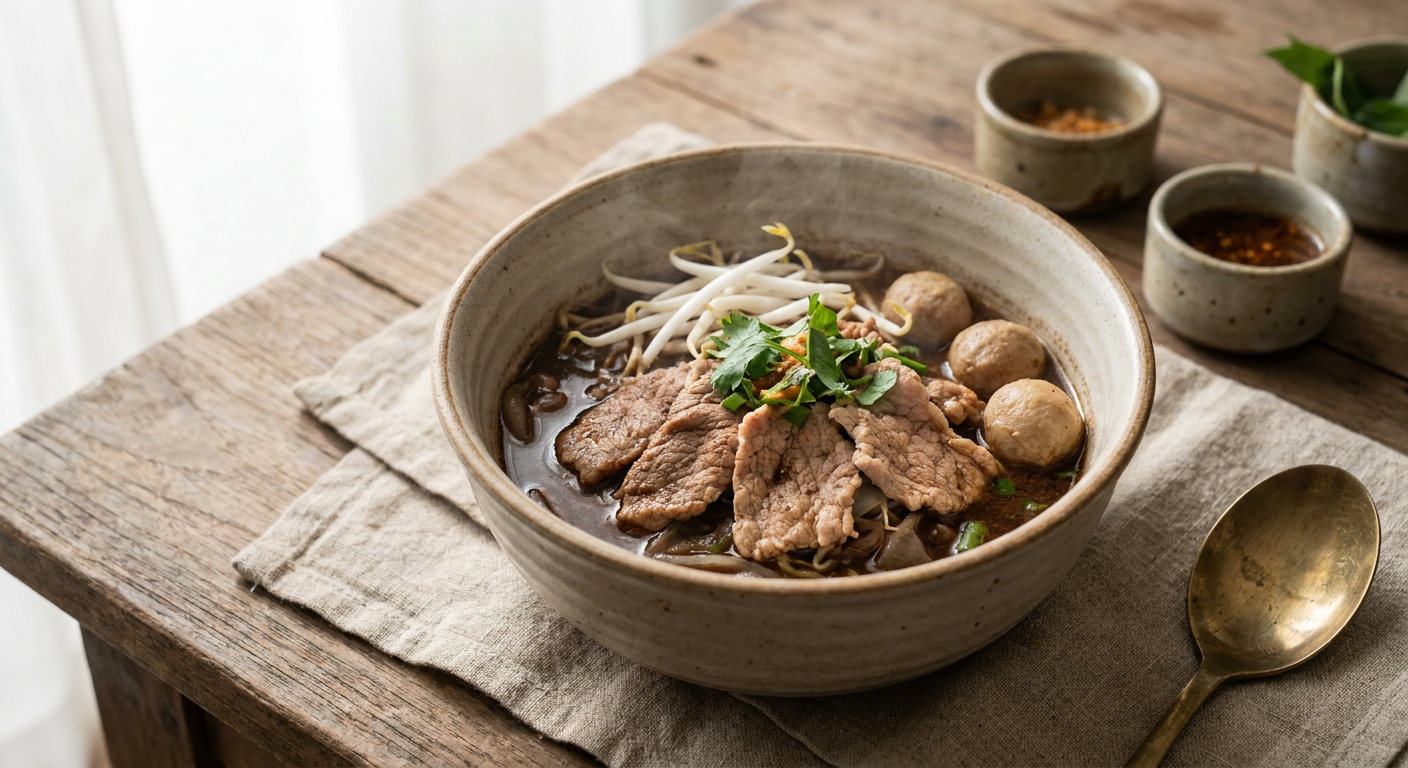
Boat noodles — named for the Bangkok canals they were served from — are the dark, intense end of the Thai noodle soup spectrum: a small bowl of black-gold broth thickened with blood and loaded with beef, pork, and bean paste sweetness, served in portions deliberately small so it stays scalding. This is not phở's gentleness (#24) or tom yum's brightness (#42) — this is the deepest, darkest bowl on the site, and the blood is load-bearing.
Quantities live in the recipe card.
The broth
- see the bridge)
The bowls (per bowl)
- the authentic thickener
The table
- the four-seasoning set
- **Simmer a dark broth.** Blanch the bones, then simmer everything 2 hours at a tremble with the charred aromatics and spices, lifting the meats at their tender points (the beef at 1½ hours, the pork loin at 45 minutes — slice both later). Season with the black soy, bean paste, fish sauce, and palm sugar — the broth should taste dark-sweet-salty-intense.
- **The bridge:** fresh blood is sold in Asian markets (or ask a butcher); it is what makes the authentic bowl's sauce-thick body and iron depth. The honest no-blood version: more black soy plus a spoon of molasses for color, and a slurry of 1 tsp starch for body — you keep the flavor architecture at a real loss of the silky-dark texture. State which you made; both bowls feed people.
Doneness & Quality Checkpoints
- The broth: 2 hours dark, intense, strained, blood-thickened off the boil.
- The bowls: small and scalding, noodles just covered.
- The table: the four seasonings in reach of every diner.
Kuay Teow Reua (Boat Noodles)
Prep: 40 minutes · Cook: 2 hours 30 minutes · Total: About 3 hours 10 minutes · Serves 4 (small, intense bowls)
Ingredients
The broth
- 1 kg beef bones; 500 g pork bones (or all beef)
- 300 g beef shank or brisket; 200 g pork loin (for slicing)
- 3 stalks lemongrass (about 90 g), bruised; 4 slices galangal (about 20 g)
- 1 onion charred; 5 cloves garlic; 1 cinnamon stick, 2 star anise
- 2 tbsp black soy sauce (about 30 ml); 2 tbsp fermented bean paste (taucheo or doenjang bridges)
- 3 tbsp (about 45 ml) fish sauce; 1 tbsp palm sugar (about 12 g)
- 100 ml fresh pork or beef blood (or 1 more tbsp black soy sauce + 1 tsp molasses for color without the body — see the bridge)
The bowls (per bowl)
- 100 g thin rice noodles (sen lek), briefly boiled
- Sliced beef and pork from the broth; a few raw beef slices (optional, cooked at the pour)
- 2 tbsp pork or beef blood (liquid), stirred into each bowl — the authentic thickener
- 1 tbsp crushed peanuts; fried garlic and its oil; spring onion and cilantro
- Bean sprouts (about 50 g per bowl); morning glory or chard, blanched
The table
- Chili vinegar (sliced chilies in vinegar), sugar, dried chili flakes, fish sauce — the four-seasoning set
Instructions
- **Finish the broth with the blood, off the boil.** The broth held just under a simmer — roughly 90 °C — as the blood goes in. Strain the broth, keep it at a bare simmer, and stir in half the blood slowly — it thickens the broth to a dark, lightly viscous sauce-broth. Do not boil hard after (blood scorches grainy). Checkpoint — the finished broth should coat a spoon with a dark film — thicker than phở, nearly a light gravy. Taste: beefy, sweet from bean paste and palm sugar, salty, with cinnamon-anise warmth and a faint iron note. This intensity is the dish — a boat noodle broth should almost be too much on its own.
- **Build small, hot bowls.** Thin noodles drained hard into the warmed bowl, the sliced meats and raw beef over, the extra blood spooned into the raw beef (it coats and enriches at the pour), a pinch of peanuts, fried garlic, and the blanched greens. Ladle the scalding broth over — the small bowl is the point: everything stays hot. Checkpoint — the pour should just cover the noodles — boat noodles are dense, not soupy, and the bowl holds maybe 300 ml total. A big bowl of this intensity loses heat and its balance; the small bowl is engineering, not portioning.
- **Season fiercely at the table.** Each diner sharpens their own bowl — chili vinegar for sour, sugar to round, flakes for heat, fish sauce for salt — and eats fast while it scalds, ordering another small bowl as tradition demands. Checkpoint — eating test: the first slurp is dark-sweet-salty all at once, the blood-silk body coating the noodles, the raw beef turned rosy at the pour, crunch from sprouts and peanuts, garlic oil on top. The bowl should finish in minutes and leave you ordering the next — that is the format's whole social design.
Finish & Plate
Small bowls, stacked seconds, the seasoning set central. The greens and sprouts blanched to order. This is a fast, loud, mid-conversation meal — and the broth keeps for the week's small bowls.
Troubleshooting
| Symptom | Cause | Fix |
|---|---|---|
| Broth grainy after the blood | Boiled hard after adding | Stir blood in off the boil; barest simmer |
| Broth tastes thin despite hours | Bean paste or black soy short | Season in spoons — the darkness is flavor, not just color |
| Bowl cooled too fast | Bowl too large, not warmed | Small preheated bowls — the format's law |
Storage, Make-Ahead & Variations
- The broth (pre-blood) keeps 4 days, freezes 3 months — add the blood fresh per batch. Assembled bowls are immediate. - Variations: the pork-forward version (all pork bones and meat), the extra-blood "special" bowl. The fusion direction — this broth as a ramen base with #5's noodles — exists in Bangkok's own shops already; the site's bridges run both ways.