Laap Moo
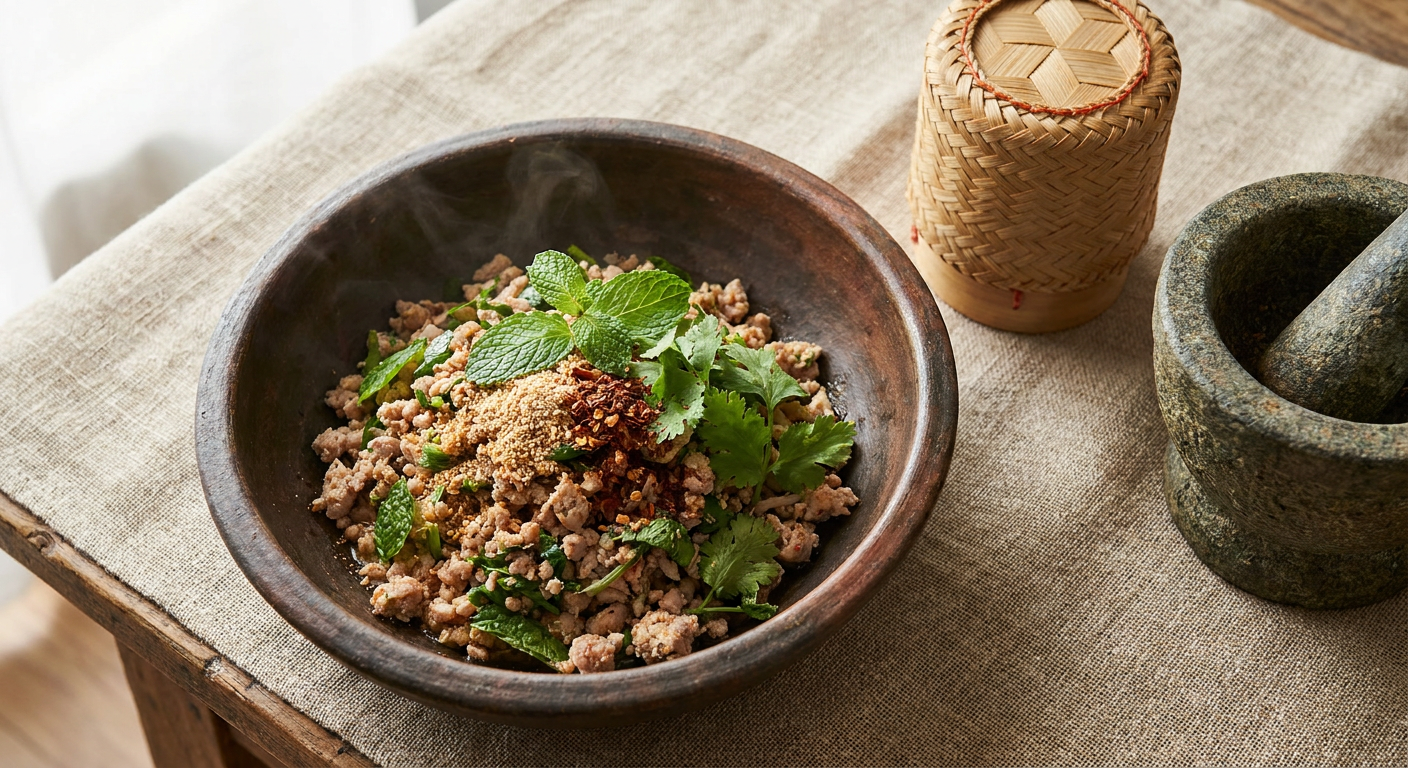
Laap moo — Lao minced pork salad — is the Thai larb's (#46) older, funkier ancestor and Laos's unofficial national dish. The differences are precise and they are the point: padaek (the thick, unfiltered fish sauce) instead of liquid fish sauce, raw garlic and long-leaf coriander, the toasted rice powder (#46's law) in heavier hand, and a plate of bitter herbs beside rather than under. Same architecture, a different and deeper voice.
Quantities live in the recipe card.
The laap
- the Lao distinction)
The herb plate (served alongside, not folded in)
- **Cook the pork plain, dress it hot.** As in the Thai version, the minced meat cooks in water — no oil — and takes its dressing while hot. The Lao differences arrive at the finish: raw garlic and shallot (not cooked), padaek, and the darker rice powder.
- **The bridge:** padaek is the soul and the one hard-to-find — Lao groceries carry it, and it keeps forever; the anchovy-paste bridge approximates its funk at a real loss. The herb plate's exotics (culantro, dill) are worth seeking: they carry the Lao bitter-fresh register that mint alone cannot.
Laap Moo
Prep: 15 minutes · Cook: 10 minutes · Total: About 25 minutes · Serves 3–4
Ingredients
The laap
- 500 g ground pork (or chicken)
- 3 tbsp water
- 3 cloves garlic, sliced paper-thin (raw, not cooked — the Lao distinction)
- 1 small shallot (about 30 g), sliced thin
- 3 tbsp padaek (Lao fermented fish sauce) — or 2 tbsp fish sauce + ½ tsp anchovy paste as the bridge
- 2 tbsp lime juice (about 30 ml); ½ tsp chili flakes or 2 minced bird's eyes
- 2 tbsp toasted rice powder (the #46 recipe, toasted darker)
The herb plate (served alongside, not folded in)
- A handful each: Thai basil, mint, cilantro — and if findable: long-leaf coriander (phak chi farang), dill, and culantro (sawtooth herb, about 20 g)
- Lettuce or cabbage leaves; cucumber slices; green beans (about 100 g), raw
- Sticky rice (#36's method), the essential base
Instructions
- **Poach the pork (6–8 minutes).** Cook the ground pork in the water over medium, breaking it to a fine crumble, until just done and the pan is nearly dry. Checkpoint — fine, moist crumbles, as the #46 — but note the Lao version often runs slightly more liquid, saucier: a spoon of the cooking liquid stays in.
- **Dress hot with the Lao voice.** Off the heat: padaek, lime, chili, and the raw garlic and shallot stirred into the warm pork — the residual heat softens their edge without cooking them. The toasted rice powder over, stirred through. Checkpoint — taste: deeper and funkier than the Thai larb — the padaek's fermented bass note, raw garlic's bite, darker toast — sour and salt riding louder. It should taste rustic and loud, less polished than #46, and that roughness is the identity.
- **Serve with sticky rice and the herb plate.** The laap in its bowl, the herbs beside (each diner picks and folds herbs per bite, rather than the herbs being mixed in), sticky rice in its basket. Checkpoint — eating test: a pinch of sticky rice, a bite of laap, a different herb each time — the Lao rhythm is the herb-plate's variety against the constant of the meat. The bitter herbs (culantro's edge) cut the padaek's funk, the funk feeds the rice. Two bowls deep, you understand why Laos claims it.
Troubleshooting
| Symptom | Cause | Fix |
|---|---|---|
| Flavor flat versus Thai larb | Padaek bridged too mildly | Anchovy paste up, or find the padaek |
| Garlic overwhelming | Sliced thick | Paper-thin slices soften in the heat |
| Texture dry | Overcooked, liquid discarded | Keep a spoon of the cooking liquid in |
Storage, Make-Ahead & Variations
- Made and eaten within the hour; the rice powder keeps 2 weeks (see #46), the padaek keeps indefinitely. Herb plates wait washed in the fridge. - Variations: laap gai (chicken, the common Lao everyday), laap made with fish, the raw-meat versions of the northern provinces (this site will not walk you through them). The fusion direction — #137's lettuce cups with chimichurri — is this format translated again, and it works because the format is the flavor engine.