Miang Kham
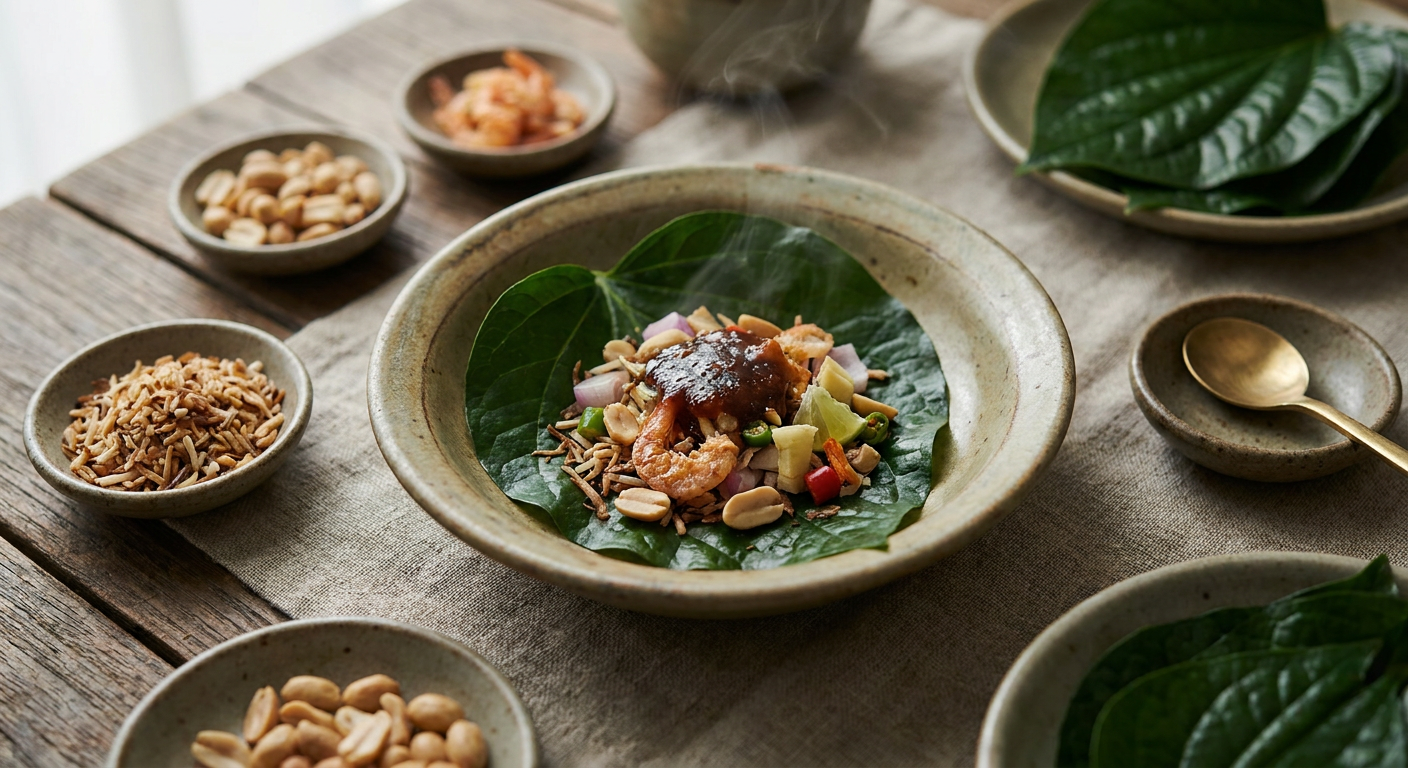
Miang kham — "one bite wrap" — is the Thai snack of contrasts served in a leaf: a wild pepper leaf (or betel leaf) holding toasted coconut, peanuts, lime with peel, ginger, chili, dried shrimp, and a sweet-salty palm sugar sauce, folded and eaten whole so all seven flavors land in one bite. It is the most interactive dish on the site and the purest expression of Thai flavor-layering: each component quiet alone, loud in assembly.
Quantities live in the recipe card.
The leaf
- or tender spinach or lettuce leaves as the bridge
The seven fillings (prepare each in a small bowl)
- the peel is the bitter note, non-negotiable)
The sauce
- **Toast the coconut and peanuts, dice everything tiny.** Every component must be small enough to fold into one bite — the knife work is the recipe. The lime is diced with the peel on: its bitterness is one of the seven flavors.
- **The bridge:** the wild pepper leaf is the authentic (its own gentle mustard-pepper flavor) and Thai groceries sell it fresh or frozen; tender lettuce or young spinach leaves carry the format entirely at a leaf-flavor loss. The format is the dish; the leaf is the vehicle.
Miang Kham
Prep: 25 minutes · Cook: 10 minutes · Total: About 35 minutes · Makes about 20 bites
Ingredients
The leaf
- 20 leaves: wild pepper leaves (bai cha plu, sold at Thai markets) or betel leaves — or tender spinach or lettuce leaves as the bridge
The seven fillings (prepare each in a small bowl)
- 3 tbsp toasted grated coconut (about 25 g)
- 3 tbsp roasted peanuts (about 30 g), chopped coarse
- 1 lime with peel, cut to tiny dice (about 30 g — the peel is the bitter note, non-negotiable)
- 1 thumb ginger (about 20 g), cut to tiny matchsticks
- 2–3 bird's eye chilies, sliced
- 2 tbsp dried shrimp (about 12 g), chopped
- 2 shallots (about 40 g), diced tiny
The sauce
- ½ cup (120 ml) water; 3 tbsp palm sugar (about 40 g); 2 tbsp fish sauce (about 30 ml)
- 1 tsp tamarind or lime; a pinch of dried chili flakes
- Simmered 5 minutes to a light syrup
Instructions
- **Make the sauce.** Simmer the water, palm sugar, and fish sauce 5 minutes to a light syrup that coats a spoon lightly; stir in the tamarind and chili flakes. Cool. Checkpoint — taste: sweet first, salty behind, a sour edge — like a thin, savory caramel. This sauce is the glue; it should be slightly too strong alone.
- **Build the tray.** Lay a spoon of each filling in small bowls around the leaves; the sauce in a dish with a spoon. Checkpoint — the traditional presentation is a tray of separate bowls — each diner builds their own, and the first attempt at balance is part of the game.
- **Build and eat the bite.** Lay a leaf flat, add a pinch of each filling (coconut, peanut, lime, ginger, chili, shrimp, shallot), spoon a little sauce over, fold into a parcel, and eat in one bite. Checkpoint — eating test: the first bite should arrive in waves — sweet sauce, then the lime's sour-bitter bite, the ginger's burn, the shrimp's salt, the coconut and peanut's sweet richness, the leaf's pepper — all inside three seconds. The discipline is one bite: chewing a half-folded wrap is a lesser experience. If one flavor dominates, adjust the next wrap's build — miang kham is a flavor-mixing game you eat.
Troubleshooting
| Symptom | Cause | Fix |
|---|---|---|
| Bites taste muddy, flat | Components cut too large | Tiny dice — each bite needs all seven |
| Sauce too thin, drips | Under-reduced | Simmer to the light-syrup coat |
| Bitter beyond pleasant | Too much lime peel | A few cubes per wrap — the peel is potent |
Storage, Make-Ahead & Variations
- The sauce keeps 2 weeks refrigerated; toasted components keep 3 days in jars; dice the lime, ginger, and shallot the day of. The tray is the party. - Variations: the seasonal fruit miang (green mango, pomelo versions), the noodle-filled miang kham. The fusion direction — #144's tea leaf salad in a leaf — is this format carrying Burmese flavors, and the format travels anywhere a small leaf and seven flavors meet.