Mohinga
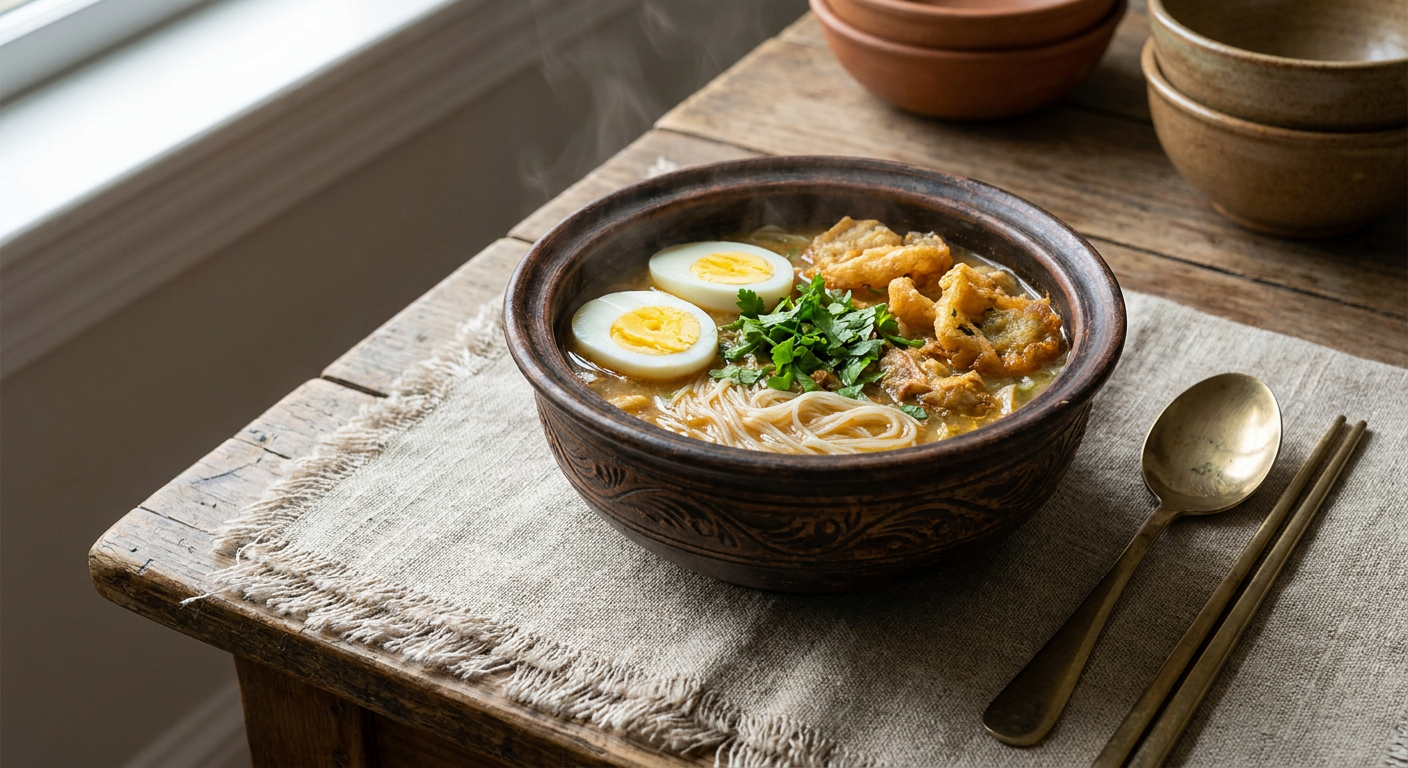
Mohinga — Myanmar's national dish — is the breakfast the whole country agrees on: a catfish and lemongrass chowder thickened with rice and chickpea flour, poured over rice noodles, with a split-pea fritter, a boiled egg, and a squeeze of lime. It is fish soup that eats like a meal — silky, herbal, faintly smoky from roasted rice flour — sold from dawn carts and eaten standing, sitting, and on trains.
Quantities live in the recipe card.
The broth
The chowder base
- the body and the smoky note
The bowls
The fritters (split yellow peas, soaked overnight, ground with turmeric and salt, fried in spoons)
- the honest bridge
- **Make the fish stock first (30 minutes).** Simmer the fish (and bones) with lemongrass, ginger, turmeric, and salt 25 minutes; lift the fish, flake it, and strain the stock. This clean start matters — mohinga's murkiness is intentional (the flours), not accidental.
- **The bridge:** ngapi (Burmese fermented fish paste) is the authentic depth-ingredient — see the #98's notes; fish sauce is the working bridge. Banana stem is the traditional vegetable, and tender bamboo or celery cores bridge honestly. The split-pea fritter is worth making (soak overnight — start the day before) but any crisp fritter carries the bowl.
Doneness & Quality Checkpoints
- The base: shallots fried to deep gold, patient.
- The body: both flours toasted, the chowder coats a spoon.
- The bowl: noodles, chowder, fritter, egg, lime — all five present.
Mohinga
Prep: 40 minutes · Cook: 1 hour 15 minutes · Total: About 2 hours · Serves 4–6
Ingredients
The broth
- 600 g catfish fillet (or any firm fish), cut in large chunks, plus head/bones if available
- 2 litres water; 3 stalks lemongrass (about 90 g), bruised; 4 slices ginger
- 1 tsp turmeric; 1 tsp salt
The chowder base
- 100 ml neutral oil (about 95 g); 6 shallots (about 200 g), sliced; 1 head garlic (about 30 g), sliced
- 2 tbsp finely chopped ginger; 1 tsp turmeric; 1 tbsp paprika or chili powder
- 4 tbsp chickpea flour (about 30 g), toasted dry until fragrant
- 3 tbsp toasted rice flour (the #46 method, 25 g) — the body and the smoky note
- 1 fish sauce, 2 tbsp (about 30 ml) — or ngapi (Burmese fermented fish paste), 1 tbsp, for the authentic depth
- 1 banana stem heart or 100 g tender bamboo or the soft core of celery, sliced fine (optional, traditional)
The bowls
- 300 g rice vermicelli or banh pho noodles, soaked and briefly boiled
- Split-pea fritters (below) or 1 onion, sliced and fried crisp; boiled eggs, halved
- Lime wedges; sliced chilies; cilantro; the #99 balachaung on the side
The fritters (split yellow peas, soaked overnight, ground with turmeric and salt, fried in spoons)
- Or buy any good vegetable fritter — the honest bridge
Instructions
- **Fry the base low and slow (15 minutes).** In the oil, fry the shallots and garlic over medium-low until deeply golden — 10–12 minutes, patient; this is the soup's aromatic foundation and under-fried shallots make a thin broth. Add the ginger, turmeric, and paprika for 1 minute. Checkpoint — the shallots should be a mass of soft gold threads — darkened, sweet, collapsed. The oil should stain red-orange. This slow fry is the mohinga flavor signature; rushing it is the main failure.
- **Add the flours and build the chowder (10 minutes).** The stock at a rolling 100 °C as it goes in, then back to the simmer as the flours thicken. Stir in the toasted chickpea flour and rice flour, frying 2 minutes in the aromatic oil, then whisk in the fish stock gradually — the soup will thicken as it comes to a simmer. Add the fish sauce/ngapi and the banana stem or bamboo. Checkpoint — the soup should thicken to a pourable chowder — it should coat a spoon lightly and hold the flaked fish in suspension. The toasted rice flour gives body plus its faint smoky roast — taste for it; it is mohinga's soul note.
- **The fish and the simmer (20 minutes).** Return the flaked fish and simmer gently 15–20 minutes — the soup darkens slightly, the flavors marry, and the banana stem softens. Adjust with fish sauce to a savory, fully-salted depth. Checkpoint — the final soup: tan-gold, herbs visible, thick enough that the spoon leaves a brief trail. Taste: deep fish-savory first, lemongrass behind, turmeric's warmth, the rice flour's toast — a chowder, not a broth. It should be one notch saltier than drinkable; the noodles dilute.
- **Build the bowls and the table.** Noodles in each bowl, the chowder ladled generously over, the fritter broken on one side, egg half beside, and the lime, chili, and cilantro at each diner's hand. Checkpoint — eating test: the first spoonful is the chowder's silk over the noodles — fish depth, lemongrass, toast — then the fritter's crunch soaked half-crisp, the egg's richness, a lime squeeze lifting the whole bowl brighter. The chilies go in by appetite. It should be breakfast, lunch, and a strong argument for Myanmar's quiet place among the great breakfast cultures.
Finish & Plate
One assembly per bowl, the table set with lime, chili, and cilantro, and the fritters passed separately (crisp to the last). Mohinga is a morning dish that earns the day's first appetite; eat it early at least once.
Troubleshooting
| Symptom | Cause | Fix |
|---|---|---|
| Soup thin, broth-like | Flours under-toasted or under-dosed | Toast both flours; whisk more in slurry-form |
| Fish flavor absent | Weak stock or fish sauce short | Bones in the stock pot; ngapi or fish sauce up |
| Gritty texture | Flour dumped, not whisked | Slurry the flours with stock before adding |
Storage, Make-Ahead & Variations
- The chowder keeps 3 days and improves; noodles, fritters, and eggs to order. The #146's mohinga chowder — the fusion block's own — is this recipe's New England bridge, and the chowder's thickness is precisely why it crosses. - Variations: the fish-paste-heavy Rangoon style, the chicken version. Serve with the #99's balachaung on the side — the classic pairing.