Ngapi Yay
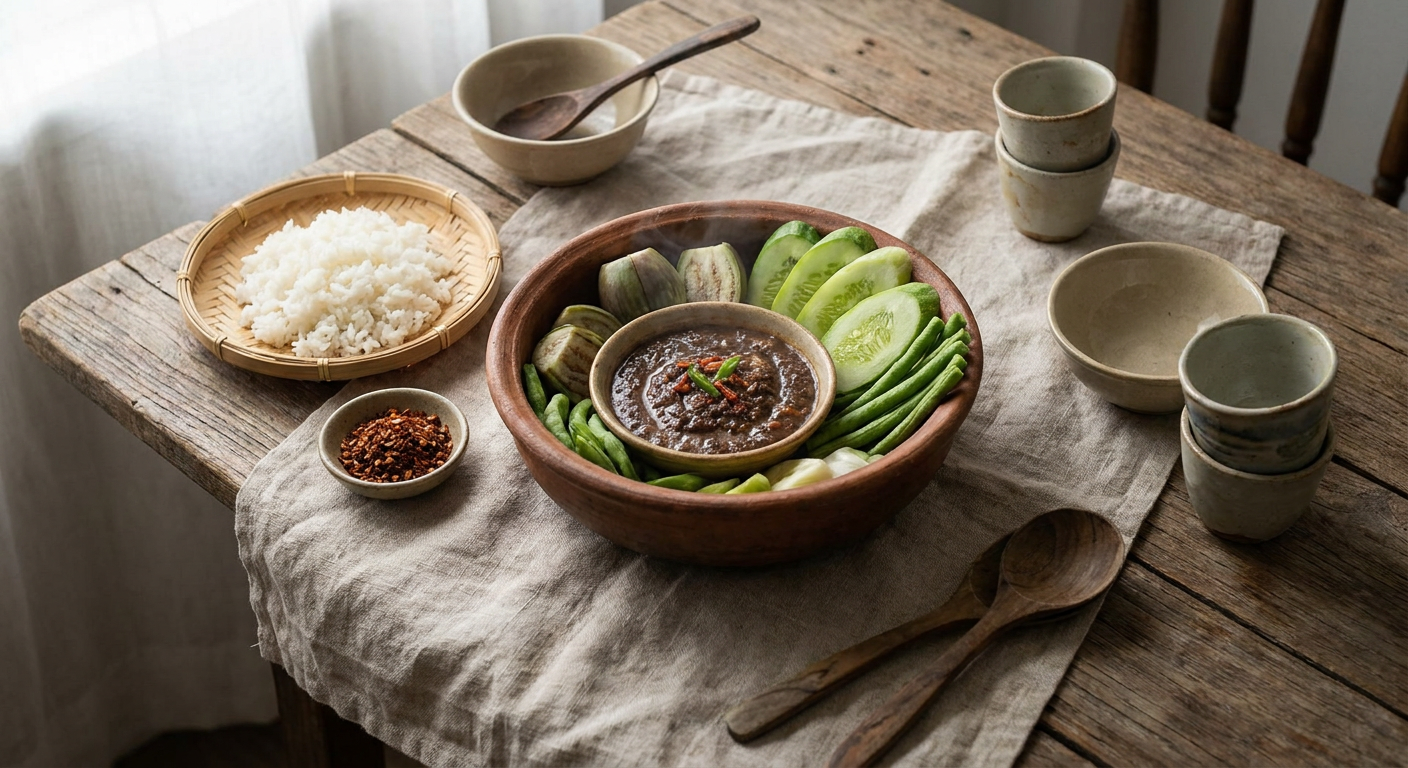
Ngapi yay — Burmese fermented fish dip — is Myanmar's most essential table ritual: a small, bubbling pot of ngapi (fermented fish or shrimp paste) simmered with water, garlic, and chili into a liquid dip, surrounded by a plate of raw and blanched vegetables for dragging through it. It is not a dish so much as the Burmese table's beating heart — the salt, funk, and fire that rice and vegetables ride on — and the closest cousin to the #98's family across the border.
- **Choose your ngapi honestly.** Burmese ngapi ranges from fish paste to shrimp paste; both work. The bridge — fish sauce plus anchovy paste — approximates the funk at a real depth loss; Southeast Asian shrimp paste (belacan/trassi) bridges closer. Whatever you use, this dish is its ingredient: buy the real jar if any Asian grocery is reachable.
- **The bridge for the table:** any crisp vegetable plate carries the format — the Burmese originals (wing beans, roselle leaves) are worth seeking, but the dip is the dish.
Ngapi Yay
Prep: 10 minutes · Cook: 15 minutes · Total: About 25 minutes · Serves 4 as a table condiment-course
Ingredients
The dip
- 3 tbsp ngapi (Burmese fermented fish or shrimp paste — see the bridge) or 3 tbsp fish sauce plus 1 tsp anchovy paste
- 200 ml water; 4 cloves garlic (about 15 g), sliced
- 2 dried red chilies, broken, or 1 tsp chili flakes; a pinch of turmeric
- ½ small onion (about 50 g), sliced; 1 tomato wedge (optional, for roundness)
The vegetable plate (the course's body)
- Raw: cucumber spears (about 100 g), green beans (about 100 g), cabbage leaves, eggplant slices
- Blanched: wing beans or long beans, briefly; boiled eggs, halved; boiled or fried fish (the protein extension)
- Rice, always — the third element
Instructions
- **Simmer the dip (12–15 minutes).** Combine the ngapi, water, garlic, chilies, turmeric, and onion in a small pot; simmer gently 10–12 minutes, mashing the paste into the liquid, until the dip is smooth, faintly thickened, and the garlic and onion have softened into it. Checkpoint — the finished dip should be a murky, red-flecked liquid — pourable, dippable — that smells powerfully savory-funky and tastes intensely salty with a slow chili hum. It should be too strong to eat by the spoonful: this is seasoning, concentrated, waiting for its vegetables and rice.
- **Set the table.** The dip in its small pot at the center, the vegetable plate and eggs around it, rice in each bowl — the classic assembly. Checkpoint — the correct ratio: each diner drags a vegetable through the dip, takes it with a pinch of rice, and repeats. The dip's intensity is calibrated exactly for this dilution — it is not a sauce, it is a salt-and-funk engine, and the vegetables and rice are its delivery.
- **Eat communally.** Checkpoint — eating test: a crisp raw cucumber dragged through, its cool water against the dip's salt-funk; the rice's neutral chew; an egg half with a lighter touch of the same. The meal is interactive and quiet — the dip in the middle doing what the #91's tea leaves do for Myanmar's other tables: making plain food vivid.
Troubleshooting
| Symptom | Cause | Fix |
|---|---|---|
| Dip too salty to bear | Ngapi straight or under-diluted | More water and garlic; a tomato wedge mellows |
| Dip thin, one-note | Bridged paste, no aromatics | The garlic-onion simmer is the roundness |
| Funk overwhelming first-timers | The honest ngapi voice | Serve with more rice and blander vegetables |
Storage, Make-Ahead & Variations
- The dip keeps 1 week refrigerated and improves; re-simmer with a splash of water to serve. The vegetable plate is daily-fresh. - Variations: the shrimp-paste version, the tomato-heavy version. The fusion crossing — #147's balachaung caesar and #138's padaek aioli — both run this paste's logic into Western dressings, and the site's block built them from exactly this recipe's foundation.