Ohn No Khao Swè
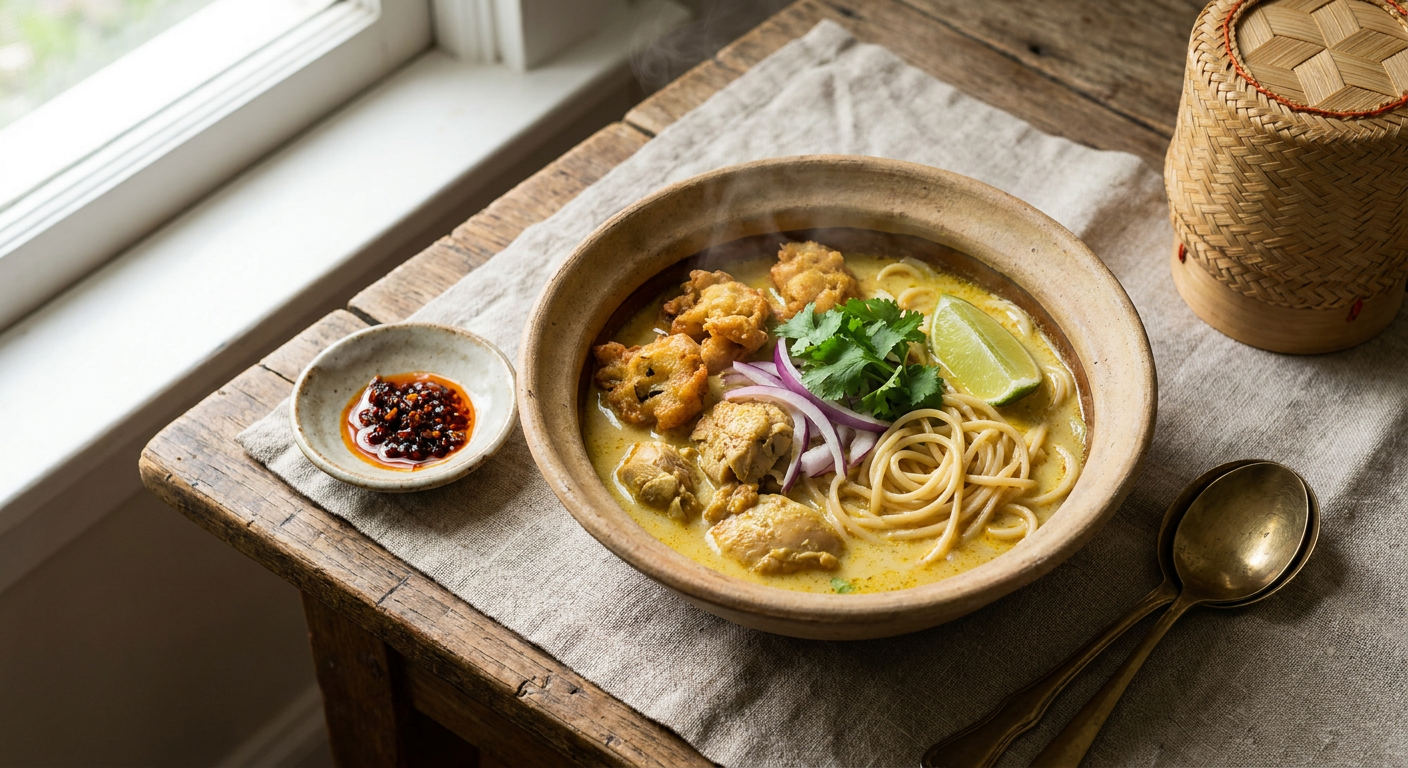
Ohn no khao swè — Burmese coconut chicken noodle soup — is the dish that traveled east and became khao soi (#2): chicken simmered in coconut milk with curry spices, egg noodles, and a mountain of garnishes. The Burmese original runs thinner and soupier than its Thai descendant — no fried-noodle crown required — and its garnish table is the ritual: lime, shallots, chili, crispy noodles, and a boiled egg to each bowl.
Quantities live in the recipe card.
The chicken and curry base
The noodles and garnish table
- the Thai khao soi's flat ones bridge)
- the khao soi inheritance, served here as a side garnish, not the crown
- **Fry the curry powder in coconut cream first.** The shared law (#2, #43): crack the cream, fry the aromatics and curry powder in the split oil until darkened and fragrant — 3 minutes — before any liquid. This fried base is the soup's depth.
- **The bridge:** Burmese curry powder is close to a mild Madras; either works. The fried-noodle garnish is where khao soi's crown came from — make a small nest's worth (5–6 nests) or buy the crispy wheat nests. What you lose by skipping it is the crunch garnish, not the dish's identity — in Myanmar it is one garnish among several, not the centerpiece Thailand made it.
Doneness & Quality Checkpoints
- The base: cream cracked, curry powder fried dark-gold.
- The broth: soupy-gold, coconut-spice balance, just past salted.
- The table: every garnish present — the bowl is finished by the diner.
Ohn No Khao Swè
Prep: 35 minutes · Cook: 50 minutes · Total: About 1 hour 30 minutes · Serves 4–6
Ingredients
The chicken and curry base
- 700 g bone-in chicken thighs (about 500 g boneless weight)
- 200 ml coconut cream (thick top of a chilled can) + 400 ml thin coconut milk
- 2 tsp curry powder (about 4 g, Burmese-style or a mild Indian blend); ½ tsp turmeric
- 1 onion (about 150 g), sliced; 4 cloves garlic (about 15 g), sliced; 1 tbsp minced ginger (about 10 g)
- 2 stalks lemongrass (about 60 g), bruised; 1 cinnamon stick; 2 bay leaves
- 1 tbsp fish sauce (about 15 ml), plus more to finish; 1 tsp salt; 1 tsp sugar
The noodles and garnish table
- 400 g fresh egg noodles, boiled to order (the Burmese use wheat noodles — the Thai khao soi's flat ones bridge)
- 1 boiled egg per bowl, halved; lime wedges; sliced shallots; sliced chilies
- A handful each cilantro and spring onion (about 15 g each)
- A nest of the same noodles, fried crisp at 180 °C — the khao soi inheritance, served here as a side garnish, not the crown
Instructions
- **Fry the base and sear the chicken (10 minutes).** Crack the coconut cream in a heavy pot, add the onion, garlic, and ginger, and fry until the onion is golden — 6–8 minutes. Stir in the curry powder and turmeric for 1 minute, then add the chicken pieces and turn to coat in the spice paste for 2 minutes. Checkpoint — the oil should split and streak red-gold around the aromatics, and the kitchen should smell of fried curry powder — toasted, sweet, gently hot. The chicken's surface takes the paste's color. This fried start is everything the simmer will build on.
- **Simmer in coconut milk (35–40 minutes).** Add the thin coconut milk, lemongrass, cinnamon, and bay; bring to the barest simmer and cook until the chicken is tender and the broth is a warm gold — 35–40 minutes. Lift the chicken, shred or joint it, return it. Season with fish sauce, salt, and sugar. Checkpoint — the finished broth should be pourable-soupy — noticeably thinner than khao soi's (#2) coconut body — and taste of coconut and warm spice in equal balance, salted to just past comfort. The chicken should be spoon-tender and curry-stained to the bone.
- **Build the bowls and set the garnish table.** Noodles in each bowl, chicken and broth over, and the garnish table beside: the crisp noodle nests, eggs, lime, shallots, chilies, herbs — each diner garnishes their own bowl into their own balance. Checkpoint — eating test: the first slurp is coconut-warm and gently curried, the noodles springy; then the garnishes begin — a crunch of fried noodle, a bite of raw shallot's sharp, lime's lift, chili's building heat — and the bowl becomes a personal composition. The Burmese way is soupier and more garnish-live than its Thai descendant: where khao soi converges on its crown, khao swè spreads out across its table.
Finish & Plate
One assembly per bowl, the garnish table central, and the broth pot on a back burner for refills — the format is the Lao khao poon's (#88) cousin: a gentle pot and a live table.
Troubleshooting
| Symptom | Cause | Fix |
|---|---|---|
| Broth too thick, khao soi-like | Over-reduced or cream-heavy | The thin-milk majority; stock or water to loosen |
| Curry taste raw | Powder not fried | The 3-minute fry in split cream |
| Garnishes soggy on contact | Added to the pot | The table's garnishes never touch the stove |
Storage, Make-Ahead & Variations
- The broth and chicken keep 3 days and improve; noodles, eggs, and fried nests to order. The #100's variant and the #148's mac & cheese — the fusion block's own crossings — both start from this pot. - Variations: the beef version, the duck version, the Rangoon style with extra noodles. The fusion direction is literal: this dish is the ancestor — the site's block simply continues its journey.