Oyakodon
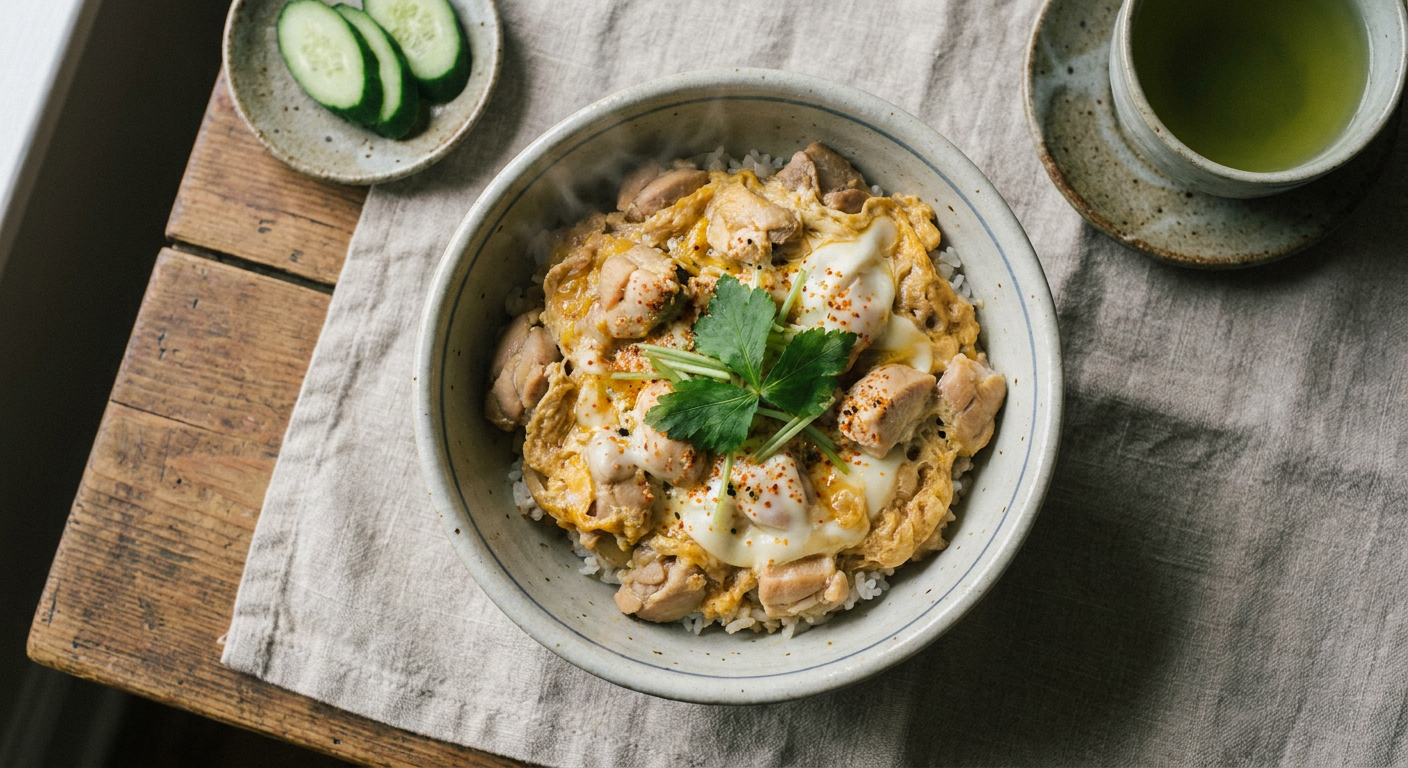
Oyakodon — "parent and child bowl" — is chicken and egg simmered together in a sweet dashi-soy broth, poured still-soft over rice. It is the great Japanese weeknight dinner: one pan, ten minutes of cooking, and the entire technique is knowing when to stop — the egg should be set at the edges and barely custard at the center, because it finishes on the hot rice.
Quantities live in the recipe card.
Ingredients
- streaky, not homogeneous
- **Beat the eggs wrong on purpose.** Twenty strokes with chopsticks: whites and yolks broken but not blended. The streaky egg sets in layers — white ribbons and yolk richness — which is the dish's texture. Fully beaten egg makes uniform scrambles and you lose the layering.
- **The bridge:** no dashi? Water plus a pinch of granules, or even chicken stock, works — you lose the oceanic note the kelp gives, and the soy covers most of it.
Oyakodon
Prep: 10 minutes · Cook: 15 minutes · Total: About 25 minutes · Serves 2
Ingredients
Ingredients
- 300 g boneless chicken thigh, cut to bite pieces (skin on if you like the richness)
- 2 spring onions (about 30 g), cut to 3 cm lengths
- 150 ml dashi (or water + a pinch of dashi granules)
- 1½ tbsp soy sauce, 1½ tbsp mirin, 1 tsp sugar, ½ tsp sake
- 3 eggs (about 150 g), beaten just enough to break the yolks — streaky, not homogeneous
- 2 bowls hot steamed rice; mitsuba or scallion greens, and a pinch of sansho or shichimi to finish
Instructions
- **Simmer the chicken (6–7 minutes).** Bring dashi, soy, mirin, sugar, and sake to a simmer in a small pan that is wide enough to hold the chicken in one layer. Add chicken and the white parts of the onion, cover, and poach at a gentle bubble until just cooked through. Checkpoint — the chicken should be just opaque and the broth should taste one notch saltier than drinkable — the rice will absorb and dilute. Skim any scum now, not later.
- **The egg, in two pours (90 seconds total).** Push the chicken into an even layer. Pour two-thirds of the streaky egg over, wait 30 seconds for it to cloud, then pour the remaining third. Scatter the green onion tops. Count to 45 — the edges should set, the center should still move when the pan is tilted. Checkpoint — this is the doneness decision: the egg on the pan's floor is set, the top layer glossy and loose. Pull it now. Sixty more seconds makes dry curds that no rice can rescue.
- **The transfer, in one motion.** Slide the whole soft set — chicken, egg, and a spoon of broth — over a bowl of hot rice. The residual heat finishes the egg as you carry the bowl to the table. Checkpoint — eating test: the first spoonful should have rice, savory broth, tender chicken, and soft egg in one scoop, with the raw onion's bite and a sansho tingle at the end. The egg should be sauce-like, closer to carbonara's cream than an omelet.
Troubleshooting
| Symptom | Cause | Fix |
|---|---|---|
| Egg dry and puffy | Overcooked before the transfer | Pull when the center still moves |
| Broth disappears into rice completely | Too little liquid, pan too big | 150 ml minimum for 300 g chicken; small pan |
| Chicken tough | Boiled hard | A bare bubble, lid on, 6–7 minutes |
Storage, Make-Ahead & Variations
- Cooked to order — the egg waits for no one. Prep (cut chicken, mix broth) keeps 1 day refrigerated; assembly is 15 minutes. - Variations: swap chicken for thinly sliced onion alone (tamago don), or leftover tonkotsu chashu (#5) in the same broth — the parent-child system holds whatever the fridge offers.