Phở Bò
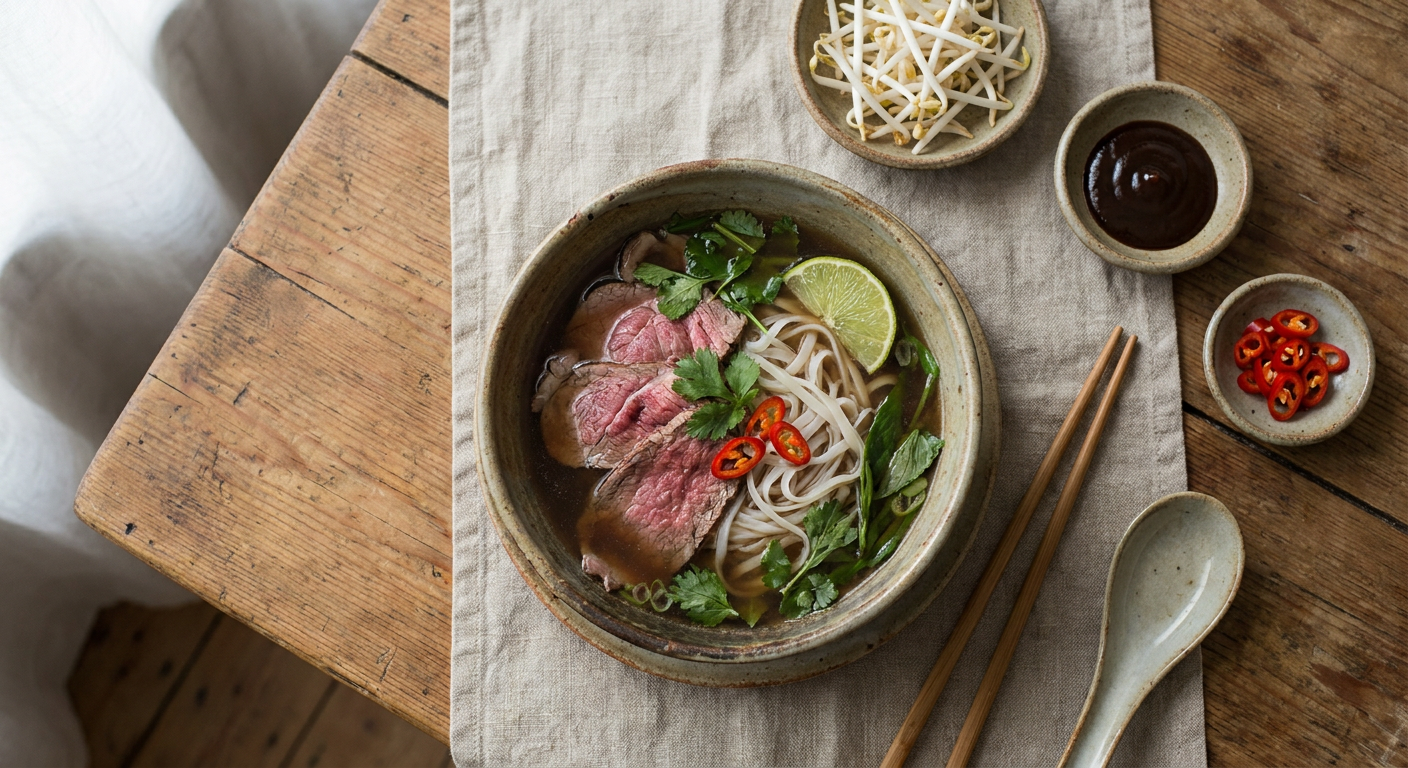
Quantities live in the recipe card.
The broth
- both charred
- toasted
The bowls
The garnish table
The bridges, honestly stated:
(1) Store beef stock + charred aromatics + toasted spices simmered 45 minutes makes a genuinely good weeknight phở — what you lose is the marrow's body and the collagen's silk. (2) The spice set is sold pre-packed as "phở spices" in Vietnamese groceries. (3) Banh pho noodles have no substitute that matters — rice sticks of any width keep the dish; wheat noodles change it. What cannot be bridged: fish sauce. It is the dish's salt and much of its soul.
Doneness & Quality Checkpoints
- The char: properly blackened onion and ginger faces, rinsed.
- The simmer: barest tremble, 4–6 hours, amber-clear.
- The seasoning: fish sauce forward, saltier than final, at the strain.
- The bowl: rolling-boil broth, paper-thin raw beef cooked at the pour, garnish table live.
Phở Bò
Prep: 45 minutes · Cook: 4–6 hours, largely unattended · Total: About 5–7 hours · Serves 6
Ingredients
The broth
- 2 kg beef leg bones (marrow and knuckle mix), plus 500 g oxtail or 400 g beef shank for meat
- 300 g beef shank or brisket for slicing into the bowls (the second meat — the first 500 g of oxtail stays in the pot)
- 2 large onions, halved; a 7 cm piece of ginger, halved lengthwise — both charred
- 4 star anise, 1 cinnamon stick, 1 tbsp (about 6 g) coriander seeds, 3 cloves, 1 black cardamom pod — toasted
- 1 tsp salt; 3 tbsp (about 45 ml) fish sauce, plus more at the finish
- 1 rock candy sugar or 1 tsp sugar; 4 litres cold water (the 3 kg of bone against it is the concentration's arithmetic)
The bowls
- 500 g dried flat rice noodles (bánh phở), medium width
- 200 g beef sirloin or eye of round, frozen 30 minutes, sliced paper-thin — about 35 g per bowl, cooked in the bowl by the broth
- The braised shank from the broth, sliced thin
- 2 onions (about 400 g), sliced paper-thin; 6 spring onions (about 60 g), sliced; a handful of cilantro (about 30 g)
The garnish table
- Bean sprouts (about 200 g), Thai basil, sawtooth herb (ngo gai) or regular cilantro, lime wedges, sliced chili; hoisin and sriracha for the southern school
The bridges, honestly stated:
Instructions
- **Char the aromatics (15 minutes).** Halve the onions and ginger and char the cut faces directly over a gas flame, under the broiler, or in a dry pan until blackened — properly black, not browned. Then rinse off the loose char and any grit. Checkpoint — the kitchen should smell of sweet smoke, and the blackened faces should be 2–3 mm deep. This step is non-negotiable: it contributes the mild bitterness and smoky sweetness that make phở taste like phở rather than French beef broth. Pale onions make flat phở — this is the most commonly skipped step and the most costly.
- **Toast the spices (3 minutes).** Warm the star anise, cinnamon, coriander, cloves, and cardamom in a dry pan until fragrant — just until the first wisp of smoke. Bundle them in a spice bag or tied cheesecloth. Checkpoint — toasting wakes the essential oils; the spices should smell sweet and warm, not dusty. Keep them in a bag so you can remove them at the end — spices that simmer to the finish turn the broth medicinal.
- **Blanch the bones (10 minutes).** Cover the bones and oxtail with cold water, bring to a hard boil for 10 minutes, and watch the grey scum rise. Drain, scrub the bones under running water, and rinse the pot. Checkpoint — the discarded water should look unappetizing and the bones should look clean. Like the tonkotsu's blanch (#5), this is clarity insurance — phở's broth is clear amber, and unblanched bones guarantee cloudiness.
- **The long simmer.** Return the cleaned bones, oxtail, and the sliced-shank meat to the pot with 4 litres of cold water. Bring to a bare simmer — the surface barely moving, 90–95 °C on a thermometer — and hold it there, uncovered, skimming the first hour's foam whenever it forms. Add the charred onions, ginger, and spice bag after the first hour. Continue at the barest simmer 4–6 hours total, topping up with hot water only if bones surface. Checkpoint — this is the opposite of tonkotsu (#5): clarity wants stillness. A rolling boil emulsifies fat into the broth and turns it cloudy-grey. The target color is deep amber-red-brown, transparent enough to see the spoon through. At hour four, taste: the broth should be sweet from bone, warm from spice, and still slightly under-salted — the fish sauce comes at the end.
- **Season and strain.** Fish out and reserve the braised meat. Remove the spice bag, onions, and ginger. Skim the visible fat — leave a light sheen, phở is not a defatted consommé. Then season: fish sauce and salt by the spoon, tasting, until the broth tastes slightly saltier than a finished soup — the noodles and raw beef will pull it back. Strain through a fine sieve into a clean pot. Checkpoint — the final broth, tasted hot from the ladle: savory first, then the star anise's warmth, then a sweet after-finish, with the ginger's faint heat at the swallow. It should coat the lips lightly. If it tastes thin even after good simmering, reduce it 20 minutes — concentration is the honest fix.
- **Prepare everything at once.** Soak the banh pho in hot water 20–30 minutes until pliable, then boil 45–60 seconds to order (fresh noodles: 15 seconds). Slice the braised shank thin against the grain. Slice the raw sirloin paper-thin against the grain — 30 minutes in the freezer firms it for this. Set out the garnish table. Checkpoint — the raw beef should be thin enough to read through — it cooks in the bowl, and thick slices stay raw at the center where thin ones turn instantly rosy.
- **Build each bowl in order.** Noodles drained hard (shake the basket — water dilutes the broth), into the warmed bowl. Raw beef slices fanned over the noodles — the hot broth poured over them is the cooking. Braised shank beside. Broth ladled from a rolling boil over everything, aiming directly at the raw beef. Onion slices, scallion, cilantro over. Checkpoint — the raw beef should turn from red to pink-brown at the pour — watch it happen: the rolling 100 °C broth does in seconds what a pan does in minutes. If it stays raw, the broth lost its heat (the pot must be at a rolling boil at assembly) — the table remedy is to push the slices under with chopsticks.
- **The table's seasonings.** Each diner adds bean sprouts, herbs torn by hand (sawtooth herb's grassy note is Hanoi in a leaf), lime, and chili. Hoisin and sriracha at the table is the southern school; Hanoi purists dip the meat into the sauces rather than tinting the broth. Checkpoint — the perfect bowl, assembled: clear amber broth, rosy beef, white noodles, green herbs, in that order visually — and in the mouth: broth first, then noodle, then beef, then the herbal bite of the garnish. The broth should still taste like itself after the garnish, not like salad water.
Finish & Plate
One assembly per bowl, served instantly — phở waits for no one, and the noodles' best minute is the first. The garnish plate in the table's center, the sauces beside it, the broth pot at a simmer on the back burner for refills. The authentic posture: two hands on the bowl, slurping loudly, spoon working the beef.
Troubleshooting
| Symptom | Cause | Fix |
|---|---|---|
| Broth cloudy and grey | Boiled instead of simmered, blanch skipped | Bare tremble, next time; today, strain and accept |
| Weak flavor despite hours | Not enough bone, or too much water | Reduce 20–30 minutes; 2 kg bone per 4 litres is the floor |
| Spices dominate, medicinal edge | Spice bag simmered to the end | Remove at hour 4; toast, never boil, the spices |
| Bowl tastes flat at the table | Broth under-salted or under-lime | Fish sauce by the teaspoon into the pot; lime at the table |
Storage, Make-Ahead & Variations
- Broth: 4 days refrigerated, 3 months frozen in 500 ml blocks. Braised meat: 3 days, sliced cold. Noodles and raw beef: to order. The freezer-block phở station is the weeknight reward — see the note above. - Variations: phở gà (the chicken version — same aromatics, a chicken carcass and 2 hours); phở dry (broth on the side); the southern sweeter bowl with more garnish. The fusion direction lives at #113 (the French dip) and #146 (the chowder) — the broth is generous.