Samgyeopsal
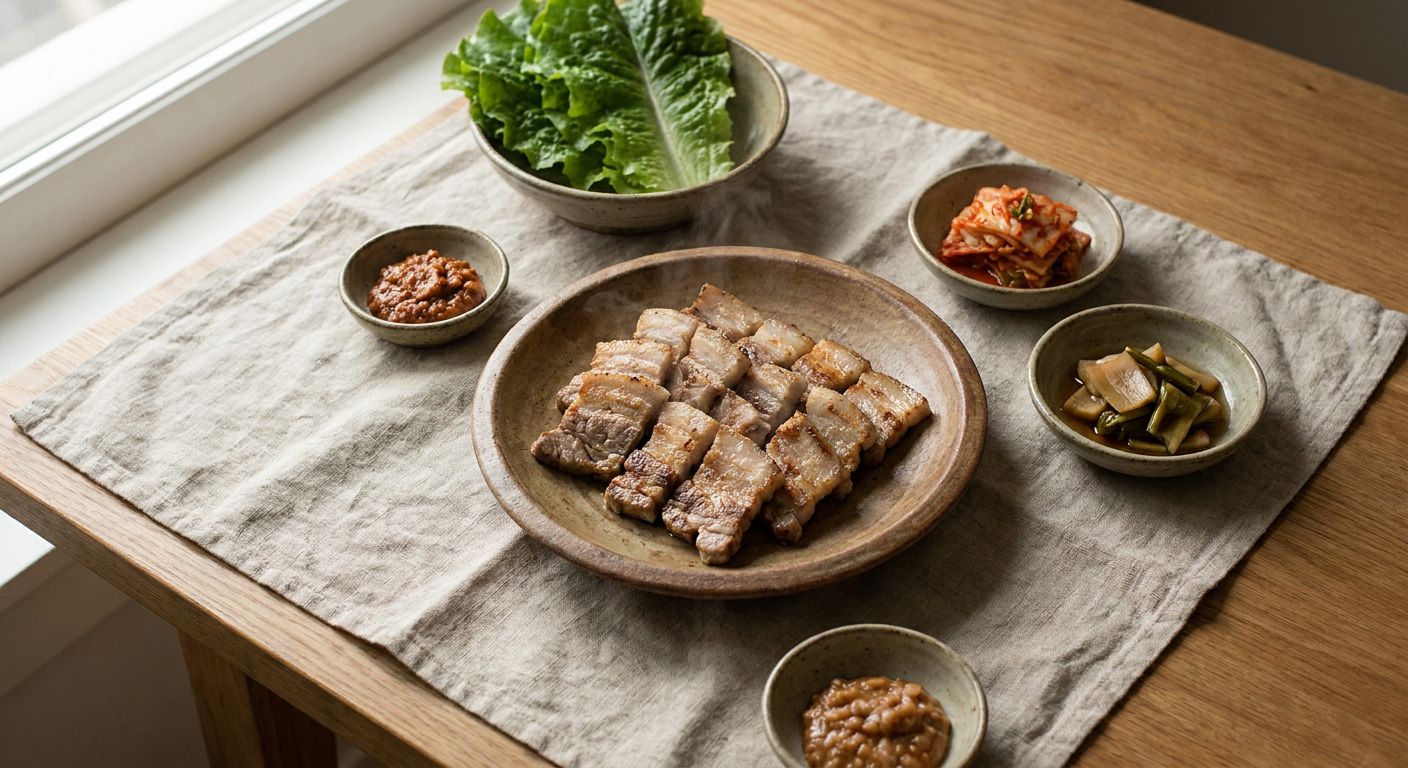
Samgyeopsal — thick-cut pork belly grilled at the table — is Korean barbecue at its most essential: no marinade, no sauce before the fire, just salt-aided pork and the diners' own ssam assembly. The "recipe" is a shopping list (good pork, the condiments) and a format (grill, snip, wrap, repeat). The technique is in the wrapping.
Quantities live in the recipe card.
The pork
- the Korean grocery sells it pre-cut; the butcher cut is the bridge
The table's assembly
- **Set the whole table before the fire.** Samgyeopsal cooks in front of you, fast — the condiments, leaves, scissors, and tongs all in place before the pan heats. A grill pan at the table burner or a cast-iron pan over the stove both work.
- **The bridge:** there is nothing to bridge but the cut — thick, whole strips of pork belly, not thin slices (that's the bulgogi family, #59). The perilla leaves (kkaennip) are worth the Korean grocery trip; lettuce alone carries the format.
Samgyeopsal
Prep: 15 minutes · Cook: 25 minutes at the table · Total: About 45 minutes · Serves 3–4
Ingredients
The pork
- 800 g pork belly, thick-cut (about 1 cm) in whole strips — the Korean grocery sells it pre-cut; the butcher cut is the bridge
The table's assembly
- Lettuce leaves (about 150 g) and perilla leaves (about 30 g)
- Ssamjang: 3 tbsp doenjang or miso, 1 tbsp gochujang, 1 tsp sesame oil (about 5 ml), 1 clove garlic, a pinch of sugar
- Sliced garlic (6 cloves, raw) and sliced fresh chili; a dish of salt-and-sesame (1 tsp salt + 1 tsp toasted sesame seeds) or salt-and-pepper for dipping
- Kimchi (about 200 g), grilled alongside; 1 onion or spring onion scallion, also grillable
- Steamed rice; a bottle of soju or beer (the traditional service)
Instructions
- **Grill the strips whole, turning often (15–20 minutes).** Lay the strips on the hot pan and let them render and brown, turning every few minutes — the fat cooks the meat, and the strips curl and blister. Grill the kimchi and onion beside them in the rendered fat. Checkpoint — the pork is done when deeply browned and blistered outside, cooked through but still juicy at the center, with crisp edges. The grilled kimchi should be charred at its edges and glazed in pork fat — it is the dish's hidden course, not a garnish.
- **Snip, dip or sauce, wrap.** Cut the strips into bite pieces with scissors directly on the grill. Each diner builds: a lettuce leaf, a piece of pork (dipped in the salt-sesame or dabbed with ssamjang — choose one per bite), a slice of raw garlic, a piece of grilled kimchi, folded and eaten whole. Checkpoint — eating test: the wrap is the dish — crisp lettuce, hot fat-rich pork, the sharp bite of raw garlic, the fermented kimchi's char. Each wrap is a small decision (salt or ssamjang? perilla or lettuce?) and the meal is the accumulation. The grilled kimchi wrap is the classic peak.
- **The finish: the pan's fried rice.** When the pork is done, push the rendered fat and crisp bits aside, add a bowl of rice directly to the pan with the leftover kimchi and sauce scraps, and fry it in the drippings — the meal's traditional last course. Checkpoint — the pan rice should be crackling at the bottom and stained with everything that came before. Eating it is the sign the night went correctly.
Troubleshooting
| Symptom | Cause | Fix |
|---|---|---|
| Pork burnt outside, raw inside | Pan too hot, strips too thick | Medium-high; snip thick strips in half to finish |
| Wraps falling apart | Overfilled lettuce | One piece of pork per leaf, small fold |
| Pan smoking unbearably | Rendered fat accumulating | Pour off excess fat (save it — it is the rice's fuel) |
Storage, Make-Ahead & Variations
- Made and eaten at the table; leftovers (rare) re-grill passably. The ssamjang keeps 1 week; the format keeps forever. - Variations: the kimchi-jjigae finish (add the #60's stew base to the pan instead of rice), the cheese-dip modern style. The fusion direction — #131's Korean fried chicken sliders — carries the ssam idea into burger format.