Sanwin Makin
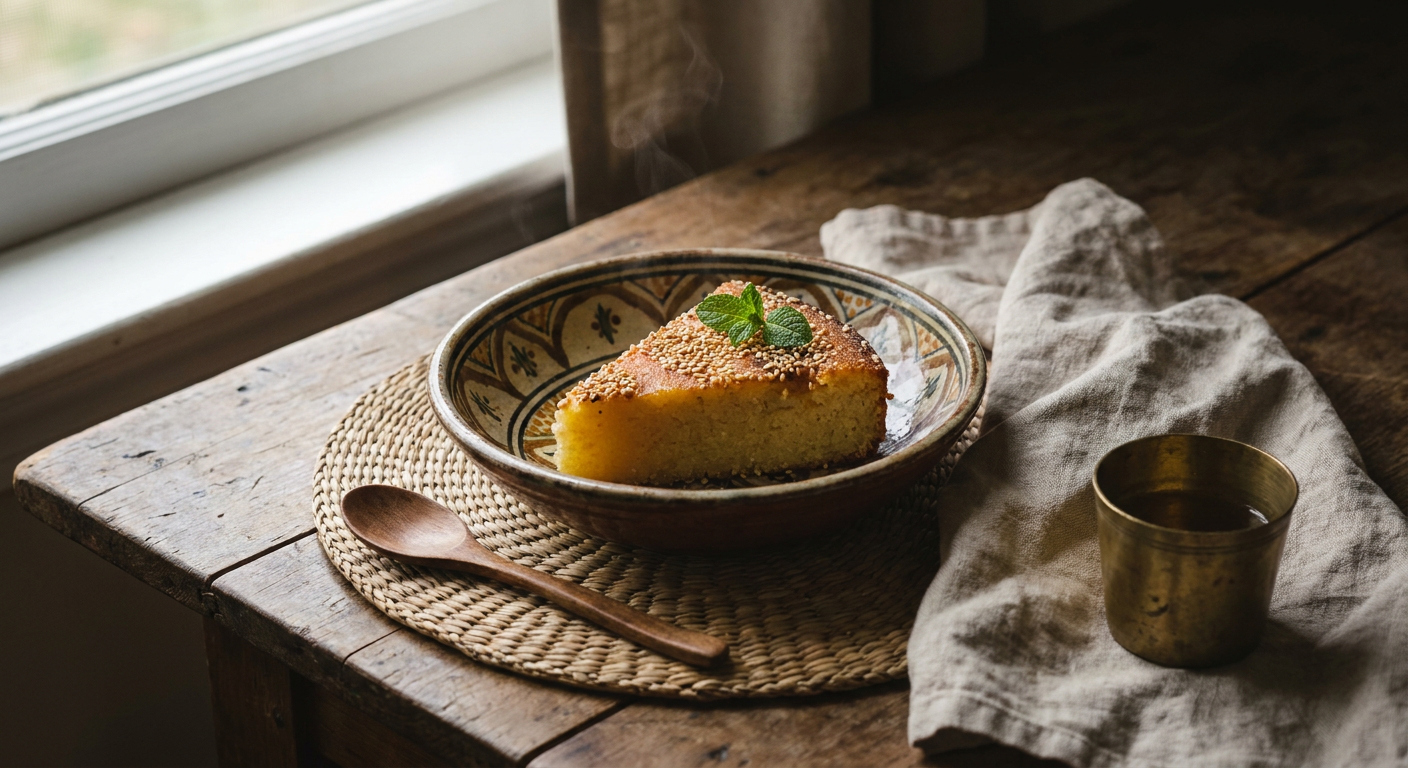
Sanwin makin — Burmese semolina cake — is the colonial-era dessert that Myanmar made its own: a dense, fudgy semolina and coconut cake sweetened and perfumed with cardamom, studded with raisins, and topped with sesame. It is closer to a halvah-bridge than a Western cake — no flour, no leavening — and its texture, cooked on the stovetop before baking, is the recipe's whole craft.
Quantities live in the recipe card.
The cake
- **Toast the semolina first.** In the dry pan or a low oven, toast the semolina 5–8 minutes until it smells nutty and turns faintly gold — this precooking is what makes the cake's toasty flavor and prevents a raw, pasty interior.
- **The bridge:** semolina is semolina (the cream-of-wheat box works fine); coconut milk is the Burmese note and whole milk bridges at a small loss of perfume. The cardamom is the cake's spice signature — freshly ground if possible.
Sanwin Makin
Prep: 20 minutes · Cook: 40 minutes · Total: About 1 hour · Serves 8
Ingredients
The cake
- 200 g semolina (fine)
- 200 ml coconut milk (one small can) + 200 ml water or milk
- 200 g sugar (palm or brown for depth, or half white)
- 100 g butter or ghee, plus more for the pan
- 3 eggs (about 150 g), beaten
- ½ tsp salt; ½ tsp ground cardamom (about 1 g); ½ tsp vanilla (optional)
- 50 g raisins or currants; 1 tbsp sesame seeds for the top
Instructions
- **Cook the semolina mixture on the stovetop (15 minutes).** Combine the coconut milk, water, and sugar in a heavy pan; bring to a simmer and dissolve the sugar. Add the toasted semolina in a stream, stirring, and cook over medium-low 8–10 minutes, stirring constantly, until it thickens to a heavy, pull-away-from-the-sides pudding. Off the heat, beat in the butter, then the eggs (the mixture's heat tempers them — add in thirds, stirring), the salt, cardamom, and raisins. Checkpoint — the mixture should be a thick, glossy, fudgy mass that holds the spoon briefly upright — this stovetop cooking is the cake's real baking, and the eggs must go in off the flame, tempered in thirds so they enrich rather than scramble. Taste: sweet, toasty, coconuty, cardamom-lifted.
- **Bake low (30 minutes at 160 °C).** Press the mixture into a buttered 20 cm pan, smooth the top, scatter the sesame seeds, and bake 30 minutes at 160 °C, until the top is set and golden at the edges and a knife's tip comes out clean. Checkpoint — the cake should be set but still slightly soft at the center's press — it firms as it cools to its signature fudgy-dense slice. The top a deep gold under its sesame scatter. Over-baking dries it; the toothpick test is barely-wet-clean, not bone-dry.
- **Cool fully, then cut in diamonds.** Cool in the pan 30 minutes, then to a rack; cut the Burmese way — diamonds, not squares — once fully cool. Checkpoint — eating test: dense and moist, almost chewy, the semolina's toast and the coconut's perfume meeting cardamom's lift; a raisin's burst and the sesame's faint crunch on the glazed top. It should taste of tea-time in Yangon — a cake that pairs with strong milk tea and holds for days, improving like a fruitcake's polite cousin.
Troubleshooting
| Symptom | Cause | Fix |
|---|---|---|
| Cake gritty, raw-tasting | Semolina untoasted or under-cooked | The toast and the 10-minute stovetop cook |
| Cake dry, crumbly | Over-baked, eggs over-done | Pull at barely-set; temper eggs off-flame |
| Top pale, sticky | Under-baked | 5 more minutes — gold at the edges |
Storage, Make-Ahead & Variations
- Keeps 4–5 days wrapped (improving like its relatives) and freezes 1 month. Serve at tea time with strong milk tea — the Burmese pairing. - Variations: with shredded coconut folded in, the cashew-studded version. The fusion direction — the #116's panna cotta neighborhood — is the site's coconut-dessert conversation, and this cake's fudge logic bridges toward the #96's cousins.