Sien Savanh Jerky
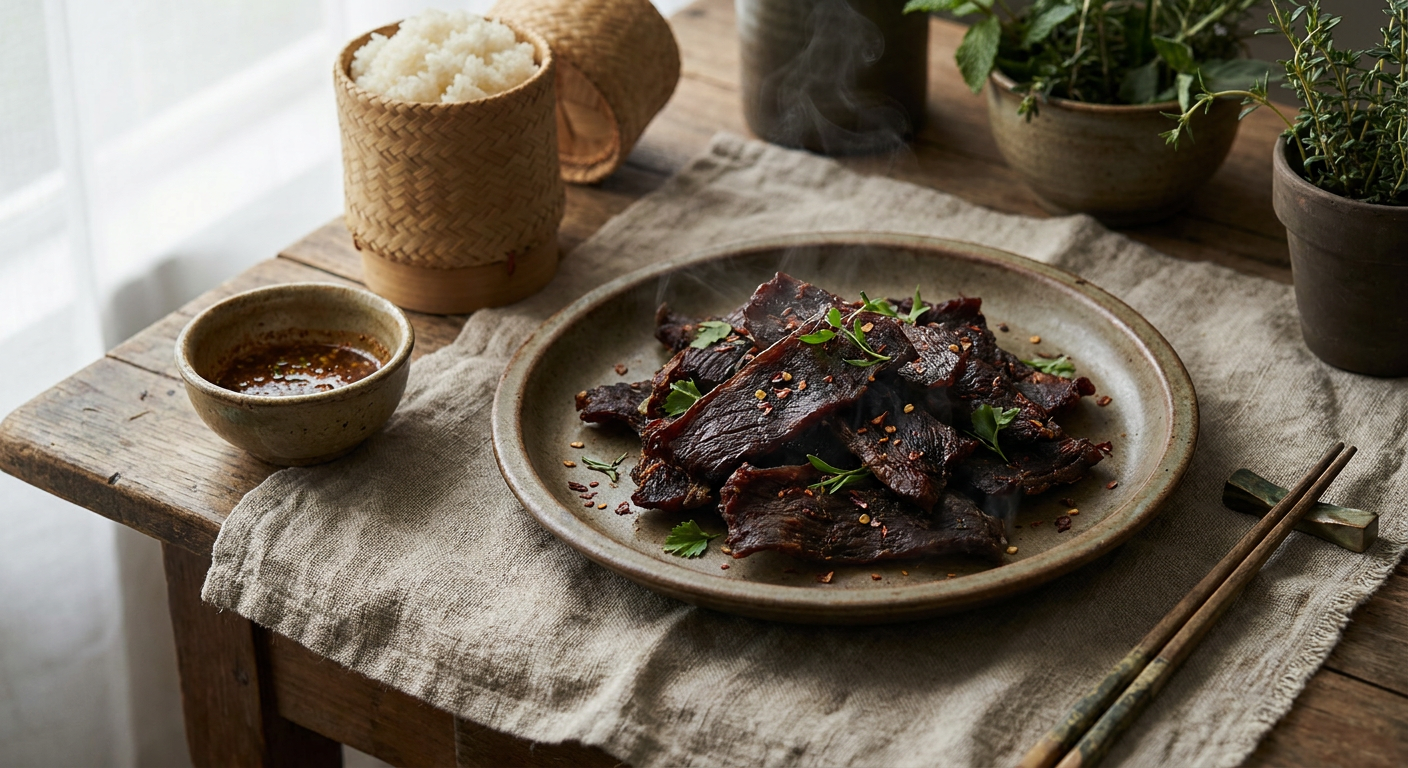
Sien savanh — Lao beef jerky — is the Mekong's road food: thin strips of beef marinated in fish sauce, garlic, and sugar, then dried in the sun (here, the oven or dehydrator) and deep-fried or grilled to order into a chewy-sweet, savory snack sold by the bag at every bus station. Sweet, fish-sauce-deep, and chewier than American jerky, it is the sticky rice's (#36) favorite traveling companion.
Quantities live in the recipe card.
The beef and marinade
- the grain cut makes the chew
- the Lao sweet note; a splash of lime juice
The finish
- the traditional finishes — or serve straight from the dehydrator
- **Slice with the grain at 5 mm.** The grain-running cut is what makes jerky chew instead of crumble — the muscle fibers stay long. Partial freezing (1 hour) makes the thin slice easy.
- **Marinate 6 hours or overnight.** The fish sauce and sugar penetrate the thin strips fully in this time; longer is fine and slightly deeper.
Sien Savanh Jerky
Prep: 20 minutes, plus 6 hours marinating · Cook: 3 hours dehydrating (or 5 hours oven) · Total: About 9 hours 20 minutes (mostly unattended) · Makes about 200 g
Ingredients
The beef and marinade
- 500 g lean beef (top round or flank), partially frozen and sliced 5 mm thin with the grain — the grain cut makes the chew
- 2 tbsp fish sauce (about 30 ml); 1 tbsp soy sauce
- 4 cloves garlic (about 15 g), grated; 1 tsp cracked black pepper (about 3 g)
- 1½ tbsp sugar or honey (about 20 g) — the Lao sweet note; a splash of lime juice
- Optional: 1 tsp minced lemongrass
The finish
- Deep fry (180 °C, 30–45 seconds) or grill over charcoal — the traditional finishes — or serve straight from the dehydrator
- Sticky rice and jaew bong (#86) for the classic pairing
Instructions
- **Dry the strips.** Dehydrator: 65–70 °C for 3–4 hours, until dry, dark, and bendable — a strip should crack when bent sharply but not snap cleanly in two. Oven: lowest setting (60–70 °C), strips on racks, door propped ajar, 4–5 hours. Sun-drying: the authentic — 1–2 dry hot days, net-covered. Checkpoint — the dried strips should be uniformly dark, dry to the touch, and bend with a leathery give. Under-dried strips spoil; over-dried ones shatter. This stage keeps for weeks refrigerated — the Lao pantry's original storage food.
- **Finish by frying or grilling (1 minute).** The traditional eating is a quick fry (30–45 seconds at 180 °C, until the edges blister and the strip puffs slightly) or a fast charcoal turn — the finish cooks the jerky from storage food to hot snack, caramelizing the sugar at the surface. Checkpoint — the fried strip should be glossy-dark, blistered at the edges, still chewy within — the quick fry softens the leather slightly and caramelizes the surface sugars. Drain briefly.
- **Serve with sticky rice and jaew.** Checkpoint — eating test: the chew is the dish — a long, sweet-savory gnaw with fish sauce depth and pepper's warmth, the jaew bong's smoky sweetness beside, and pinches of sticky rice between. It is denser and sweeter than American jerky and made for sharing one strip among friends at a bus window, per tradition.
Troubleshooting
| Symptom | Cause | Fix |
|---|---|---|
| Strips crumble to powder | Dried too long or cut across-grain | Pull at bendable; slice with the grain |
| Strips mold in storage | Under-dried | Dry until uniformly leathery; refrigerate |
| Flavor one-dimensional | Under-marinated | The full 6 hours minimum |
Storage, Make-Ahead & Variations
- The dried strips keep 4–6 weeks refrigerated (longer frozen); fry or grill to order. Once fried, eaten within the day. - Variations: buffalo (the original), water buffalo or venison when findable, the chili-heavy version. The fusion direction — sien savanh in a Caesar (#147's balachaung cousin) or beside the #143's toasted rice ice cream — is the site's snack-to-plate conversation continuing.