Tamago Kake Gohan
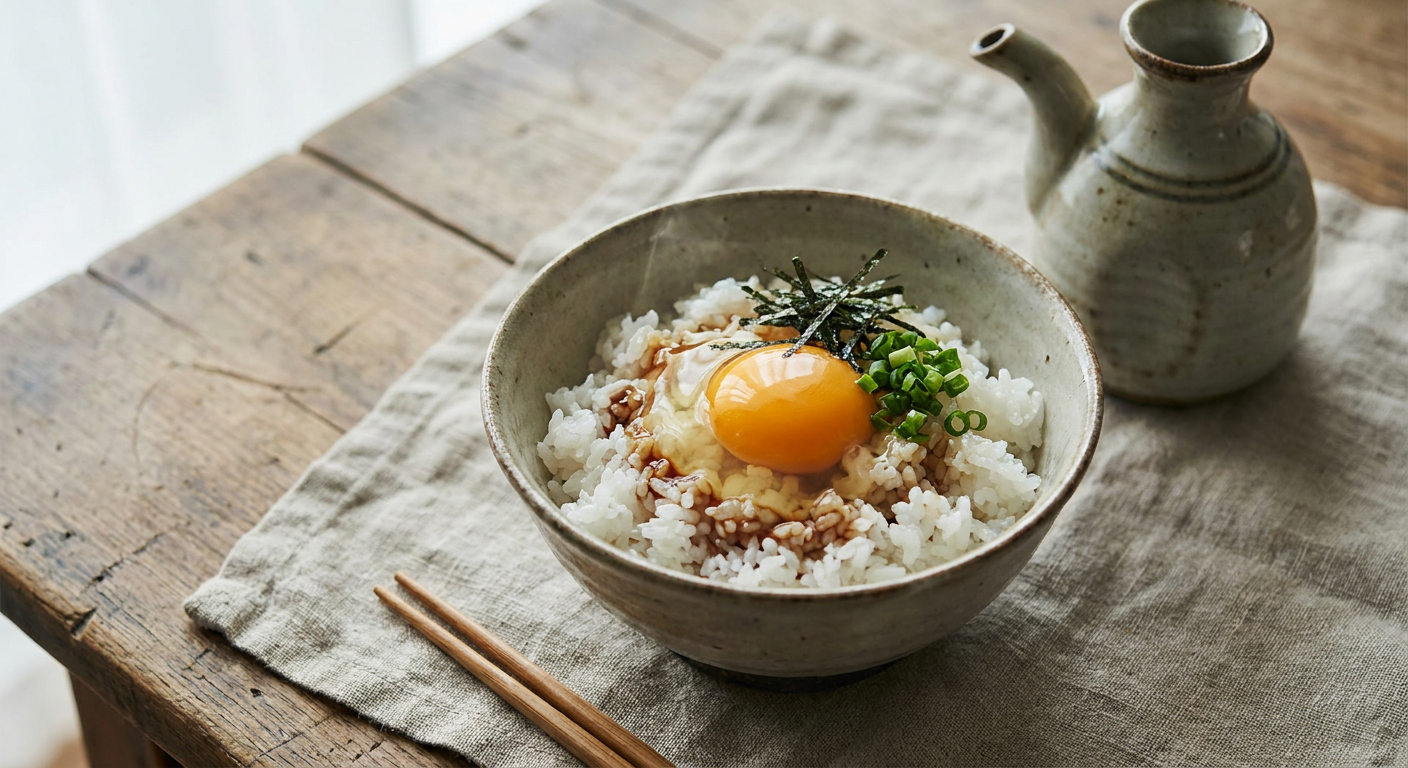
TKG — raw egg over hot rice — is Japan's beloved breakfast minimalism: a very fresh egg stirred into steaming rice with soy sauce, where the heat cooks the egg into a soft, savory custard. Three ingredients, two minutes, one rule about egg safety and one about rice heat. It is the smallest recipe on this site and one of the best.
Quantities live in the recipe card.
Ingredients
- 90 °C-plus, straight from the pot
- **The egg is the only risk and the only rule.** In Japan, eggs are vaccinated against salmonella and sold raw-safe. Elsewhere: use pasteurized eggs (widely sold), or pasteurize your own — hold eggs in 60 °C water for 5 minutes with a thermometer. What you lose with a reluctant "probably fine" egg is peace of mind; what you gain by pasteurizing is the whole dish, safely.
- **The bridge:** this dish is honest about needing very fresh eggs. If your eggs are weeks old, make tamago kake gohan's cooked cousin instead — the oyakodon (#11) — the same egg-rice-soy trinity, scrambled into the bowl.
Tamago Kake Gohan
Prep: 3 minutes · Cook: 15 minutes (rice) · Total: About 20 minutes · Serves 1
Ingredients
Ingredients
- 1 bowl (about 300 g) freshly cooked short-grain rice, steaming hot — 90 °C-plus, straight from the pot
- 1 very fresh egg (about 60 g), at room temperature
- 1 tsp soy sauce (about 6 ml, or 5 g if you weigh it), plus more at the table
- Optional: a pinch of dashi powder, a few drops of sesame oil, scallion, furikake, or umeboshi on the side
Instructions
- **Egg first, rice immediately.** Crack the egg into the empty rice bowl and beat it roughly with chopsticks — 10 strokes, no more (a little structure remains). Add the soy sauce to the raw egg. Checkpoint — the egg should be loose but not frothy. This order — egg seasoned in the bowl — distributes the soy through the custard rather than sitting on the rice.
- **Rice onto egg, not egg onto rice.** Scoop the piping-hot rice directly over the beaten egg, mounding it in the bowl, and wait 10 seconds — the rice's own steam trapped against the egg begins the cooking. Checkpoint — this is the physics of the dish: the 90 °C rice meets the 20 °C egg and the mixture settles around 65–70 °C — exactly custard range. Rice that has cooled even slightly misses the window and you get slick raw egg instead of silk.
- **Stir thoroughly and eat immediately.** Stir from the bottom up — rice, egg, soy — until every grain is coated in a glossy, pale yellow sauce. The egg should thicken slightly as you stir, turning creamy. Eat at once, in big, hot spoonfuls. Checkpoint — eating test: the texture is loose rice pudding — glossy, savory, faintly sweet from the rice itself, the soy doing salt and umami. If the egg stays slick and transparent, the rice wasn't hot enough; salvage it with 20 seconds in the microwave, or accept the (pasteurized) rawness — that version has its fans too.
Troubleshooting
| Symptom | Cause | Fix |
|---|---|---|
| Egg stays raw and slick | Rice not hot enough | Straight from the pot, no delay; hotter rice next time |
| Dish tastes bland | Not enough soy, or egg too large | 1 tsp per 60 g egg is the floor — adjust by drops |
| Texture gluey | Over-stirred into paste | 15–20 strokes, bottom-up, then stop |
Storage, Make-Ahead & Variations
- Made to order, eaten in ninety seconds; nothing keeps. This is a technique more than a recipe — the variations are the toppings: scallion and sesame, a spoon of roe, natto, or (the fusion direction) a shake of furikake and a slice of butter, which melts into the custard exactly the way you hope.