Thai Tea Crème Brûlée
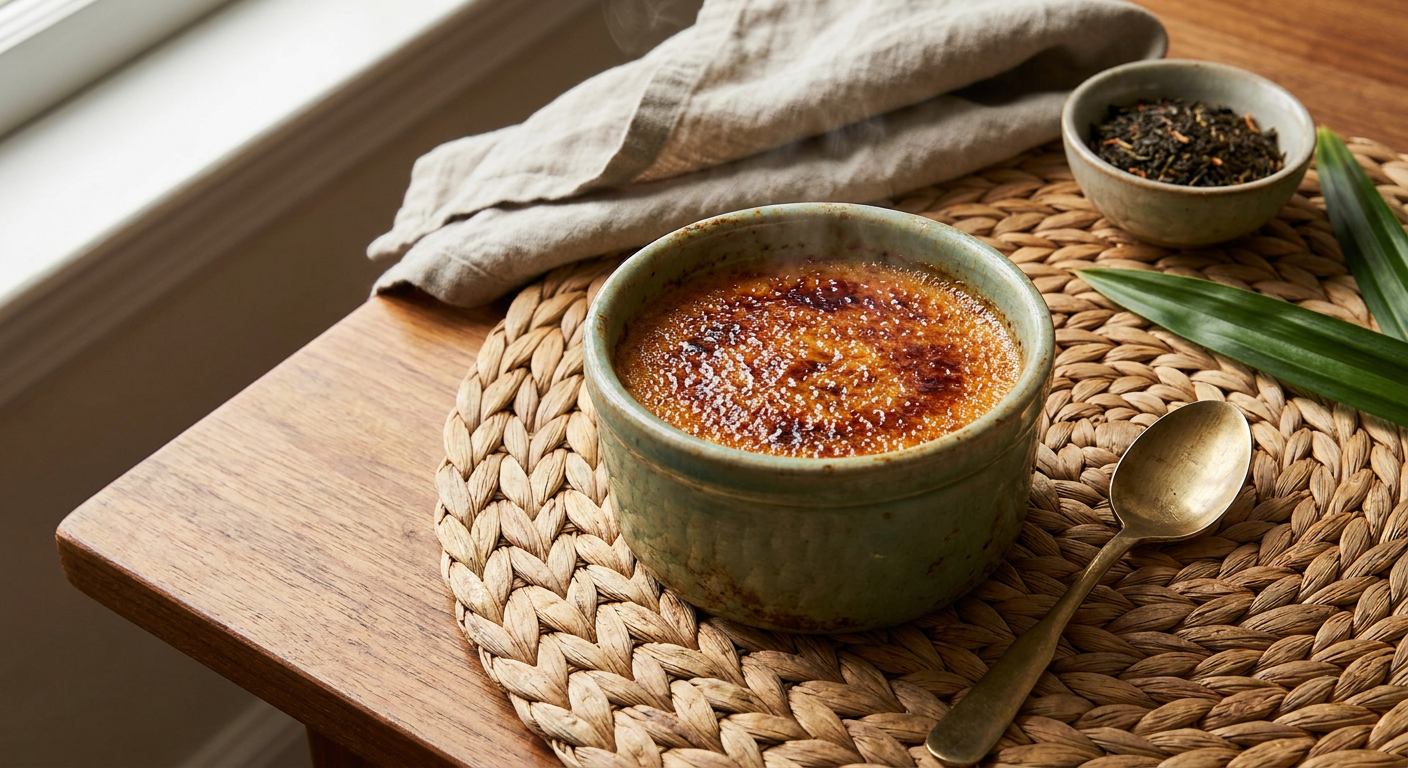
Thai tea crème brûlée steeps the tea-shop's signature — the orange, star-anise-scented Thai tea — into the classic custard, and brûlées a sugar top over it. The dessert is a one-ingredient crossing of the #4's kind: the custard method unchanged, the cream infused with tea and its spice, the color running amber-orange under the torch's crust.
Quantities live in the recipe card.
The custard
- the orange mix, sold as "Thai tea" or "cha yen")
The top and service
- **Steep the tea in the cream — color and spice, both.** Warm the cream with the tea leaves and spices, off the heat, 10 minutes: the cream turns the tea's signature orange and takes its anise perfume. Strain hard (the tea's dust is relentless — a fine sieve, twice).
- **The bridge:** Thai tea mix (with its food-coloring-orange identity) is in Asian groceries; strong black tea with a star anise and a pinch of vanilla bridges the flavor at a plain-cream loss. The color is the one thing unbridgeable — and it is only color.
Thai Tea Crème Brûlée
Prep: 20 minutes, plus 3 hours setting · Cook: 45 minutes · Total: About 4 hours 15 minutes · Serves 6
Ingredients
The custard
- 500 ml heavy cream (about 500 g)
- 4 tbsp Thai tea leaves (about 20 g — the orange mix, sold as "Thai tea" or "cha yen")
- 5 egg yolks (about 90 g); 80 g sugar, divided
- 1 star anise and a 2 cm cinnamon stick, with the tea (the authentic accent)
- A pinch of salt; ½ tsp vanilla
The top and service
- 3–4 tsp sugar per ramekin (about 15 g), torched or broiled to a glass crust just before serving
Instructions
- **Make the custard base.** Steep and strain the cream; whisk the yolks with 60 g of the sugar and the salt; temper the warm cream into the yolks slowly (the #20's discipline), and strain again into a pouring jug. Checkpoint — the base should be smooth, orange-amber, and tasting faintly, clearly of Thai tea — anise forward, tea behind. It should be sweet but not dessert-sweet; the brûlée's top adds the final sweetness.
- **Bake in a water bath (40–45 minutes at 150 °C).** Pour into 6 ramekins; set them in a roasting pan with hot water to come halfway up; bake until the custards are set at the perimeter and barely tremble at the center's nudge. Checkpoint — the classic doneness — the shimmy test: shake the pan; only the center 3 cm should move like set custard, not liquid. Over-baking is the grainy failure, and the water bath's gentleness is the insurance.
- **Chill fully (3 hours minimum), then brûlée at the table's edge.** Sprinkle each custard's surface with a thin, even layer of the remaining sugar and torch (or broil, watching) to a deep amber glass. Serve within minutes — the crust's crack is the dish's theater. Checkpoint — eating test: the crack of the spoon through the glass crust, then the custard — silky, cold, unmistakably Thai tea: anise and tea and cream in one mouthful, the burnt sugar's bitterness over it. It should taste like the classic crème brûlée went to a Bangkok tea shop and came back with an accent, not a costume.
Troubleshooting
| Symptom | Cause | Fix |
|---|---|---|
| Custard grainy | Over-baked or oven too hot | The water bath, 150 °C, the shimmy test |
| Tea flavor faint | Under-steeped or over-diluted yolks | The full 10-minute steep; strain, don't press |
| Crust soggy by serving | Torched too early | Brûlée within 10 minutes of serving |
Storage, Make-Ahead & Variations
- The custards keep 2 days refrigerated unbbrûléed; the sugar top is always at serving. The block's #4 and #107 are this recipe's steeped-family circle. - Variations: with a spoon of condensed milk swirled into the base (the cha yen's milk echo), the espresso-dark version. The fusion block's dessert aisle (#124, #125, #127) is this recipe's neighborhood.