Tonkotsu Ramen
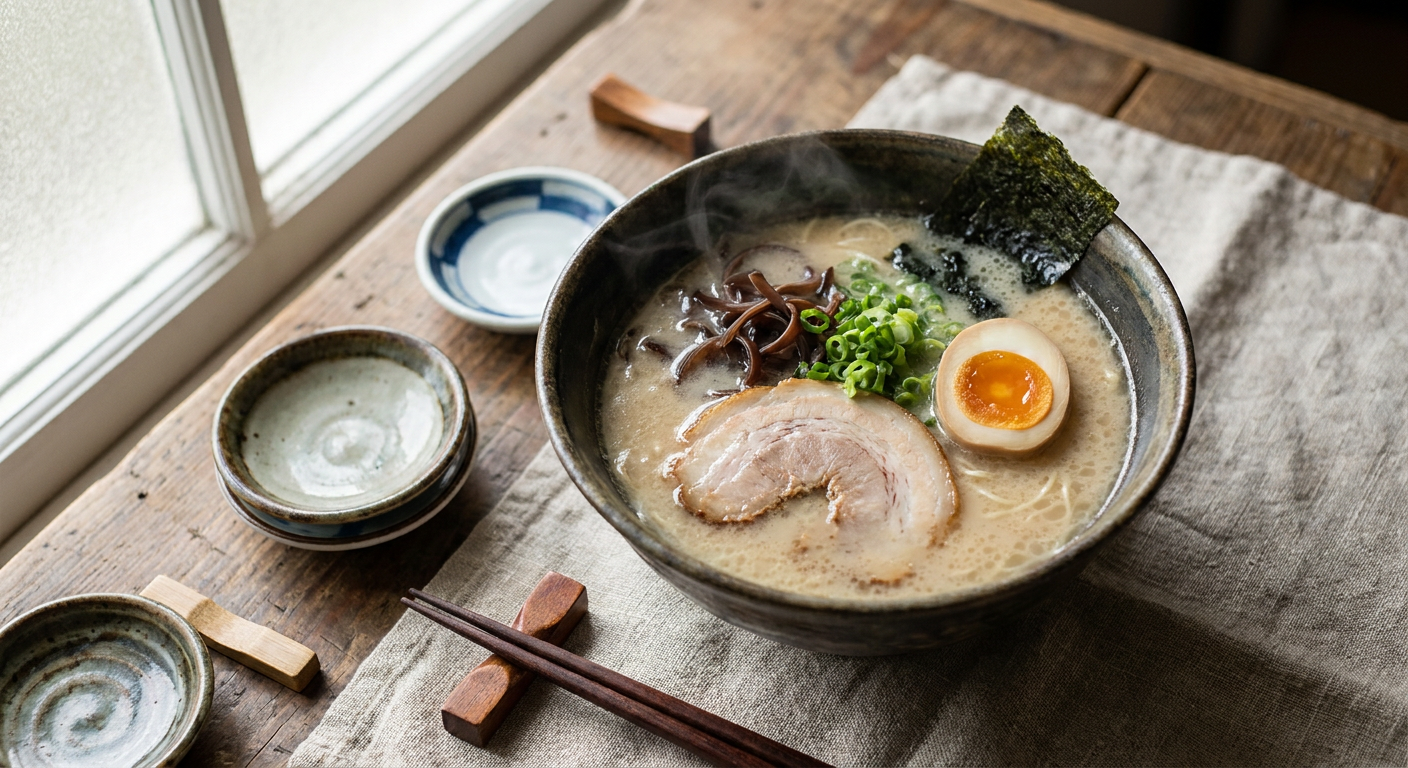
Quantities live in the recipe card.
The broth
The chashu (soy-braised pork shoulder)
- nothing is wasted)
The ajitama eggs
The tare and the bowl (per bowl)
Doneness & Quality Checkpoints
- The broth: opaque, spoon-coating, sets like jelly when chilled.
- The chashu: chopstick-tender, glazed, sliceable.
- The eggs: stained white, jammy center.
- The bowl: hot bowls, hard-drained noodles, tare first, eaten immediately.
Tonkotsu Ramen
Prep: 45 minutes · Cook: 12 hours, largely unattended · Total: About 13 hours (mostly simmering) · Serves 4
Ingredients
The broth
- 1.5 kg pork trotters (1500 g, two whole trotters), split by the butcher
- 1 kg pork neck bones or femur bones (two large bones' weight, about 1000 g)
- 500 g chicken carcass or wings (the roundness insurance; 250 g of that is pure bone)
- 1 onion, halved and charred; 1 head of garlic, halved crosswise
- A thumb of ginger, sliced
- 4 litres cold water, plus refills
The chashu (soy-braised pork shoulder)
- 800 g rolled pork shoulder or pork belly, tied
- 150 ml soy sauce, 100 ml mirin, 100 ml sake, 50 g sugar, 4 cloves garlic (20 g)
- 300 ml water; 4 cloves garlic, 4 slices ginger, 2 spring onions
- (The leftover braise liquid becomes the tare — nothing is wasted)
The ajitama eggs
- 4 eggs; the cooled chashu liquid, once it exists
The tare and the bowl (per bowl)
- 2 tbsp chashu braising liquid (the tare)
- 1 portion fresh ramen noodles (about 120 g)
- 250 ml (per bowl) of the finished broth, at a full rolling boil
- Sliced scallions, nori sheet, mayu (black garlic oil) optional
Instructions
- **Blanch hard (20 minutes).** Cover the trotters, bones, and chicken with cold water, bring to a rolling boil, and let it roll hard 15–20 minutes. You will watch the water turn grey-brown and unappetizing — this is the point. Drain, scrub the bones under running water, and rinse the pot. Checkpoint — the blanched bones should look clean and pale, and the discarded water should look terrible. This step is the difference between a clean creamy broth and a grey, muddy one; skipping it is the most common home failure.
- **The rolling boil (10–12 hours).** Return the cleaned bones to the pot with the charred onion, garlic, and ginger. Add 4 litres of cold water — the bones should be covered generously — and bring to a hard, rolling boil. Then keep it there — a sustained rolling boil at 100 °C, uncovered or loosely lidded, vigorous enough to agitate the bones, topping up with hot water only when bones begin to surface. After hour six, top up less — you want the level to fall and concentrate. Checkpoint — at hour three the broth turns from clear to milky. At hour six it is opaque white. At hour ten to twelve it is creamy, faintly beige, and coats a spoon like thin cream. This is emulsion physics: the rolling boil shatters fat and collagen into particles small enough to suspend in water permanently. A gentle simmer — the rule for every other stock on this site — is exactly wrong here.
- **Strain and rest.** Strain through a fine sieve — do not press on the solids, that pushes bitterness through — and let the broth settle 20 minutes. Skim only the pure oil layer if there is a heavy one; a light sheen stays. Season now with salt only, lightly: the tare does the final seasoning at the bowl. Checkpoint — the finished broth, hot, should taste rich and sweet with almost no salt, and feel rounded on the tongue. Chilled, it should set like soft jelly — that is your collagen proof. If it doesn't set, the simmer was too gentle; fix it next time, and today lean on the tare.
- **Sear and braise.** Sear the tied pork in a hot pan on all sides until browned. Add the soy, mirin, sake, sugar, water, aromatics, and bring to a bare simmer. Cover with a lid slightly ajar, and cook at the lowest simmer, turning the pork every 30 minutes, until a chopstick slides through the thickest part with no resistance — 1.5 to 2 hours. Checkpoint — the liquid should reduce to a dark, syrupy braising glaze and the pork should slice without crumbling. If the pot runs dry before the pork is tender, add hot water 100 ml at a time.
- **Soak the eggs in it.** Soft-boil the eggs exactly 6 minutes 45 seconds, chill in ice water, peel, and submerge them in the cooled chashu liquid. Four hours minimum, overnight better. Checkpoint — the white takes on a tan stain and the yolk stays bright and jammy. The egg is seasoned by salt and sugar working inward — this is the same slow-cure logic as the miso cod (#1), at breakfast scale.
- **Warm everything.** Broth back to a rolling boil. Bowls warmed with hot water. Tare (2 tbsp chashu liquid per bowl) in the bottom of each warm bowl. Checkpoint — cold bowls kill tonkotsu — the emulsion breaks and the broth goes thin on contact — bowls straight from hot water hold near 60 °C, close enough to the broth's own heat that no shock ever happens. Hot bowls are not fussiness; they are part of the recipe.
- **Boil the noodles (90 seconds for fresh; per package for dried), and assemble in order.** Noodles drained hard (shake the basket — water in the bowl dilutes the tare), into the bowl; 250 ml of boiling broth ladled over; chashu slices fanned at the edge, egg halved, scallions, and a sheet of nori stuck against the bowl's wall at the last second. Checkpoint — the bowl should be eaten within five minutes of the ladle — ramen waits for nobody, and the noodles' best texture is a two-minute window. The finished bowl should taste: rich and creamy first, then salty-sweet from the tare, then pork. If it tastes flat, the tare is short — add a teaspoon more to the next bowl and adjust.
Finish & Plate
No garnish pile — tonkotsu's classicism is restraint: chashu, egg, scallion, nori, and nothing else fighting the broth. Slurping is not manners failure; it cools the noodle and aerates the broth, and the bowl was designed for it.
Troubleshooting
| Symptom | Cause | Fix |
|---|---|---|
| Broth stayed clear after hours | Simmer too gentle | Rolling boil, bones agitated — or accept it as a clear pork soup and re-plan |
| Broth tastes muddy | Blanch skipped, or solids pressed at the strain | Blanch hard next time; strain without pressing today |
| Chashu slices crumble | Overcooked or sliced hot | Chill before slicing; slice 5 mm with a sharp knife |
| Bowl tastes thin despite good broth | Cold bowl, wet noodles, or short tare | Hot bowls, shaken-dry noodles, another teaspoon of tare |
Storage, Make-Ahead & Variations
- Broth: 4 days refrigerated, 1 month frozen in portions. Chashu: 1 week in its liquid, freezes sliced. Eggs: 3 days. Together, a 15-minute ramen kit lives permanently in a well-run freezer. - Variations: the Kyushu classic stays pork-only; Tokyo-style halves the broth with chicken and pairs with a shoyu tare; the spicy version adds a spoon of miso-chili paste (#8's okonomiyaki sauce is a cousin). Fusion direction: the tonkotsu carbonara — the broth emulsion and a raw egg yolk have been circling each other for years.