Yakitori Negima
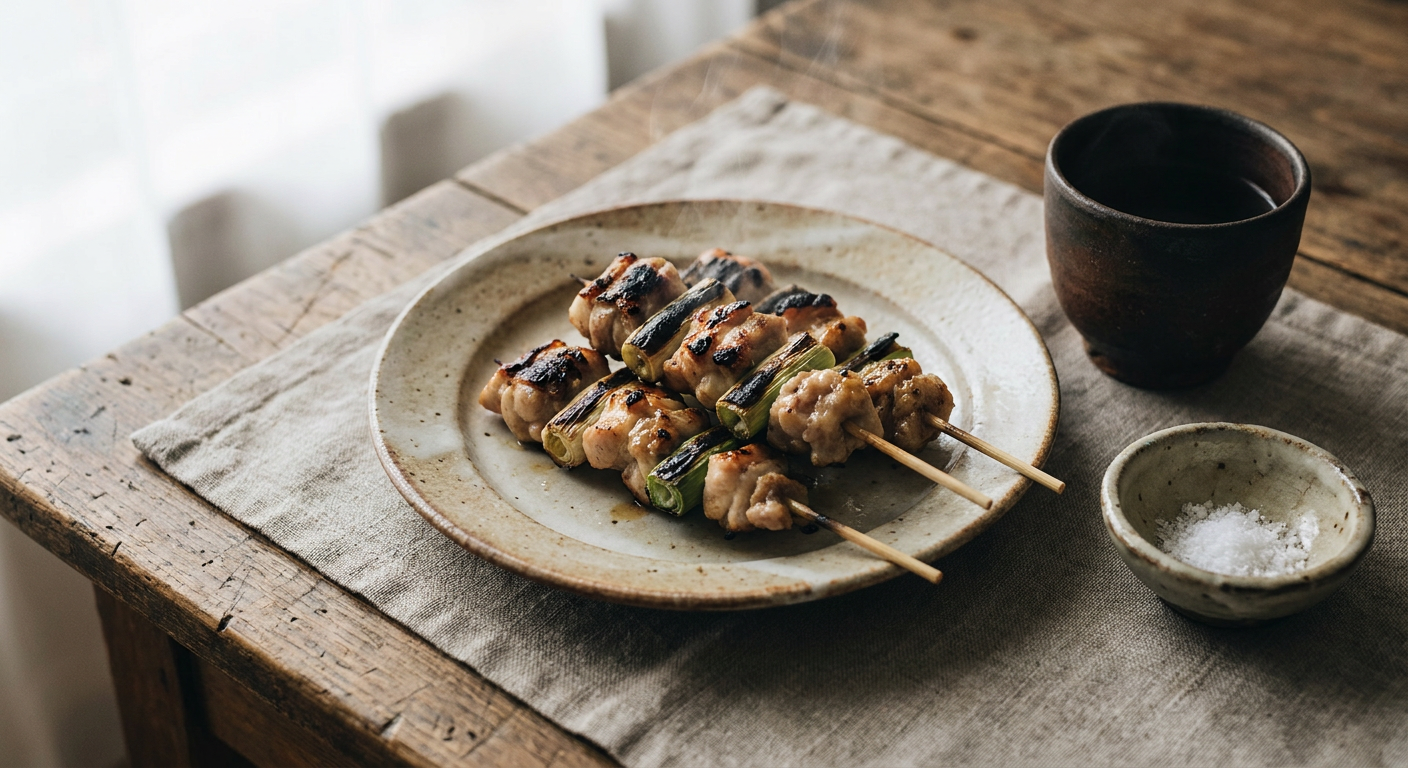
Quantities live in the recipe card.
The skewers
- roughly 15 pieces per thigh, and the trim becomes the tare's first seasoning
- use the white and pale green sections; the dark green tops garnish the finished platter
The tare (glaze)
- the Tokyo shops' quiet trick
- the reduction is the flavor concentration
Or the salt school (shio)
To serve
Doneness & Quality Checkpoints
- The skewering: flat, compressed, even pieces.
- The cook: nearly done before the first glaze; four thin glazes after.
- The finish: lacquered dark, blistered edges, scallion charred-sweet.
Yakitori Negima
Prep: 40 minutes, plus 30 minutes soaking · Cook: 15 minutes · Total: About 1 hour 30 minutes · Makes 12 skewers (serves 4 as a snack)
Ingredients
The skewers
- 700 g boneless chicken thighs, skin on (about 500 g boneless weight once trimmed), cut into 2.5 cm pieces — roughly 15 pieces per thigh, and the trim becomes the tare's first seasoning
- 6 spring onions (about 120 g), cut into 2.5 cm lengths — use the white and pale green sections; the dark green tops garnish the finished platter
- 12 bamboo skewers, soaked in water 30 minutes (the soak is what keeps them from charring through)
The tare (glaze)
- 100 ml soy sauce (about 90 g), 100 ml mirin, 50 ml sake, 25 g sugar, 10 g ginger
- Optional depth: a 2 cm piece of ginger and 2 garlic cloves, simmered in and removed — the Tokyo shops' quiet trick
- Simmer 10 minutes to a light syrup that coats a spoon thinly and weighs about 220 g — the reduction is the flavor concentration
Or the salt school (shio)
- Coarse salt (about 2 g per skewer), a pinch of yuzu zest or sansho per skewer, and nothing else
To serve
- Sansho or shichimi pepper (about 1 g per skewer); a lemon wedge and a pinch of salt for the shio version, served on the side so each diner seasons their own
Instructions
- **Skewer with intention.** Thread thigh piece, scallion, thigh, scallion, thigh — 3 chicken, 2 scallion per stick — piercing each piece through its center so it lies flat and cooks evenly. Slight compression, no gaps. Checkpoint — laid on the counter, each skewer should sit flat, pieces touching. Loose pieces rotate on the stick and cook unevenly — press gently as you thread.
- **First cook, no glaze (6–8 minutes).** Grill or broil the skewers — the broiler's zone runs past 250 °C, the grill pan's surface near 230 °C — turning every 90 seconds, until the chicken is nearly cooked and the skin's edges render crisp; the fat should hiss and drip consistently. Checkpoint — the surface should be blotchy gold-brown and dry-looking. Glazing now would burn — sugar goes on cooked meat. The chicken's center should be just barely pink — the glaze rounds carry it to done.
- **Glaze in layers (3–4 rounds).** Brush or dip each skewer in the tare, return to the heat 30–45 seconds, and repeat — four thin glazes build a lacquer that one thick coat never will. Pull when the final layer blisters at the edges. Checkpoint — the finished skewer should be lacquered, glossy-dark, with visible glaze ridges where it pooled slightly. Bite test: the scallion should be charred-soft and sweet, the chicken juicy with crisp skin — the alternating bite is the entire format.
Finish & Plate
Straight off the heat onto a small plate, eaten within two minutes — yakitori is a rhythm dish, cooked in waves with the meal. A cold beer or highball is the classic pairing; the first skewer belongs to the cook.
Troubleshooting
| Symptom | Cause | Fix |
|---|---|---|
| Glaze burnt black | Sugared too early or too thick | Glaze on cooked meat, thin coats, 30-second passes |
| Chicken dry | Lean breast on high heat | Thigh, skin on; frequent turns |
| Scallion falls off | Skewered at the soft green | Use the white and pale green, thread through the center |
Storage, Make-Ahead & Variations
- Tare keeps for weeks and improves (see note). Raw skewered chicken holds 1 day; cooked yakitori waits for no one. - Variations across the bird: skin (kawa), meatballs (tsukune), wings, heart, cartilage — each with its cut and cook. The fusion direction: the same tare glazes the pork belly in the banh mi (#25) or brushes grilled corn where the sugar does the same work.