Yam Woon Sen
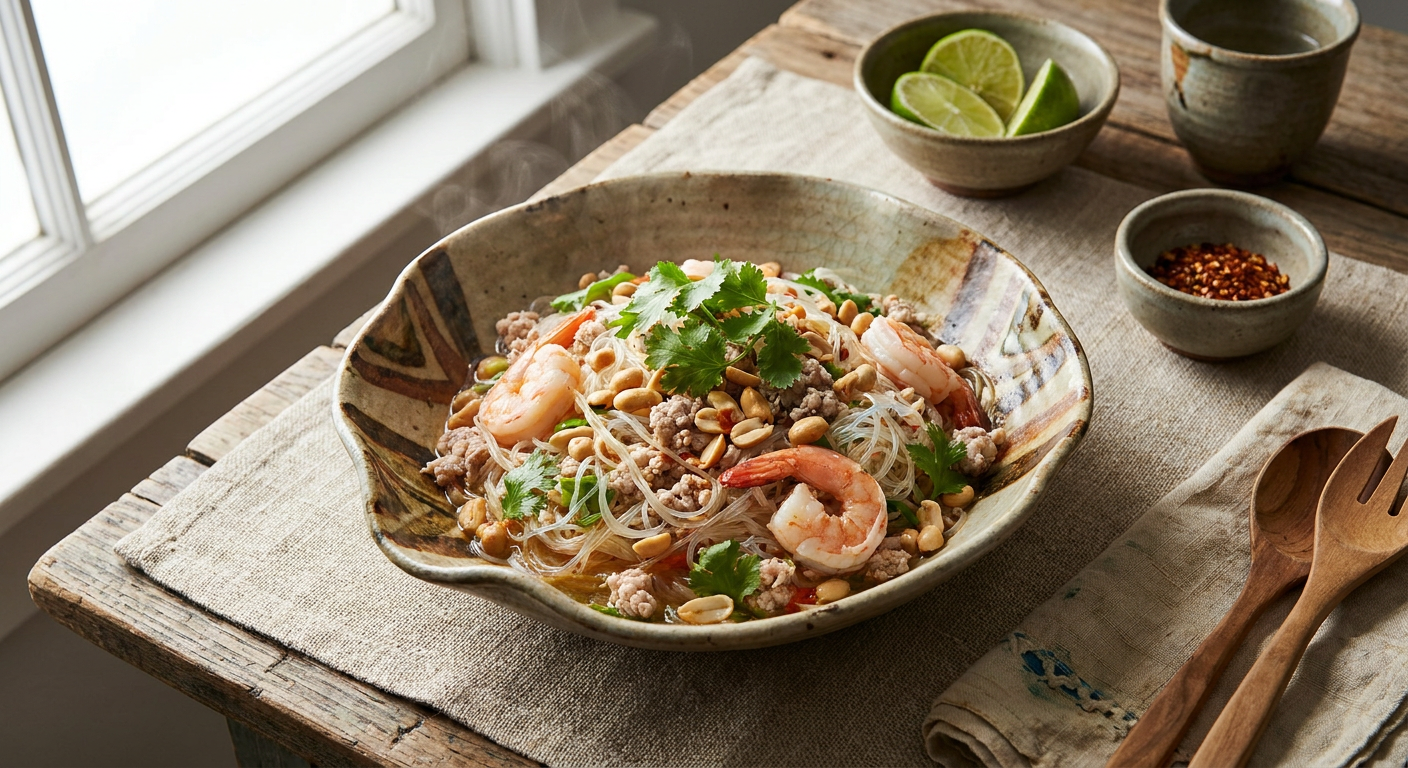
Yam woon sen — Thai glass noodle salad — is the hot-weather main course that behaves like a salad and eats like a meal: woon sen (mung bean glass noodles) tossed while warm with ground pork, shrimp, and a loud lime-fish sauce dressing, plus tomato, celery, and herbs, finished with peanuts and chili. The glass noodle's trick is that it drinks dressing like nothing else — a "dry" noodle that absorbs sour and salt into itself.
- **Mix the dressing first and taste it raw.** Sour first, salt with it, sweet behind, heat last — it should be almost too intense alone; the noodles will absorb half its force. Adjust now, because after the toss there is no fixing it.
- **The bridge:** glass noodles (mung bean vermicelli) are in every Asian grocery and keep for years; rice vermicelli bridges at a texture loss (less springy, less absorbent). This is a clean-out-the-fridge dish: the pork and shrimp are the classic, but chicken, tofu, or extra vegetables all work.
Yam Woon Sen
Prep: 20 minutes · Cook: 10 minutes · Total: About 30 minutes · Serves 3–4
Ingredients
The salad
- 100 g dried glass noodles (woon sen), soaked in warm water 10 minutes, cut to manageable lengths
- 150 g ground pork; 150 g shrimp, halved
- 2 cloves garlic, minced; 1 tomato (about 100 g), wedged
- 2 sticks celery (about 60 g), sliced thin on the diagonal; ½ a small onion, sliced
- A handful each cilantro, mint, and scallion (about 20 g each)
The dressing (loud on purpose)
- 3 tbsp lime juice (about 45 ml); 2½ tbsp fish sauce (about 35 ml)
- 1½ tbsp palm sugar (about 18 g); 2–3 bird's eye chilies, minced
- 2 tbsp roasted peanuts (about 20 g), crushed
Instructions
- **Cook the pork and shrimp in the dressing's pot (4 minutes).** In a wide pan, fry the garlic briefly, add the ground pork and break it up until it changes color, then the shrimp until just curled. Off the heat, add the tomato, celery, and onion — they soften in the residual heat. Checkpoint — the pork should be in small crumbles and the shrimp just done; both will drink the dressing. The residual-heat trick keeps the vegetables crisp-tender, not cooked.
- **Toss everything while warm (2 minutes).** Add the drained, soaked noodles to the warm pan (they are already softened; a quick 30-second stir in the warm pan finishes them), pour the dressing over, and toss thoroughly — the noodles turn glossy and slightly translucent as they absorb. Fold in the herbs. Checkpoint — the warm toss is the technique: warm noodles absorb; cold noodles repel. The salad should look glossy, with a small pool of dressing at the bottom that the noodles keep drinking as they sit (briefly).
- **Serve at room temperature, peanuts on top.** Turn out onto a platter, scatter the crushed peanuts, and eat within the half hour. Checkpoint — eating test: the first bite is the full dressing — sour, salty, sweet, hot — then the springy noodle and savory pork and shrimp, celery's crunch, herbs' perfume, peanut's finish. It should taste brighter than any cooked dish has a right to; if it tastes merely seasoned, the dressing was built too timidly.
Troubleshooting
| Symptom | Cause | Fix |
|---|---|---|
| Salad bland despite dressing | Tossed cold, or dressing timid | Warm toss; rebuild the dressing louder |
| Noodles gluey, broken | Over-soaked or over-stirred | 10-minute soak, gentle toss |
| Pool of dressing at the bottom | Noodles cold, or time passed | Serve sooner — the pool means absorption stopped |
Storage, Make-Ahead & Variations
- Made and eaten within the hour — the noodles keep drinking and then give up. Components hold 1 day separately; the dressing keeps 3 days in a jar. - Variations: the seafood-loaded version with squid, the vegetarian tofu version. The fusion direction — yam woon sen's dressing on the #145's pot pie filling as a hot-sour counterpoint — is the kind of bridge this site's fusion block (#102–150) was built to test.